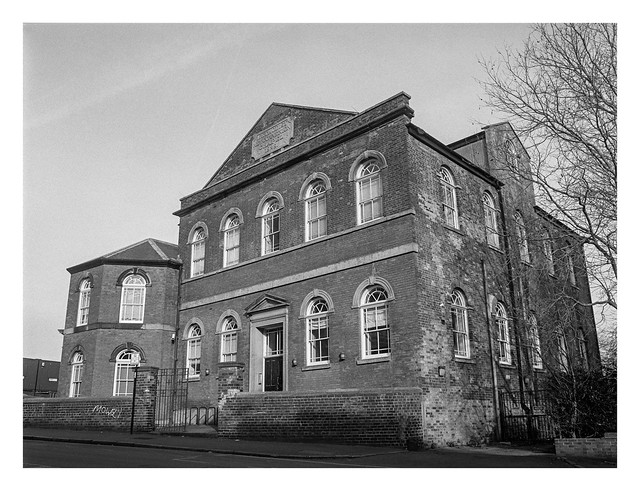
This is the Methodist New Connexion Chapel in Sheffield. I’ve photographed the building before and the area – another part of sheffield where new construction is booming – is rapidly changing to something new. Many of the buildings that were present last time I walked past have now vanished to be replaced by blocks of apartments. But this chapel remains.
The building dates back to 1828, built three decades on from the founding of the church by Sheffield man Alexander Kilham after seceding from the Wesleyan Methodists. Early in the 20th century the church would become part of the United Methodist Church.
Bronica ETRSi & Zenzanon 50mm f/2.8 MC & Ilford HP5+. Ilfotec DD-X 1+4 9 mins @ 20°
I went out this evening after work with the intent of taking some long-exposure nighttime photos (for the photo comp I participate in that I’ve mentioned on here a few times). I took the Bronica loaded with some HP5+ with the intent on getting some light trails from traffic a busy road. I’d have preferred to shoot colour but I wouldn’t be able to get it developed in time to meet the end of the month closing date.
I drove out to the location, set up the Bronica, used my digital camera to work out a suitable exposure time and set up everything, including screwing in a cable release. It was too dark to focus with the waist level finder so I just set the focus to infinity and chanced it. Because the exposure was going to come in at a few seconds, I attempted to allow for reciprocity failure, deciding on an 8-second exposure. Feeling happy with all this I took three pictures. The first one I forgot to use mirror lock-up, so re-took it, just in case. Then the third shot I took was a different composition.
After this I packed everything up and set off back. It was only when I was almost home that I realised that I’d not removed the dark-slide when taking the pictures, meaning all three of them are going to be blank wasted frames! This was even more annoying because, normally, the camera won’t fire if the dark-slide is inserted, so I can only assume that using a cable release bypasses this somehow. Whatever the cause, I’m feeling somewhat pissed off about it. Partly because of the wasted film, but mostly for the fact that I now have to repeat the exercise again tomorrow.
Here’s a picture of some balloons I took earlier this month. I feel like the middle one right now.
Bronica ETRSi & Zenzanon 75mm f/2.8 PE & Ilford HP5+. Ilfotec DD-X 1+4 9 mins @ 20°
Today’s post features one of those picture which I find oddly appealing. Something about it catches my eye despite it maybe being something that no-one else will glance at twice. I think that, in this case, it’s the light and the way it’s casting shadows across and onto parts of the scene. It had a nice three-dimensionality to it, I think.
I am wondering if I should have cropped it a little at the top to remove that bit of the hotel logo though…
Bronica ETRSi & Zenzanon 75mm f/2.8 PE & Ilford HP5+. Ilfotec DD-X 1+4 9 mins @ 20°
I’ve wandered around Kelham Island in Sheffield to take photos on many occasions and I still manage to find things I’ve not photographed before. This view east through Little Kelham is one such composition. The skyline will no doubt look different again before long once the cranes in the distance finish their work.
Bronica ETRSi, Zenzanon 75mm f/2.8 PE & Fujifilm Pro 400H. Lab developed. Home scanned and and converted using Negative Lab Pro.
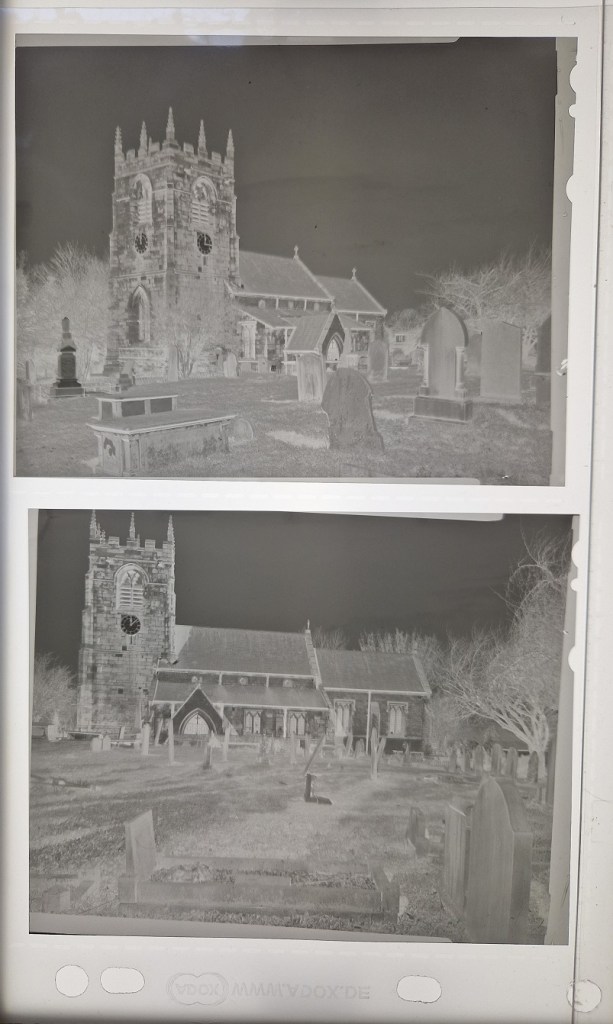
Another couple of shots taken this week and then developed today. The good news is that I’m now fully confident that the light leak issues I had before are now resolved. The bad news is that I think I somehow managed to load these two sheets incorrectly. Not in a significant way, but negatives from both sides of the film holder indicate the the sheet wasn’t aligned properly and the photos are wonky as a result. You can see what I mean in this photo of the negs on my lightbox – if you look at the film border you can see how it’s out of whack:
I’m not sure how I managed to do this and, to be honest, I didn’t even realise it was possible! None of the other sheets I’ve loaded have suffered from this problem so I will have to keep an eye on things in the future. Sadly it means that the side-on picture of the church is spoiled as the wonky frame has chopped the top off the church – this is made worse when scanned as the border isn’t included in the scan.
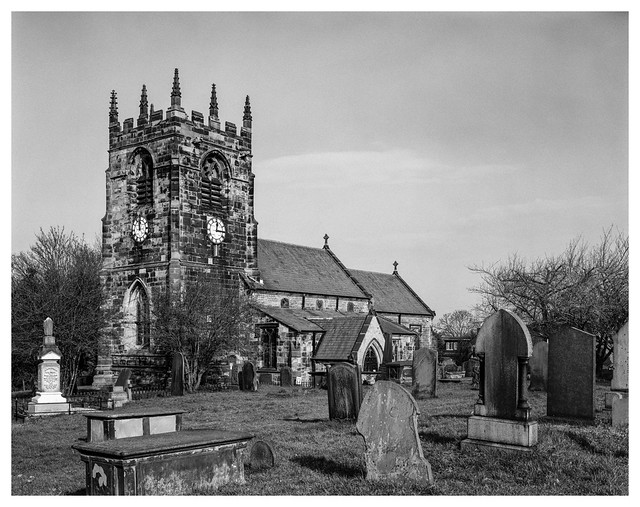
The other image was retrievable though as I’d not framed the subject so tightly. The good news is that these were really just a couple of final test shots to make sure everything was working ok. I think I’ll make sure not to tightly frame my subjects for the time being though, just to be safe.
Here’s the shot that worked ok. If you click through to Flickr you can see that there’s a lot of detail.
Behind the fence and trees flows the River Don. Across the river stands New Testament Church of God (formerly Holy Trinity Church). The chimney and large brick building to the left of the frame is Aizlewood’s Mill, which I wrote about the other day.
Bronica ETRSi, Zenzanon 75mm f/2.8 PE & Fujifilm Pro 400H. Lab developed. Home scanned and and converted using Negative Lab Pro.
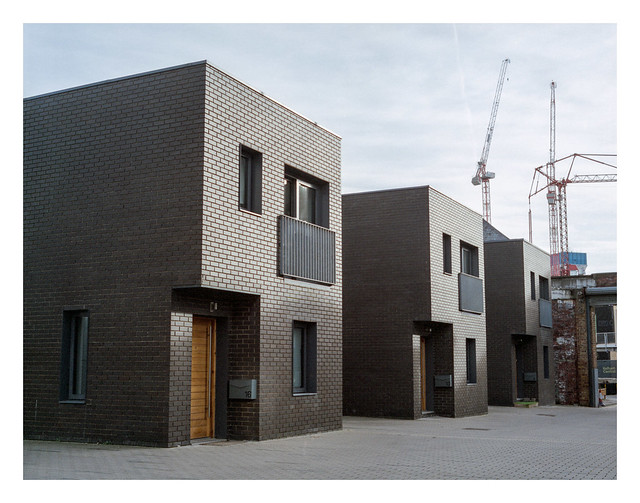
There’s a definite appeal to these block-like houses. It’s like someone has taken a cube of fresh clay, imprinted a brickwork pattern, and then cut perfectly angular upenings into the material. Despite the very up-and-coming nature of this part of town, I’m not sure I’d want to live in a home that people can walk so close in front of, and I’m unsure if they have any sort of green space such as a garden (although it could be atop the flat roofs for all I know). Photographically though, I find them very attractive.
Bronica ETRSi, Zenzanon 75mm f/2.8 PE & Fujifilm Pro 400H. Lab developed. Home scanned and and converted using Negative Lab Pro.
Following on from yesterday’s post about me testing my newly repaired 4×5 camera, here’s the second of the two photos I made while out. Again, this is nothing special, and mainly a test shot. It’s a little out of focus at the top of the frame, but otherwise ok. Had I spent more time I would have corrected the focusing.
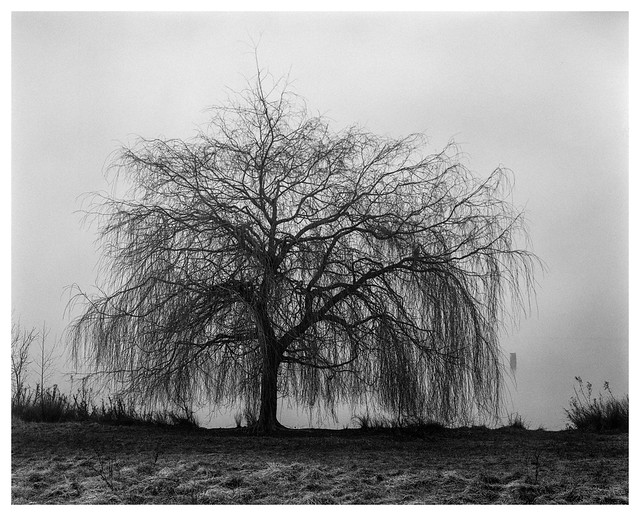
I’ve photographed this willow tree on a number of occasions (see here, here, and here) and I think it would be a good subject for a more carefully considered large format shot if I pick the conditions right.