Another batch of pictures from the roll of Kodak Gold I put through my Kodak H35N half-frame camera.


Kodak H35N & Kodak Gold. Lab developed. Home scanned and converted with Negative Lab Pro.
Taken on 25 January 2025

35mm, medium format and large format film photography (with the odd bit of digital every now and then…)
Another batch of pictures from the roll of Kodak Gold I put through my Kodak H35N half-frame camera.
Kodak H35N & Kodak Gold. Lab developed. Home scanned and converted with Negative Lab Pro.
Taken on 25 January 2025
I received my invitation to take part in this year’s Emulsive Secret Santa last week. I was wondering if it would still be going ahead as Emulsive.org, the site from whence it originally sprang now seems to be defunct, having not been updated for quite some time.
So I was glad to get an email inviting me to this year’s gift exchange although, due to the current tariff situation in the US, the swap has been split into US and rest of the world sections this time around. Registration closes tomorrow, after which people will be provided with the details of their recipients and the task of finding a suitable gift begun (timescales are quite tight this time, so it’s likely that some folks will be receiving a late Christmas gift, but that’s not so bad – January can be quite glum, so a nice present arriving in the mail will cheer things up somewhat).
I was very fortunate last year to receive not only a bunch of 35mm film a lovely notebook, and other goodies, but also a Kodak H35N half-frame camera, and it was with this that I shot the pictures in today’s post (although I already posted a few others about six weeks ago).
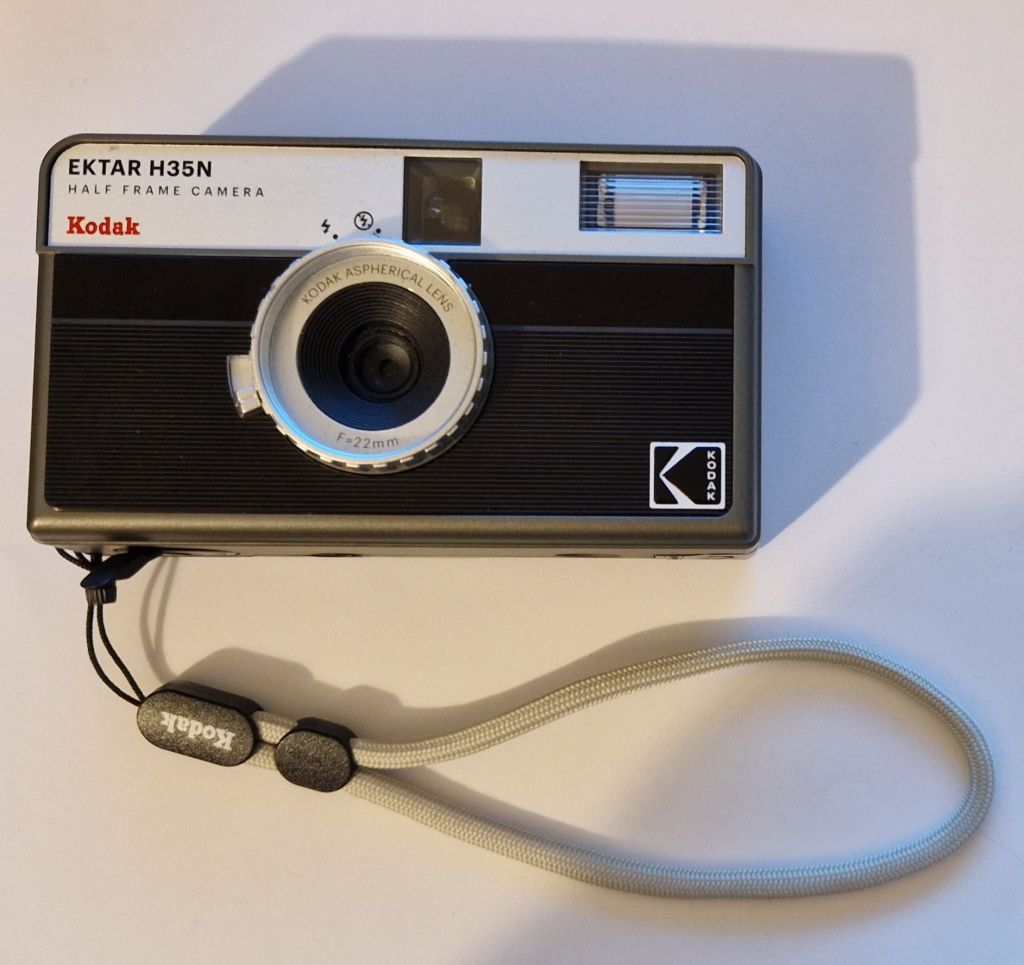
The camera itself (branded Kodak, but actually made by RETO) is a relatively simple affair with a 2 element 22mm f/8 coated lens (part glass, part acrylic), a 1/100sec shutter speed, a built-in flash, and a built-in star filter. For it’s basic spec, the camera produces reasonable pictures if you don’t mind noticeable softness at the narrow ends of the frame. I didn’t feel any need to scan them at high resolution because the detail simply isn’t there, but at smaller size they look nice and, as is the case with any camera, it’s what you do with it that counts.
The camera design has a clear lineage to the old Kodak Instamatic models. It’s very lightweight and doesn’t feel like it will take much rough handling (but for the price, that is to be expected), but it works perfectly well in use and I didn’t have any sense that it would break – something my other RETO-made camera, an Ultrawide and Slim, does suffer from in regard to advancing the film. The film advance on the H35N was fine, as was the film rewind crank, which is located on the base of the camera along with a plastic tripod socket.
The top of the camera features the shutter button, frame counter and, because there is a bulb-mode, a cable release socket, which is nice to have and opens the camera up to additional creative possibilities. Apart from bulb, because of the otherwise fixed shutter speed and aperture settings, there is no ISO setting control, and certainly no DX-coding mechanism is required.
I didn’t have a need to use the flash at any point (and didn’t have a battery in the camera anyway – the battery is only needed for the flash), and the star filter feels somewhat gimmicky and not something I would want to use anyway. So I didn’t.
Although I like the pictures I got when using the H35N, I can’t help thinking that I would probably have liked them more if I’d taken them with a different camera – even if it would have meant using twice as much film. However, despite these reservations, I still had fun using the camera, got pictures I like, and it’s made me think about maybe getting a better specced half-frame camera somewhere down the line – maybe an older model like an Olympus PEN, or perhaps a Pentax 17 if I can find one for a decent price.
I’ll post some more pictures from the H35N tomorrow – half-frame gives you a LOT of photos!


Kodak H35N & Kodak Gold. Lab developed. Home scanned and converted with Negative Lab Pro.
Taken on 25 January 2025
I thought I’d finished posting my pictures from the day-trip I took to Hull a few months back but then I remembered this lone medium-format picture I took.
I’d planned on shooting more pictures with this camera – my 1950s Zeiss folder – but when I retrieved it from my bag after I took this shot I noticed that the film advance knob had fallen off! Luckily the bits were in the bottom of the bag but, without a screwdriver, I was unable to make a repair. Later, when I got home I put it together again, but something wasn’t right – the dial was wobbly in a way it hadn’t been before, so I feared that I might have lost some of the mechanism after all.
Then, a few days later, I decided to take another look in the camera bag and there, squeezed right under the padding at its base. was the final missing piece of camera. After fixing it back together properly I then shot the rest of the film on a couple of further outings – although there were further problems to come… I’ll reveal those in a future post.
Zeiss Mess-Ikonta 524/16 on Fujifilm Pro 400H. Lab developed. Home scanned and converted with Negative Lab Pro.
Taken on 9 August 2025

Olympus 35 RC on Kodak Ultramax. Lab developed. Home scanned and converted with Negative Lab Pro.
Taken on 24 August 2025
Continuing on from yesterday’s black and white pictures, here are my colour shots from this year’s Classics on The Moor.
I’m quite pleased how, in most of the shots, there are matching splashes of colour in the scene that align with the vehicle’s paintwork.


Yashicamat 124G & Kodak Portra 400. Lab developed. Home scanned and converted with Negative Lab Pro.
Taken on 17 August 2025
As happens most years, I went into town on the day of the annual Classics on the Moor car show in Sheffield city centre. I took my Yashica Mat 124G with me and shot a couple of rolls of film, one black and white, the other colour. Here are the black and white images.
The same owners and cars are often present at the event, so some of these cars will have undoubtedly featured on the blog before. The little Fiat 500 certainly has.


Yashicamat 124G & Fujifilm Acros. Ilfotec DD-X 1+4 9mins @ 20°.
Taken on 17 August 2025

Yashicamat 124G & Fujifilm Acros. Ilfotec DD-X 1+4 9mins @ 20°.
Taken on 16 August 2025
Castle Hill overlooks the West Yorkshire town of Huddersfield and has served as a settlement for more than 4,000 years. The remains of ancient hill forts can be found there, but the most striking feature now is Victoria Tower, a considerably more recent addition, dating back a mere 126 years to when it was opened in commemoration of the then-queen having sat on the British throne for 60 years.
The tower is 106 feet tall and you can climb to the top (or near to the top) for a small fee. There are a number of landings with seats at various levels of the tower for the weary climber to regain their breath. The bottom picture was taken from one of these, with the distant (and considerably taller, at 1,047 feet) Emley Moor television transmitter visible through the window.


Yashicamat 124G & Fujifilm Acros. Ilfotec DD-X 1+4 9mins @ 20°.
Taken on 16 August 2025
One of the interesting things about the area around Dean Clough Mill in Halifax is the way that the inner city road system crosses the deep valley. Look one way and there are Victorian factory buildings and smokestacks, look the other and concrete flyovers criss-cross the sky like something out of a Judge Dredd story.
In places they contrast, such as in the first three images below – in fact the first picture is actually an alternate view of the famous snicket photographed by Bill Brandt, which I posted about a few days ago.
It’s a very interesting location to make photographs.


Yashicamat 124G & Ilford XP2 Super. Lab developed. Home scanned and converted with Negative Lab Pro.
Taken on 16 August 2025
Many pubs have shelters for their customers who choose to sit or stand outside the premises with their drinks, often in the form of gazebos or large umbrellas. The Hop Monkey in Halifax has taken things to a whole new level though, placing a shelter over the entire pub…

Yashicamat 124G & Ilford XP2 Super. Lab developed. Home scanned and converted with Negative Lab Pro.
Taken on 16 August 2025

