35mm · Film photography · Photography

Vulcan

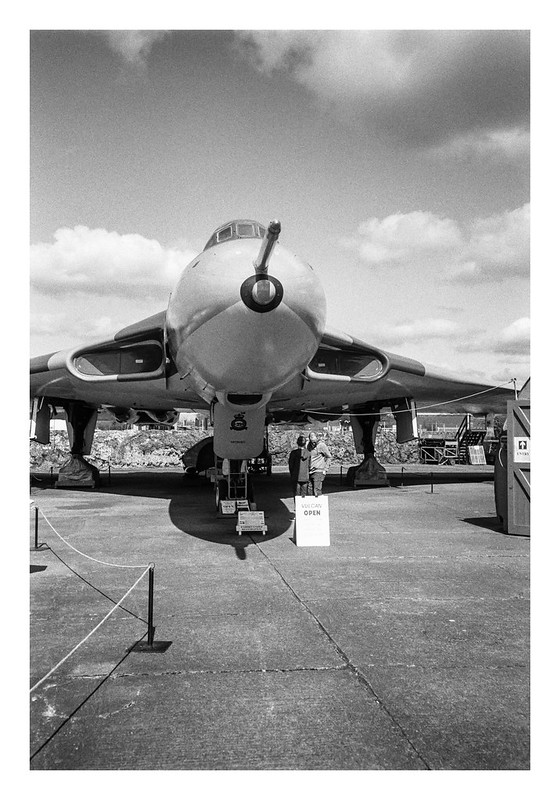
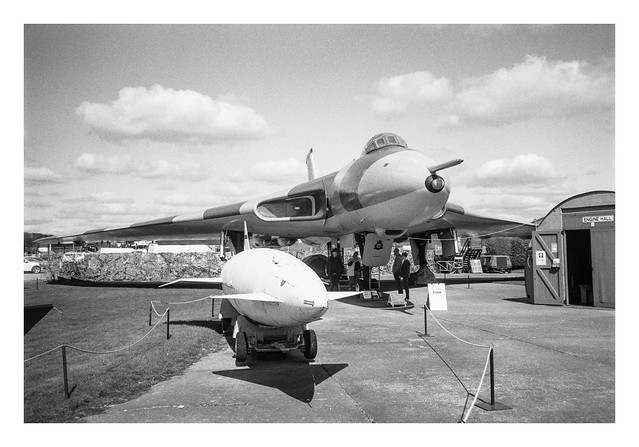
The Avro Vulcan bomber is a truly impressive aircraft. It’s huge delta wings span almost 100 feet and it’s an imposing feeling when you walk beneath. The Vulcan was one of three aircraft that formed to so-called V-Bombers – the other two being the Vickers Valliant (two Vs in one!) and the Handley Page Victor. – Britain’s nuclear capable bomber force from the 1950s to the early 1980s. In the mid-1960s the V-bomber fleet counted almost one-hundred-and-sixty aircraft, with Vulcan making up the largest part with seventy aircraft in service.

Seeing one of these fly is a majestic experience, the noise of the engines and the shape of the huge delta wings was unforgetable and I remeber seeing them in flight sometimes as a child, and was also fortunate enought to see one of the (then) surviving airworthy aircraft making a display flight at an airshown in the 1990s.

Sadly, none of the surviving Vulcans is in airworthy condition any longer, although there are three which are taxiable, and the one pictured here at Newark Air Museum is on static display (although it is possible to go inside the aircraft).

Live long and prosper! (I had to get that in! :))
V bomber
Under Vulcan's wing

Canon Sure Shot Supreme & Ilford HP5+. Ilfotec DD-X 1+4 9 mins 30 secs @ 20°

Taken 7 April 2023.
35mm · Film photography · Photography

Meteor

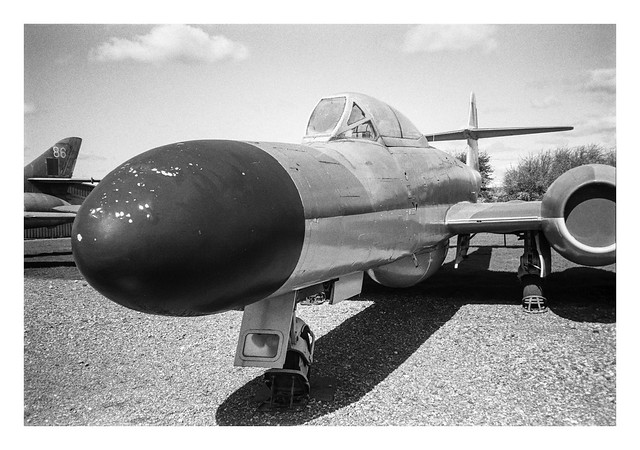
A couple of days back I posted about the Shooting Star (or the Lockheed T-33A, as it was formally known), today I have a picture of a Meteor. A Gloster Meteor NF-14.

The Gloster Meteor was the first British jet fighter, and the only one to see service during World War II. Several versions were produced, and the NF-14 was designed as a night-fighter variant to supercede the DeHavilland Mosquito. The NF-14 entered service in 1954 but was already being replaced by more advanced aircraft just a couple of years later.

Gloster Meteor NF.14

Canon Sure Shot Supreme & Ilford HP5+. Ilfotec DD-X 1+4 9 mins 30 secs @ 20°

Taken 7 April 2023.

35mm · Film photography · Photography

Shooting Star

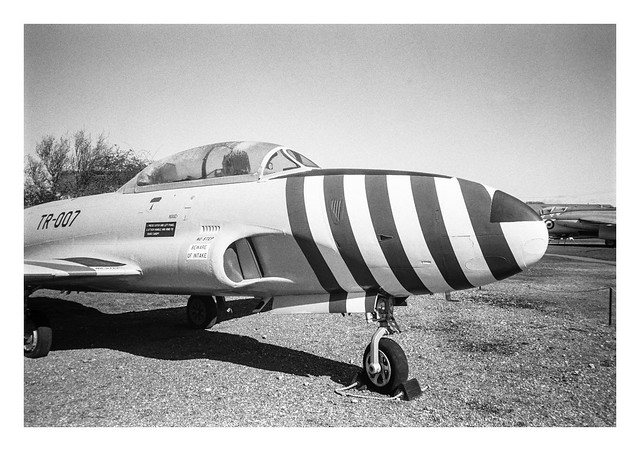
Of all the aircraft at Newark Air Museum, it was the Lockheed T-33A that got the most attention from my camera. Something about those zebra stripes on its nose did it for me a guess.

Although originally put in service as a jet fighter, the Shooting Star (or T-Bird as it was otherwise known) spent much of it’s operational life serving as a training aircraft. Amazingly, despite first going into service in the late 1940s, the Bolivian airforce only retired theirs from service in 2017!

It’s a pretty nice looking machine.

Lockheed T-33A
Stripes
On the nose
Lockheed T-33A

Canon Sure Shot Supreme & Ilford HP5+. Ilfotec DD-X 1+4 9 mins 30 secs @ 20°

Taken 7 April 2023.

35mm · Film photography · Photography

Hastings

Here’s the nose of the Handley Page Hastings at Newark Air Museum. It’s a quite colourful mix of silver, orange and red, but these also transfer quite nicely to black and white tones. The paintwork and detail on the fuselage also stand out quite nicely thanks to the light I had.

Nose

Canon Sure Shot Supreme & Ilford HP5+. Ilfotec DD-X 1+4 9 mins 30 secs @ 20°

Taken 7 April 2023.

35mm · Film photography · Photography

Shckleton nose

Here’s a close-up of the Avro Shackleton that appeared in the wider shot I published yesterday. My dad did some of his National Service stationed in Northern Ireland back in the 60s and told me that he once got a lift back over to to the mainland in an RAF Shackleton.

Avro Shackleton

Canon Sure Shot Supreme & Ilford HP5+. Ilfotec DD-X 1+4 9 mins 30 secs @ 20°

Taken 7 April 2023.
35mm · Film photography · Photography

All in a row

Three of the largest aircraft at Newark Air Museum, all in a row. From right to left: A Handley Page Hastings, an Avro Shackleton, and at far left, and Avro Vulcan. There will be further pictures of each of these impressive aeroplanes to come shortly.

Depending on when you visit, it’s possible to go onboard each of the aircraft. I’ve only been aboard the Shackleton (on a previous visit) and, despite the large size, it’s incredibly cramped inside. I managed to work my way all the way down the length of the plane to the nose, but it involved a few places where I had to climb over bulkeads and similar to get there.

Aircraft

Canon Sure Shot Supreme & Ilford HP5+. Ilfotec DD-X 1+4 9 mins 30 secs @ 20°

Taken 7 April 2023.

35mm · Film photography · Photography

A pair of MIGs

I’ve posted about my visit to Newark Air Museum last month here on the blog already, but those posts were mostly about the problems I’d encountered with my large format camera. Thankfully, I also had a second camera with me on the day – my trusty Canon Sure Shot Supreme – and it managed to do a sterling job making pictures, some of which I’ll be posting here in the coming days.

Aircraft – in a similar fashion to cars, trains, and steam engines – are not something that I have an inherent interest in. I mean, they are interesting, and certainly in many cases, impressive, but my primary reason for seeking them out is that they make great subjects for photographs. So a trip to an air museum is not that dissimilar to a trip to a classic car show, or a steam rally in that regard – primarily for making pictures, with some secondary general interest thrown in for good measure.

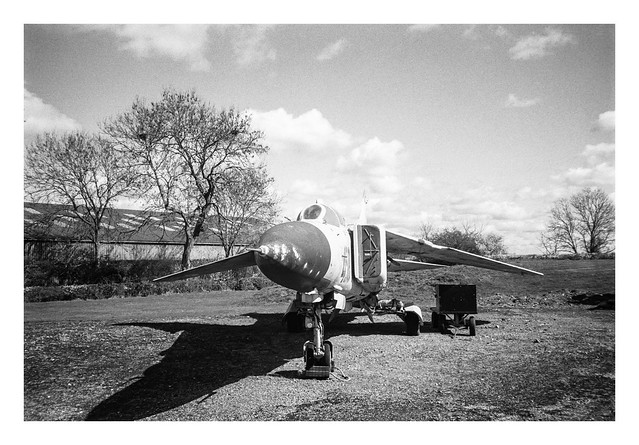
Today I have a couple of photographs of MIG aircraft – a 23ML and a 27K – both of which went under the NATO designation of “Flogger”.

MIG-23ML
MIG-27K

Canon Sure Shot Supreme & Ilford HP5+. Ilfotec DD-X 1+4 9 mins 30 secs @ 20°

Taken 7 April 2023.

35mm · Film photography · Photography

Empty skies

As air travel has been reduced by a huge amount in the current pandemic situation, it means the skies are almost devoid of aircraft where I live. I’ve seen a couple, but today’s clear blue skies have been exactly that – clear and blue – with nary a cloud nor a contrail to be seen. With that in mind, today’s picture is a reminder of what they look like. 🙂

Today marks the second full day of lock-down (although it’s not being officially called that by the government) here in the UK. As we’re still allowed to leave the house for exercise (only once a day, by yourself or with people from your immediate household), I managed to get out for a walk again at lunchtime. I’m treating these very much as walks first and foremost as the exercise is beneficial, but as I always carry a camera when I go out, I will still take photos while out if the opportunity arises and it doesn’t mean putting myself or anyone else at risk of unnecessary contact.

My walk today took me through an industrial estate where a number of businesses are still operating and, as it was lunchtime and the weather was nice, there were people eating their food outside at one place, albeit sat a good three or four metres apart. I’ve taken to crossing the street if I see someone approaching, and it’s noticeable just how much people are fearful of getting too close to one another. We had a delivery to the house yesterday and the driver, after seeing me coming to the door, retreated to the bottom of the drive before I opened it.

Sadly, although understandably, my local film-processing lab announced today that it will be closing it’s doors and stopping production for the time-being, so any film I do shoot wil need to be sent elsewhere – although I am still looking into home developing (though only if I can get any kit and chems delivered, I suppose).

Work remains, for me at least, much the same as it did before this started as I work from home full-time anyway. The main difference is having the boys at home now that school has closed. My wife still has to travel to work as she is in a key-worker role, although she has the next few days off.

The lock-down in the UK is scheduled to be reviewed in three weeks time, but I would be very surprised if it’s lifted at that point. I think we’re in it for quite some time.

Contrail

Nikon F80, Nikkor 50mm f/1.8 AF-D & Ilford HP5+.

Taken on 2 February 2020