Film photography · Medium Format · Photography

Victoria Quays part #1

Saturday was tied up this weekend with various jobs to be done, so I had little time for any photography, but Sunday dawned with bright weather that looked like it might have promise, should I decide to take advantage. However, despite a desire to make use of the available time to take photos, I was also feeling lazy, with a conflicting need to just sit on my backside watching TV and reading books. And, for a while, this secondary need prevailed as, after my dad’s usual Sunday morning visit, the cloud cover had thickened considerably, draining much of the contrast from the world outside. Now, I don’t mind dull or inclement weather where photography is concerned – in fact it can be a positive boon in some cases – but I wasn’t really feeling it at the time and so the pull of the settee won out.

After dinner (I’m from Yorkshire, so “dinner” is actually the midday meal around these parts, and what others would call “dinner” is actually “tea” – not the drink, the evening meal) the weather had perked up again, the clouds had thinned back to large puffs of cumulus, and the light was bright. Not exactly golden-hour stuff, but suitable enough to jump in the car and head out for an hour of two. I’d already planned on a destination in the event of going out, and so off I went to Sheffield’s canal basin and wharf, now known as Victoria Quays (presumably because they lie just below the site of the former Victoria Station and adjacent Royal Victoria Hotel.

I took a couple of cameras with me – the Yashica Mat 124 G, and a Minolta Hi-Matic G2 that I’ve been chucking in my pocket when I go out, and I’ll split the results over a few blog posts as I get round to uploading the photos (12 frames from the Yashica, and 24 from the Minolta – although not all the Minolta shots were from Sunday).

I parked the car in the multi-storey adjacent to the canal basin. The last time I parked here I made the mistake of trying to use the lift / stairwell to get to ground level, only to discover the lifts to be out of service, all other doors locked, and the entire area stinking like something from hell that had been slowly baking in the heat radiating through the glass windows. This time, for the sake of my nose, I parked on a lower floor and just walked down the ramps..

The exit near where I was parked opened onto the north quay, a pleasant, cobbled area with benches looking out onto the canal basin and backed onto shops built into stone arches. Most of the shops appear to be disused at present, although there is a cafe that was making the most of the passing trade, and a number of people were sat outside with coffees and ice-creams. It’s a shame that more of the shops are not in use, but I think that the conversion of a lot of the surrounding buildings to residential units has perhaps not taken off as much as the developers hoped, and so there is not enough passing footfall at present. It’s a shame as it’s a nice enough place, but it’s a little off the beaten track from the town centre.

I decided to look around the wharf area first, and it’s the shots that I took there that will be shown in this post. The canal basin shots will come in another post, and then maybe a couple more containing the Hi-Matic shots.

The first shot I took was of the Straddle Wharf building itself. I’d have liked to have gotten more of the building in shot, but the fixed focal length of the lens, and lack of other vantage points meant this was the best I could get. I’ve cropped the shot slightly to remove a bit of sky at top-right, and I like the skewed symmetry that now results between the light and dark sections of the shot.

FILM - Straddle Wharf, Victoria Quays, Sheffield

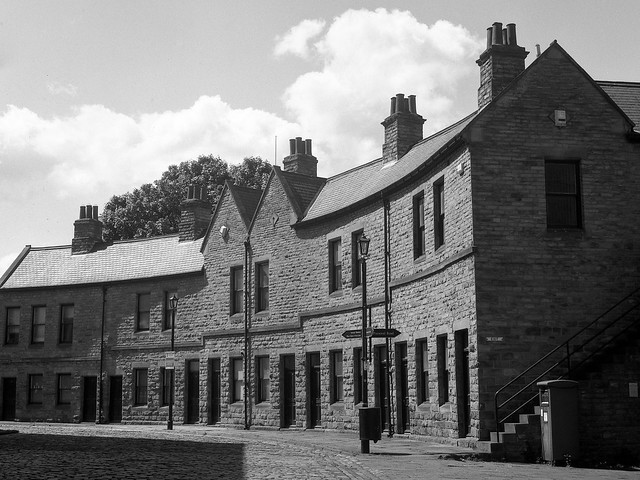
The next shot was taken a few metres from the first, this time looking in the opposite direction towards Merchant’s Crescent, a terrace of houses originally inhabited ny coal merchants, but not re-developed into residential units. Again, this is cropped (to 6:4.5 ratio this time), partly to remove a small wedge of a building that encroached from the left of the image, and also because I didn’t feel the large expanse of mostly clear sky added anything to the top of the frame. I don’t mind negative space, but it wasn’t doing anything for me here. Sadly, I think the crop is now a little too tight at the left of the frame, but there was nothing much I could do with it apart from removing large chunks of stuff with Photoshop. Lesson for self – pay better attention to the viewfinder next time, eh?!
FILM - Merchant's Crescent

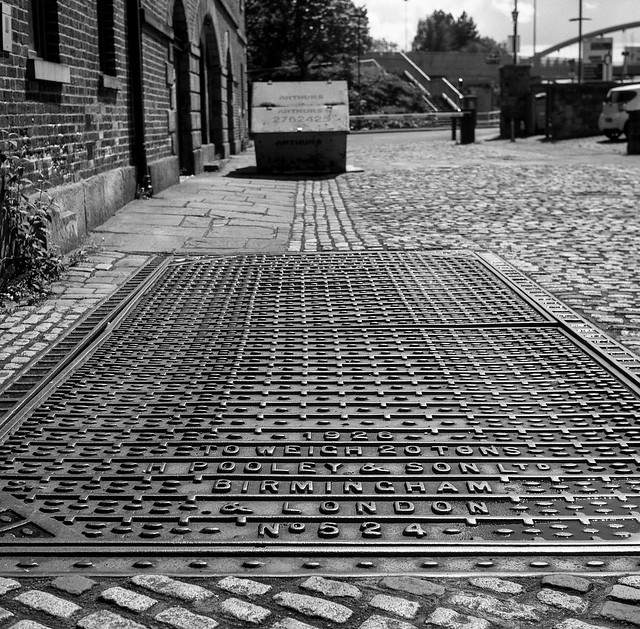
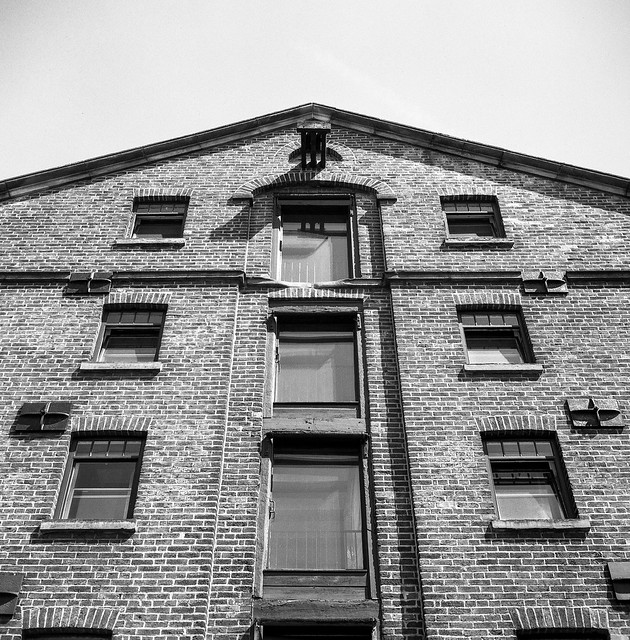
Walking past Merchant’s Crescent brings you to the front of the Grain Warehouse, where the next two shots were taken. The first is of a ninety-year-old weighbridge. I liked the way that the sun was casting the manufacturer’s mark into relief. I’d have preferred a shallower depth of field for this shot but the brightness of the sun meant I could only open up to f/8 before the combination of the Yashica’s 1/500sec maximum shutter speed and the Fomapan 200 film would have resulted in overexposure (what was I saying about dull weather before..?). The second, is the front of the Grain Warehouse itself. This is another building that is currently in the process of some renovation, but it thankfully retains signs of its former purpose. Again, the sunlight provided plenty of contrast in this shot, and a smaller aperture was no disadvantage here.
FILM - To weigh 20 tons

FILM - Hoist

The final shot of this post was taken just around the corner from the last two and is a door and window in the Grain Warehouse. I don’t think I would have considered the shot had it not been for the shovel and length of rebar resting against the wall beside the door, which adds interest. The door has a plate beside it reading “The White House”, but I have no idea why – the building is neither white, nor a house. This is definitely my favourite shot of this batch though.

FILM - The White House. Staff only

And that’s it. I’ll post about the remaining seven shots from this roll in a day or three’s time. Bye for now!

35mm · Film photography · Photography

Cleethorpes part #2

This will be a shorter post than part one, no real need to go over the events of the day a second time, but if anyone wants to know, here they are in Cleethorpes part #1.

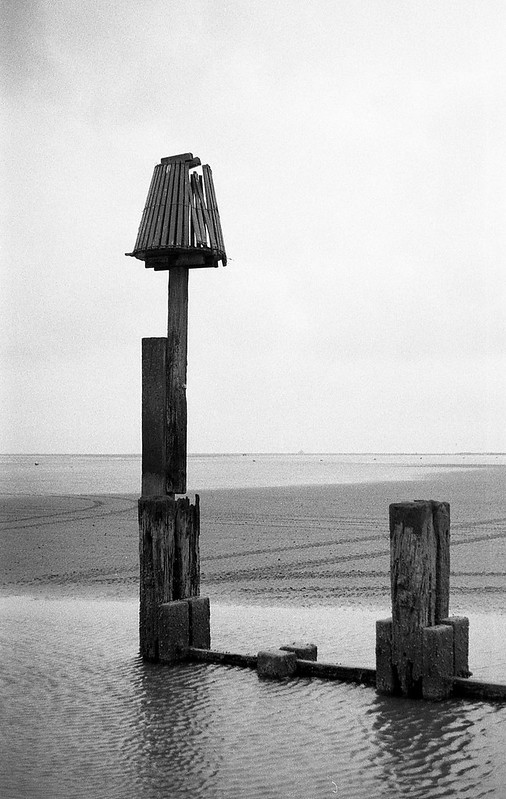
This set of shots were all taken on the beach (a couple of others – the tyre tracks, and the pier supports – in the last entry were taken at the same time). Again, the camera was my Pentax P30T with a Rikenon 50mm f/2 lens.

While my wife and boys went into an arcade near the foot of the pier, I excused myself to take some photos on the beach. The tide was still out, and although it had turned by this time, there was still plenty of exposed sand (which, as Cleethorpes is at the mouth of the Humber estuary, is a muddy brown colour – the only golden sand available is at the top of the beach and I suspect has been put there by man, rather than nature, to make a more attractive setting for sand castles and donkey rides).

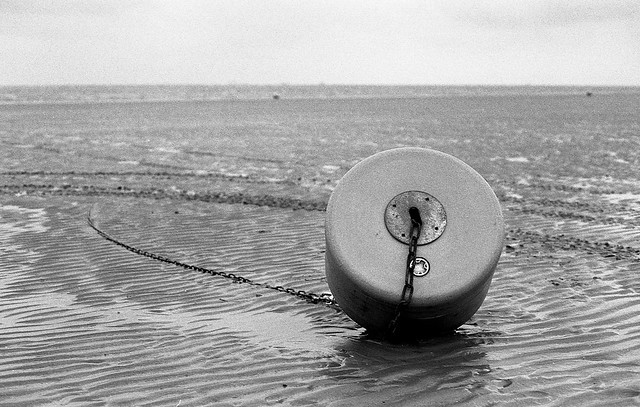
Most of the shots here are of the breakwater just north of the pier, but there are a couple of buoys there too to add a touch of spice (I need to get out more…). Again, the Bergger Pancro 400 has resulted in grainy, but pleasing shots, with plenty of contrast. My post-processing on these has consisted of adding a little extra contrast, tweaks to the highlights, whites and blacks, and a small push on the clarity slider in Lightroom.

The breakwater pictures are my favourites here, especially the first and third shots (I think shot one may be slightly soft in the foreground, but not enough to detract).

FILM - Breakwater

FILM - Breakwater

FILM - Breakwater

FILM - Breakwater

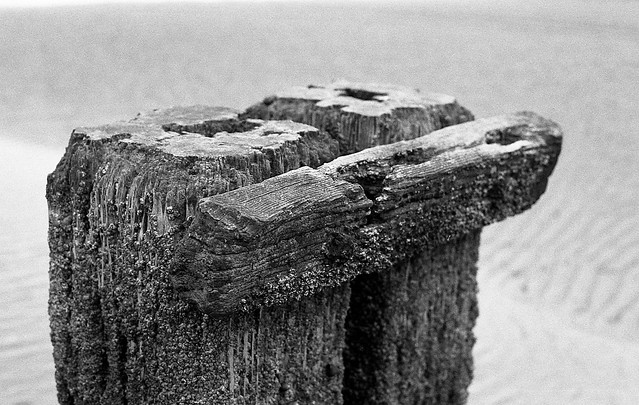
A few of my close-up shots from this roll were out of focus, and at first I was concerned about a lens or focussing issue, but other shots like the one below, are nice and sharp so, pending it happening again in future, I’m going to pin the blame on the fool holding the camera.

FILM - Barnacles

FILM - Beached

FILM - Beached-2

35mm · Film photography · Photography

Cleethorpes part #1

I went to Cleethorpes last Saturday. This was just a family day out, not a planned photography trip, so I’d prepped myself for the inevitable shots I wouldn’t be able to take due to not wanting to inconvenience my wife and children. They never complain about me taking pictures but I nonetheless have a strong sense of self-imposed guilt that I’m spoiling everyone else’s day by constantly stopping to take shots. This is compounded by a frustration when I see a good shot, but don’t have the time to do it justice – I can’t very well expect them to hang about for 10 minutes until the sun emerges from a cloud or something (well, I could, but I don’t, because that would be a bit selfish). So, these things considered, while I still take a camera on these excursions, it’s a secondary thing and I’ll get photos if I can, but not at the expense of the family trip.

The day before our visit had wonderful weather – bright blue skies with lots of cumulus clouds to add a splash of interest. As expected, Saturday dawned to a fug of thick overcast cloud stretching, seemingly, across the entire country. Oh well, such conditions are part and parcel of living in the UK. It did mean we packed some extra coats in the boot of the car, and I decided a 400 speed black& white film would be the best choice for the day. As the only such film I had to hand was a roll of Bergger Pancro 400, that was what it would have to be. I’d never shot this film before and had read that it was quite a ‘flat’ film, with low contrast, although that wasn’t really backed up by my results, all of which had plenty of contrast, even before any post processing on the scans.

The route from home to Cleethorpes is relatively painless, being the only close(ish) seaside town that can be reached by motorways and main roads for almost the full run, and it took a little over an hour to make the journey. The weather was no better there than at home, plus it was a good few degrees cooler to boot (not that the temperature put off a few hardy souls who braved the beach and let their kids paddle in the frigid pools left by the receding tide!), and we had no difficulty in finding a parking space. I’ll not go into the full day’s events, other than to confirm that cafe’s were visited to ward off the chill, fish and chips were consumed (this is THE LAW) and ice-creams were had (in clear contravention of the warming beverages we’d sought earlier). Oh, and pictures were taken. I didn’t manage to shoot the whole 36 frames, but only went home with about half-a-dozen to spare, all of which I shot over the remains of the weekend.

I ended up getting quite a few decent shots from the 36. Not living too close to the coast means that there’s always a novelty to shooting the traditional seaside-type subjects – beaches, piers, arcades, funfairs, seaside shops and cafe’s etc, and I managed my fill on the day.

I’ll add a few to this post, and them add some more in a follow-up in a few day’s time. You can see all these in higher resolution by clicking the images.

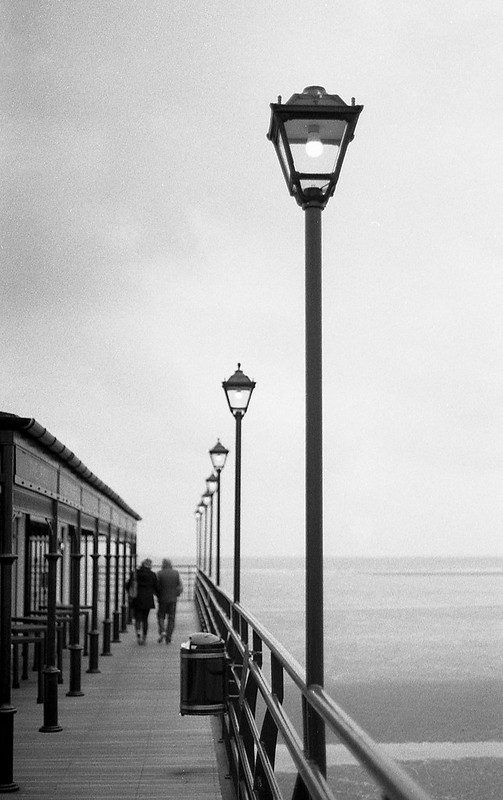
The first four shots are of the pier, two from the promenade, one from the beach, under the supports, and the last from atop the pier itself. The film shows a lot of contrast and grain in these shots, and I like the results. The picture of the two people is one of my favourites, but I really wish that bin wasn’t attached to the railings!

FILM - Cleethorpes pier

FILM - Cleethorpes pier

FILM - Humber

FILM - On the pier

Here’s another shot from the beach. Nothing fancy, but I like the way the tracks lead you through and out of the scene.

FILM - Beach ways

And finally three pictures of seaside ephemera. The hotdog dude is my favourite of these.

FILM - Weiner Man

FILM - Flying the flags

FILM - Kingpin

The rest of the shots from the trip are mostly from the beach, some of which I like a lot, so I’ll post them soon.

Film photography · Medium Format · Photography

Roche Abbey


I shot a couple of rolls of film over the past weekend and I’m writing about them in reverse order. On Saturday I shot (most of) a roll of Bergger Pancro 400 with my Pentax P30T – I’ll post something about that in the coming days – and on Sunday a roll of Fomapan 200 with the Yashica Mat 124 G. It’s that roll that I’ll talk about here.

I didn’t have any specific photography plans in mind for Sunday – my wife had gone out, and I was dependent on my eldest being around to look after his younger brothers if I was to venture anywhere. I was also in two minds as to whether to just laze around the house and watch TV – I’d recorded the documentary film, Finding Vivian Maier, and was planning on watching that at some point.

In the end I watched the film in the morning after my dad left following his usual Sunday visit, did a few chores, and then decided to go out upon seeing that the cloud cover had broken up and there was some decent light.

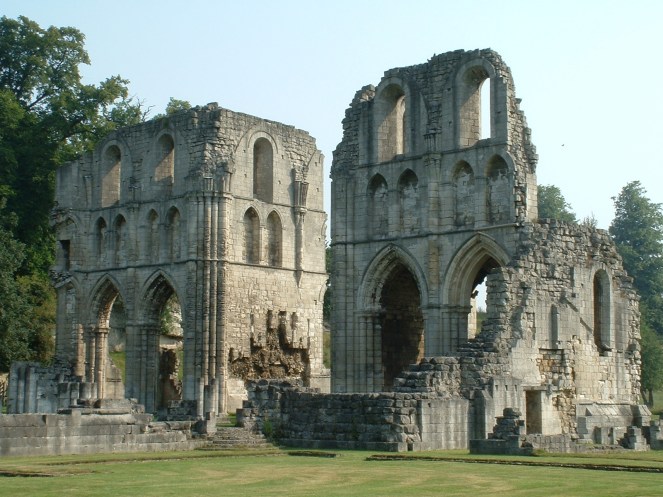
My destination was Roche Abbey, the ruins of a 12th century Cistercian monastery that lies in a pleasantly landscaped valley just to the east of Maltby. It’s about half-an-hour’s drive and I’ve visited the place once before in 2003 back when I had my first ever digital camera – a Fujifilm Finepix A204 compact, capable of a whopping 2 megapixel resolution! I mock it, but I still have the camera in a cupboard, and it still works ok, and I was very happy with the shots it took at the time. In fact, here’s one of the shots of the abbey I took with it back then:

Dscf0021
Roche Abbey – taken in August 2003 with a Fujifilm Finepix A204 digital compact camera.

The weather on that day in 2003 was very pleasant, and I visited in the morning with the sun rising up behind the remaining standing structures of the abbey. This time, the weather was against me to some extent, and despite the location not being too far from home, the cloud cover had thickened by the time I arrived, covering the sky with a largely featureless grey blanket. Oh well, not what I’d have chosen, but not the end of the world.

The abbey is down a small, cobbled lane that descends into the valley, and which didn’t seem to do the car’s suspension a great deal of good, but at least there was parking space at the bottom. There also seemed to be some sort of organised foot-race / marathon taking place as there were numbered runners passing by frequently and, in the old, vaulted gatehouse to the abbey, there was a table set up for them to take drinks.

The entrance to the abbey grounds themselves are via the Abbey House. The abbey is managed by English Heritage and a fee is chargeable upon entrance through the house (which also doubles as a gift shop and small museum). I became a member of English Heritage a couple of months ago when I discovered upon arrival that my impromptu visit to Bolsover castle would cost me over £10 to get in, and so I decided to instead pay the £50 one-year membership fee and try my utmost to visit other EH sites and get my money’s worth throughout the next 12-months. This visit to Roche Abbey was the first trip to recoup some of the investment.

For visitors not willing to pay the entrance fee, the Abbey structure can be seen easily from a public footpath running alongside the property, albeit behind a metal fence. This doesn’t allow you to get in amongst the ruins though, and probably doesn’t give you the nicest vantage points.

Anyway, I shot the full roll of Fomapan 200 (bar the last frame) during my visit, including a shot of the Abbey House, three shots of the main towers, one of the sluice that runs through the grounds, and a number of shots of memorial benches and signposts. The last shot was of one of the runners approaching along a curved track as I was returning to the car, and then I finished the roll with a photo of a potted Rhododendron plant in our back garden. It wasn’t the most productive of rolls I’ve shot, with seven of the pictures being keepers (again, your definition of a keeper may differ from mine!), and the others being a little humdrum – the shot of the sluice doesn’t really work, as does one with three benches in the frame, and the shot of the runner isn’t great either. The Rhododendron is, well, a shot of a potted rhododendron, so make of that what you will, but I’ve not included any of these pictures here (although it’s possible that some of them will go on my Flickr stream at some point).

This was my first roll of Fomapan 200 (though I’ve shot the 100 variety in 135 format before) and I’m happy with the results. The negatives are very curly though, and I did notice a large number of scratches that I’ve had to try to remove in post-processing. I’ve not really encountered this sort of scratching on other rolls I’ve shot, so think it may be the film, rather than the camera or lab (Peak Imaging, who always produce great results). A search online revealed that I’m not the only person to suffer from this. None of the scratches were sufficient to detract too much from my amateur shots though.

So, without further ado, here are the ones I like the best…

#1. This is the Abbey House as seen after you’ve entered the grounds. You come out through the lovely old studded door you can see in the picture.

FILM - Abbey House, Roche Abbey

#2. The two remaining major abbey structures.

FILM - Roche Abbey

#3. The southern tower. I’d not intended to get the OOF foreground in shot, but it was a result of the parallax difference between the viewing and taking lens of the camera. I don’t mind the effect though as I think it gives the shot a nice sense of depth.

FILM - Roche Abbey

#4. Another shot of the southern tower, but this time with the focus on foreground stonework. I like how the sprinkling of daisies stand out in the black and white of these shots.

FILM - Roche Abbey

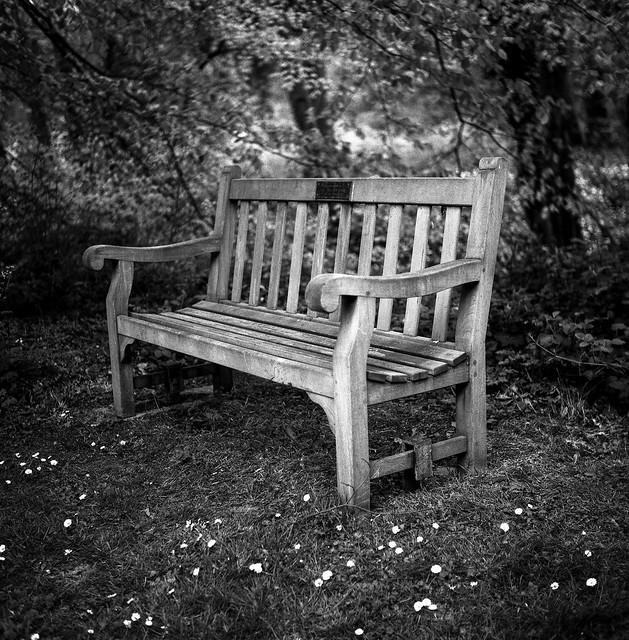
#5 & #6. A couple of the memorial benches under the trees to the west of the abbey ruins. I really like the second of these two, again because of the daisies giving interest to the foreground.

FILM - Memoriam bench

FILM - A seat amongst the daisies

#7. A warning sign stood amongst a morass of nettles highlighting the sluice that flows just behind them.

FILM - Caution

35mm · Film photography · Photography

Oddshots #1

Occasionally, I might have a single image to post, maybe something unusual or special, or just an oddment that’s slipped out of a set. Rather than saying nothing about them, I thought they might make for good “quickie” posts.

The shot here is one that was taken a few weeks ago, but which I’ve only just uploaded to Flickr (mainly because I’ve been spending a lot of time with the Yashica Mat). It was taken with a Pentax P30T and Rikenon 50mm f/2 lens combo on Agfa Vista Plus 200 – a film that can usually be bought for £1 a roll [24 exp] in the UK’s Poundland discount store chain. Poundland Agfa (as it seems to be known amongst some ‘togs) may be cheap, but I quite like the results it produces – a little grainy and edging towards the magenta, it can produce particularly nice results in sunny conditions, I  think.

Because it’s so cheap, it makes a good ‘test’ film for new cameras that you don’t want to risk with something more expensive. In this case, it was the first outing for the P30T, a camera I’d bought purely because I had the Pentax K-mount Rikenon 50mm lying around without a body to affix it to. The lens came with a Ricoh KR-10 that I’d bought at a flea market, but the focusing screen was mis-aligned and beyond my current powers to fix. I still have the KR-10, but it seems to have slipped into further disrepair, with the shutter now failing to fire even with fresh batteries. Ah well, at least the lens seems ok.

I took the camera for a walk around town and shot all 24 frames of the Agfa, and was very happy with the results. The P30T (which I use in aperture priority mode), is compact, light, and fits well in my hands, and the images were all nicely sharp and well exposed.

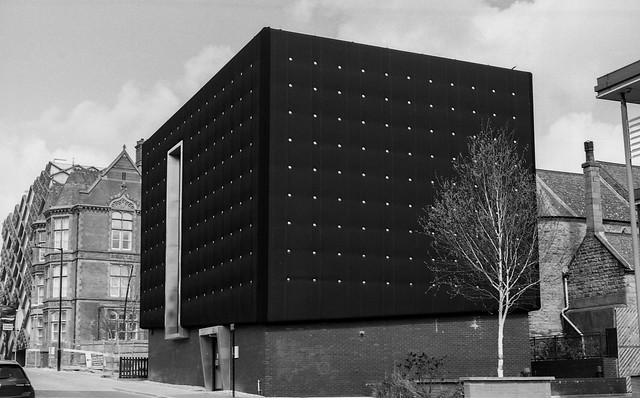
The shot below is of the Soundhouse, a building owned by the University of Sheffield’s Department of Music. It’s an unusual building with a look of a piece of studded furniture. After a bit of tweaking, I decided to convert the shot to black and white as I preferred the look. Apart from a couple of scratches I’ve noticed on the image since uploading it (I might go back and fix those, so don’t worry if you can’t see them!), I like the shot. The building’s unusual shape and its black textured exterior make it stand out nicely in the frame. The composition is maybe a little tight at the bottom though. Oh well.

FILM - Living in a box


Film photography · Medium Format · Photography

Twelve frames an hour

I’m still loving the Yashica Mat 124 G and, as I had a brief window of time before attending an appointment I’d taken the day off work for on Wednesday, I decided to go out. I only had around 90 minutes to spare, so didn’t venture far, but there’s a variety of footpaths and tracks in the area that would offer some opportunities for photographs, plus the weather was nice and bright which might make for some contrasty shadows even though the sun was riding fairly high by this time of the morning.

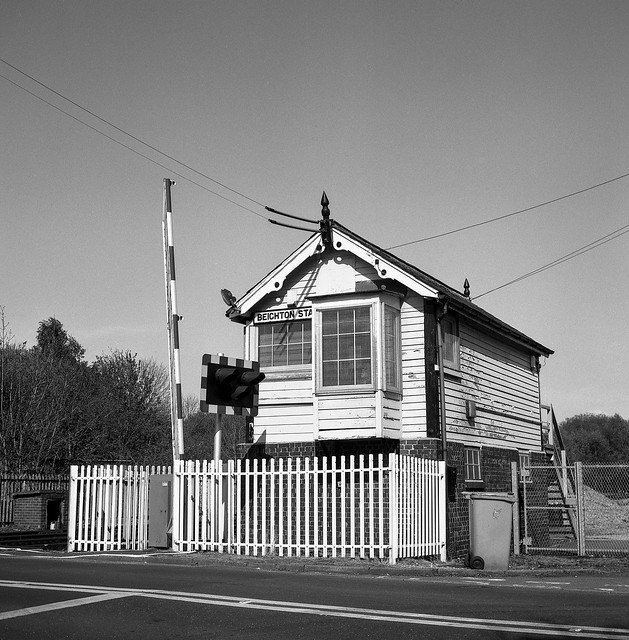
I decided to waste no time by walking to the area I planned on visiting and instead drove the car the mile or so to where I planned to start my walk. I parked up in a small lay-by close to the railway crossing – my first intended subject being the signal-box that stands beside the crossing. As I got there I though my luck was in as the alarm began to ring and the barriers descended indicating a train would shortly pass. I got my shot set up to feature the signal box at the right of the frame and the yet-to-arrive train on the left. Focus was nailed; composition was set; All I needed was the train to arrive. I waited. And waited. I noticed some curious looks from a lady in a car waiting at the crossing as she looked at the bloke staring into the top of the old-fashioned-looking camera. I waited some more and then, suddenly… the barriers raised. Bah! No train. It had not been my intention to shoot a passing train, but it would’ve been a nice addition to the picture had it arrived. Still, at least I got my shot (well, two of them actually) of the signal box.

FILM - Beighton Station

FILM - Beighton Station-2

I then walked up the small road that runs parallel to the railway tracks. This leads to a scrapyard, although it’s not really a scrapyard in the traditional sense of it being a load of old junked cars anymore. It used to be, and I remember hunting for and finding a replacement wing-mirror for my first car at the very same place about twenty-five years previously, but these days it’s more of a recycled metals place and I don’t think there are any junked cars there any more. A pity, as they would make for interesting photo opportunities. Still, I took my next shot on the lane – there was a distant electricity pylon rising between a couple of trees where the road curved up ahead, and that made for frame #3.

FILM - The road to the scrapyard

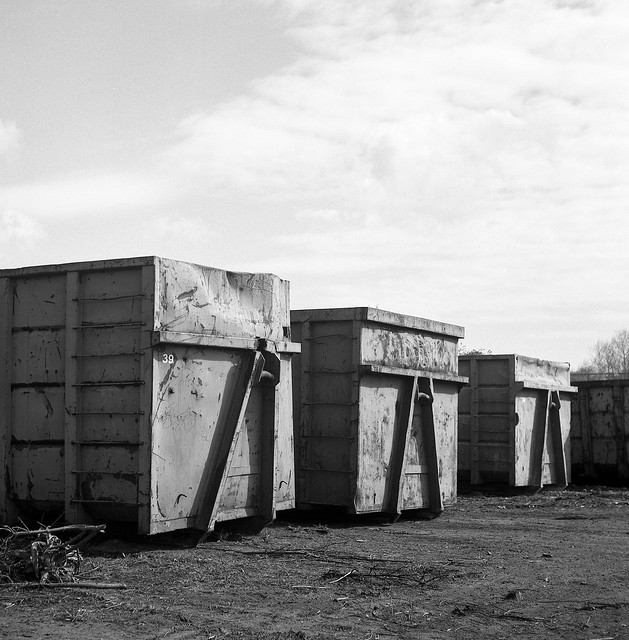
I’d intended the next shot to be of a footbridge spanning the railway lines, but there were a bunch of parked cars and vans next to the bridge that I felt spoiled the shot, so I instead turned my attention to the rows of waste-metal skips that are lined up outside the yard. I presume that these are dropped off from recycling depots and then returned later but, whatever the case, there a quite a number of them. I noticed three of the same design all in a row with some nice bright light on them, so that was shot #4.

FILM - Skips

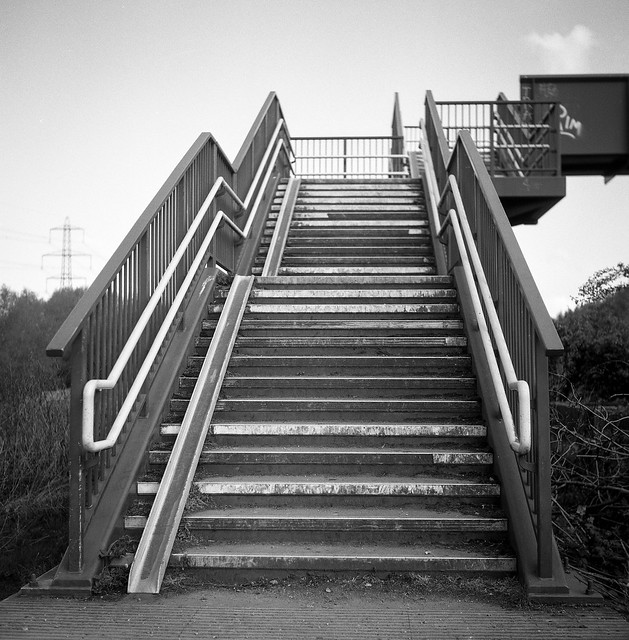
Shot #5 was of another footbridge, this one spanning a second set of railway lines (the two set join a little farther up the valley) and I attempted to get a shallow depth of field shot focussed on the foot of the steps. Alas, even with a roll of Ilford FP4+ in the camera, the light was too bright to drop below f/8 at the camera’s maximum shutter speed of 1/500 sec. The shot’s still quite nice (in an industrial style) though.

FILM - Footbridge

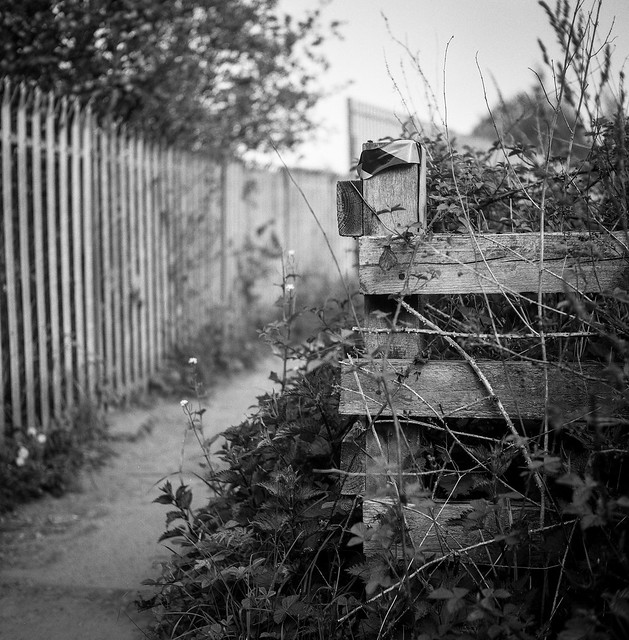
At the other side of the bridge, the path forks. Straight ahead takes you to the country park, to the left the path crosses the Rother via a narrow passage on the stone railway bridge. At the edge of the bridge I noticed a fence overgrown with brambles and nettles and decided to make it #6. The #7 was a wide aperture shot of the near-side of the path across the bridge and #8 was the same path from the opposite side. A bit of stray vegetation got into the shot here and spoils this one a little, although I’d be lying if I were to claim it would’ve been great otherwise.

FILM - The brambly fence

FILM - ...That way

FILM - This way

Shot #9 was of a cluster of directional signs poking from the undergrowth at the far side of the bridge. One of the signs looks to have had an encounter with fire at some point in its existence! Shots #10 & #11 were of the chain link fence the adjoins the right side of the path in my direction of travel – the other side is bordered by a more significant aluminium fence that separates the track from the set of railway lines.

FILM - Signs

FILM - Chainlink

FILM - Holding things up

At the end of the path I walked up the small rise that leads to the viaduct carrying the A57 across the valley (including the river and both sets of railway lines), but took the road back down into the village before getting to the pedestrian-free zone, looping me back to my start point.

I had one final frame remaining of the twelve and decided that a wooden gate in a field close to where I’d parked the car would make a decent final shot. I think the gate was shot at f/8.

FILM - The gate to where the dogs used to play

Film photography · Medium Format · Photography

Another couple of outings with the Yashica Mat

After being pretty pleased with the first set of results from my Yashica Mat 124 G, I was eager to get out and shoot some more. Given I had an extra roll of HP5 lying around, what was there to wait for?

So, a couple of days after getting the first roll back, I went out again with another twelve potential masterpieces waiting to be found. I’m not sure there are any masterpieces amongst the shots I got  (well, I’m fairly confident there aren’t), but I was happy with the majority of them nontheless.

The first five shots were taken on an evening expedition after work on the 25th. After a bit of virtual-sightseeing on Google Streetview, I’d found a photogenic-looking tree on a country lane not too far from home, so I hopped in the car and drove to the location (not far from Harthill), The weather had consisted of sunshine and showers throughout the afternoon, and the situation had persisted into the early evening, so there were plenty of big clouds in the sky to add some interest to the shots, but with the downside that I would have to hide in the car should they decide to open up on my position (no surprises here, but they did).

The location was quite nice, and the showers had left a nice sheen of water on the lane running beside the tree. The fields on either side were full of oilseed rape in full bloom and were vivid with yellow flowers. Good job I had that black and white film in the camera, eh? I managed to get three shots before the rain came, and then waited in the car for a final shot after the shower had passed. The first shot was totally out of focus for no reason I could ascertain, but as the rest were fine, it’s probably attributable to camera shake or some other dumb user error.

I decided to drive on for the last shot of the evening, another lane just outside the pleasant little village of Thorpe Salvin. I’d seen the lane before, but not taken any shots, and while I quite like the result from this trip, the road was quite dry and I feel it might’ve benefited from a bit of water like the first location. There was also a pair of purple Calvin Klein underpants affixed to a barbed wire fence next to where I parked the car, but thankfully these were not in the way of my shot so I kept a safe distance from them. No idea what their particular story was!

A day later I decided to use the remaining 7 shots and took a drive past Eckington to the cluster of small hamlets in the hills beyond. I didn’t have any particular idea of what I was going to shoot, but felt that some opportunities might present themselves as I drove around.

The first shot was of a Give Way marker at a crossroads. Not the most obvious of subjects, but I’d seen a couple of examples of similar shots on The Online Darkroom blog that I liked the look of, and so decided to get my own take. I don’t think mine matches the quality of those taken by Bruce Robinson that it seeks to emulate, but it’s quite nice anyway and I was happy with the result.

The next shot was of a random piece of farm machinery I spotted in a field near Apperknowle (another shot that necessitated waiting out a rain shower in the car). Because of the TLR’s viewfinder and the proximity of a fence and foliage to my shooting position, I ended up cropping the shot to get rid of some distracting foreground objects that didn’t add anything to the shot. I’m not sure it’s great without them, but it has a pleasant vintage feel that I think can be a hallmark of medium format images.

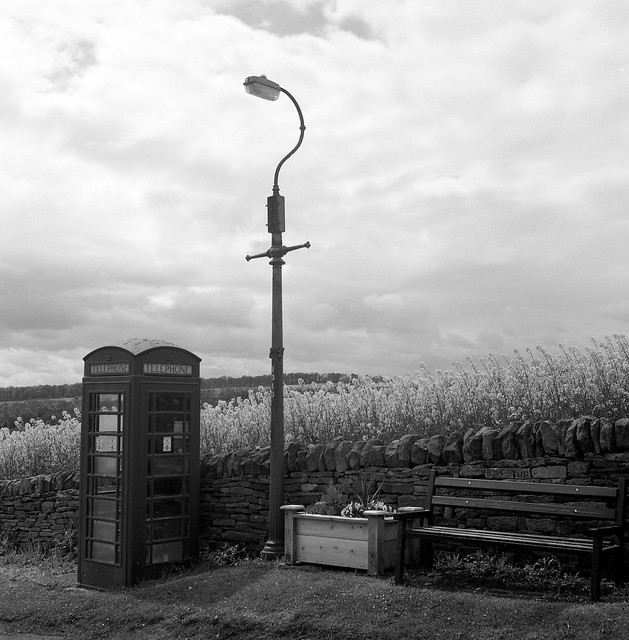
The remaining shots were all taken at the same location in West Handley, where a traditional K6 red phone box stands beside the road. Behind the box was another rapeseed field, which made for a picture of the crop stems, and an anti-fracking notice on a telephone pole made for another.

Overall, I’m pleased with this second set from the camera. It’s still a learning experience, but one that’s a pleasure to undertake. Anyway, enough wittering, here are the shots:

The first two are of the tree near Harthill.

FILM - The tree near the zig-zag

FILM - Zig-zag tree part deux

The next is the lane near Thorpe Salvin (and the underpants!).

FILM - Country Lane

Here’s the Give Way road marking shot:

FILM - On the road

And the farm machinery (not sure what it is exactly though – possibly some sort of generator / pump?):

FILM - In a field with horses

And finally, the shots from West Handley:

FILM - Oh Frack!

FILM - Growing crops

FILM - Light, comfort, communication

FILM - Callbox

Photography

Yashica Mat 124 G

Yashica Mat 124 G

I already own one medium format camera in the shape of a Lubitel 166 Universal. My reasons for buying it were primarily based on economics – Lubitels can be had in good condition for around £30-50 ish – but also because, despite their relatively lo-fi build and feature set, they are capable of pretty nice results if you put in the effort. This effort, in my case at least, comes mostly in the shape of squinting very hard into the small magnifying loupe while trying to determine if the image in the dim circle of ground glass is actually in focus or not, coupled with the fact that the waist level viewfinder has to be viewed at quite a specific angle to avoid reflections of the inside of the camera which can make composing your shot (already tricky to those not used to the reversed image) an additional hurdle. What this means in practice is that I tend to chicken out of any close focus shots and just set the thing to infinity and not worry about it beyond a slightly depressing realisation that I’m missing out on some nice shallow depth of field images that medium format can do so nicely. Still, despite thes shortcomings, I’ve managed to get some decent shots out of the 166 U, and they are extremely sharp if time is taken to get things right.

Nontheless, I had a hankering for something with a bit more umph and a bit less of a thermo-plasticky feel to it, so for the past few months I’ve been weighing up a likely replacement – ostensibly as a birthday present. I had a budget of up to £250 in mind which, while ruling out a lot of the Rolleiflexes and Hassleblads and the like, still left a reasonable amount of decent cameras to choose from, and the main decision was around format – TLR or SLR.

While I like the idea of MF SLRs for thir handling, they do tend to have a dwnside when it comes to form factor unless you’re happy to just stick with a waist level finder (which then removes a lot of the handling benefits). A Bronica ETRS becomes a much bigger machine once a grip and prism finder is attached for instance, So, having been quite happy with the 6×6 squares produced by my Lubitel, I decided a TLR was probably the way to go – smaller, lighter, and without the “1980s VHS camcorder” look that some MF SLRs can get when fully kitted out. Again, there were still a number of options – Yashica’s Rolleicords, Autocords, Mamiya C330s etc. – but my decision was mostly made when I spotted a Yashica Mat 124 G in good condition for a fair price on Gumtree. After a bit of umming & ahhing and some questions to the seller, I decided to go for it.

It’s in a different league when compared with the Lubitel. It feels solid and weighty, the focussing is smooth and easy to determine in the viewfinder. The loupe is massive in comparison, and the controls are much simpler to use. The camera is in very nice condition, but didn’t have a lens cap, so I ordered a third part cap from eBay (which, when it arrived, turned out is a pretty poor fit, but it at least stays on the camera and hasn’t fallen off by itself so far), plus a lens hood as I’d heard that the camera could be susceptible to flare.Still, despite not having the protection of either, I was itching to try the camera out so, as the weather was quite dull, I loaded up a roll of 400 ASA HP5+. I was a little unsure of how to wind the film on to the first frame – this is a completely manual process in my Lubitel, so I did something similar wuth the Yashica – stopping winding when I saw the “1” in the frame-counter window. My frst shot was a boring, “itchy trigger finger” shot of the empty HP5 box on the windowsill. I lined up the shot, got the focus dialled in and fired the shutter. I then wound on, but the lever stopped after about an inch, forcing me to back-wind and re-cock the shutter. It appeared that my method of loading the film had been incorrect. I then took a shot of one of my kids. This time the lever advanced as expected, but I was doubtful as to how the shot would emerge, now expcting a double exposure of some sort (this is exactly what I got – a shot of one of my sons superimposed on some vertical blinds).

After my hasty first shot, I decided to venture out. I didn’t have any particular location in mind for my test, but as I had some chores to run, I decided to take a few shots around Handsworth church after dropping some curtains off at the dry cleaners. The sun was showing signs of emerging between the clouds and I fired off five shots in the churchyard while getting used to the handling and then returned to the car. I then decided to have a run up to Penny Hill wind-farm and maybe get some shots of the turbines. The route to the wind-farm takes you on a narrow, high-sided country lane through the village of Ulley, and I stopped off there to take a few more shots at Ulley church. By now the clouds had dissipated quite a lot and I was forced to use narrower apertures and faster shutter speeds to compensate, so one or two of my shots look busier than I’d have liked as I couldn’t isolate the subjects as much as I wanted to. As a result, one of the shots (a small gravestone amongst some ivy) was pretty much a write-off. Still, I was hopeful for some of the others – even if I had little hopes of anything breathtaking.

After the church I had two shots remaining, so moved on to the wind-farm and finished the roll.

As I don’t currently develop my own film, the rest of the weekend passed with an urge for Monday to come around (wishing the weekend away like a fool!) so I could drop the roll off at the lab. Anyway, long story short – film dropped off on Monday morning, picked up and scanned by Monday evening,

As to the results, well those can be seen below. While I’m not massively satisfied with them in terms of interest (shots 4, 6, 7, 8  & 9 are my favourites from the roll), I am very encouraged by the quality. There’s tons of detail and the focus is largely right on the mark and I’m now very much looking forward to putting another roll through the camera.

1: The first shot (not counting the double-exposuere debacle). I wish I’d have been able to use a wider aperture for this, but the sun came out and I could’t be bothered to wait for it to go back in again!

FILM - Tilted

2: The sun was still out and lighting the side of the church, but it stood out nicely against the darker clouds in the sky to the rear.

FILM - Church and tree

3: Another shot which would’ve benefitted a wider aperture and shallower DOF perhaps?

FILM - Churchyard bench

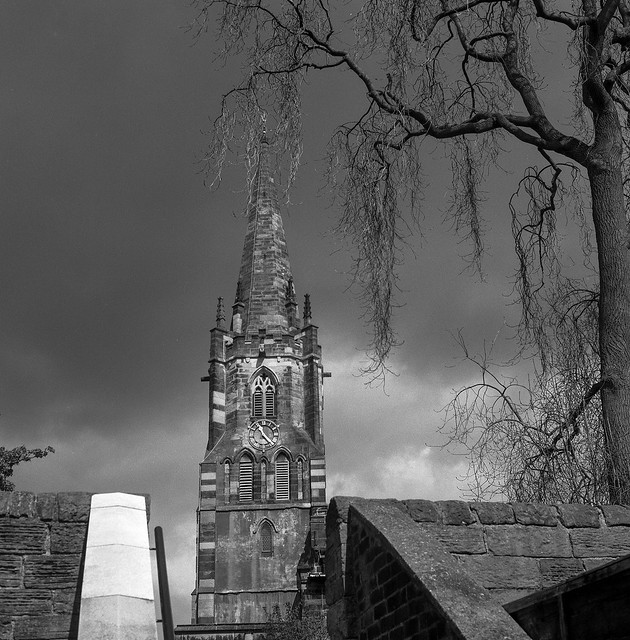
4: Another shot of St. Mary’s steeple.

FILM - St. Mary's steeple

5: The war memorial at Ulley. The light was a little bright, but the highlights are still intact.

FILM - War memorial

6: Just up the road from the memorial these gravestones are just over the wall in the churchyard.

FILM - Resting places

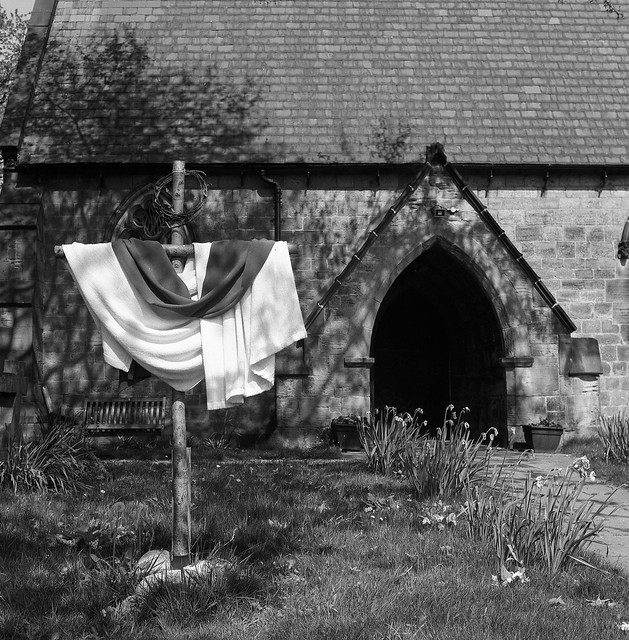
7: These red and white vestements on a wooden cross made for quite a nice subject I thought. I think the sunlight helps.

FILM - Just after Easter

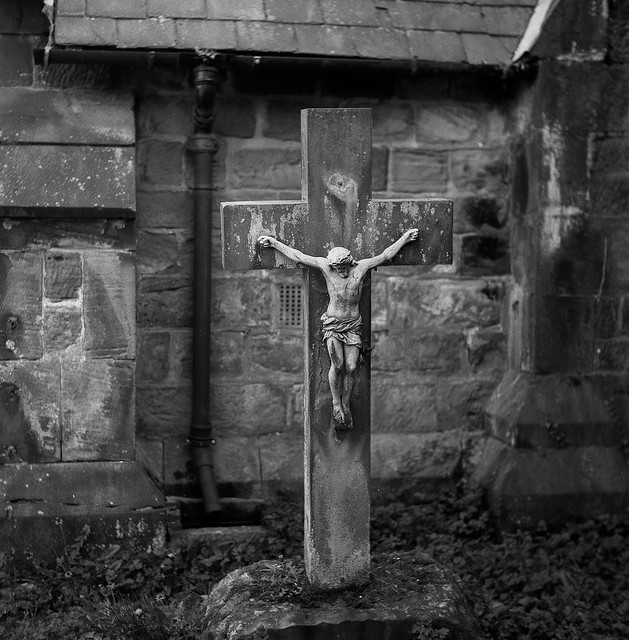
8: Tucked around the back of the church is this stone crucifix. As thei area was shaded by the church I was able to open up the aperture a little more. Not enough to throw the background out of focus, but I wuite like the shot and the figure of Jesus is nice and sharp.

FILM - At the back of the church

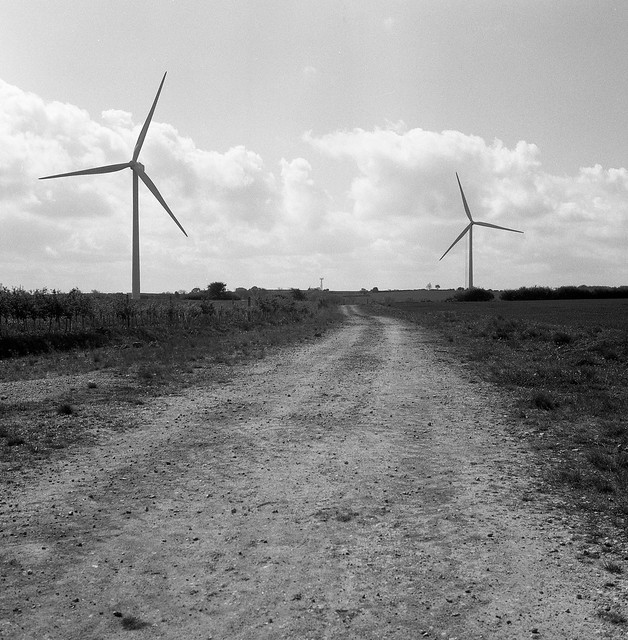
9: There seems to be a feint streak on the negative here, but this is probably my favourite shot from the roll. One of the turbines at Penny Hill wind-farm. The busy M1 / M18 junction is about 100 metres to the right of this location.

FILM - Wind power

10: Another couple of turbines, this time looking south and taken from the same location as the previous shot.

FILM - Penny Hill

Film photography · Photography

First light

This is not my first blog. Oh no. I have started several, only to see them gradually wither on the vine due to inactivity, lack of time, or just a dearth of enthusiasm on my part. Will this one suffer the same fate? We shall see.

This blog is likely to be predominantly about photography, a subject I’ve been interested over a span of many years, although not always without significant breaks in activity, and by no means in any professional capacity. A couple of years ago, I decided to scratch the shutterbug itch that had been gnawing away at me for a while by buying a DSLR camera – something I’d wanted in the past but had never had the money for (or, at times, enough desire for the purchase), and since then the itch has done nothing but intensify. In the two years since acquiring that camera I’ve taken more than double the number of photographs that I’d taken in the preceding TEN years! Not only that, but my understanding of photography has grown at a similarly accelerated rate, taking onboard all manner of technical and artistic considerations that I hadn’t considered (or ignored!) in the past.

Over the past year, a new itch developed, secondary to the first: Film.

I’m approaching my half century now, so I’m no stranger to the use of film, but I am new to using it properly. That is, taking care to understand that there’s more to a photograph than pointing the lens at something and pressing the shutter button. My early use of film was, I assume, akin to that of most people – the camera was a device that you took snapshots with while on holiday, or at birthdays and Christmas etc. Composition was an unknown country, as was light and exposure. As a result, the majority of my photographs from my earlier days featured the usual suspects that blight many a snapshot: people stuck bang-centre in the frame; boring landscapes that looked great in person, but were rendered flat and lifeless by no points of interest in the shot; out of focus friends and family outside the bounds of the lens’ focussing capabilities; white-faced and red-eyed folks blinded by a burst of dazzling pop-up flash, animals that looked exciting in the flesh, but which are rendered as vague blobs of fluff in an acre of foliage because you used a 35mm lens to photograph a rabbit from 50 metres away. … You get the gist, yeah?

So, on that note, many of the posts on here will be about my adventures with film photography. Soaking up the way it looks and, just as importantly, the way it feels to shoot. Digital is taking a bit of a back seat at the moment, although that doesn’t mean I won’t sneak something in every now and then – most likely macro stuff.

So, let’s hope this isn’t the first AND last post of this blog.

194-366 2016 - Old new toy
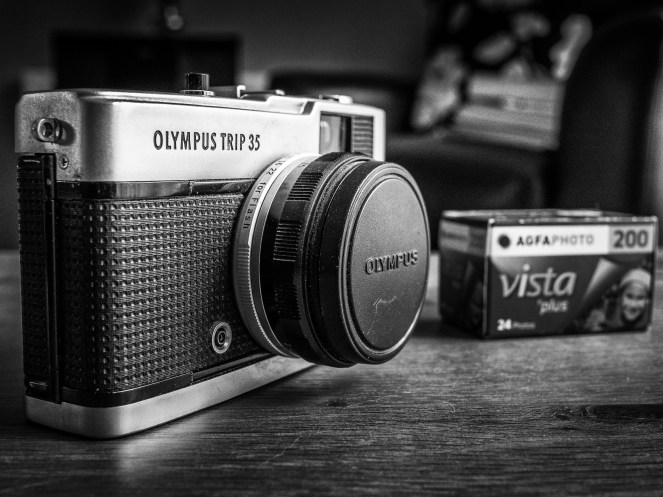
My Olympus Trip 35. I already had one of these (and still have it) that my dad gave me in the 80s, but I discovered the selenium meter had conked out, so I bought a replacement as the first camera to renew my foray into film. This one doesn’t have the nice metal shutter button that my dad’s original-model has though, but it does have the benefit of being fully working.