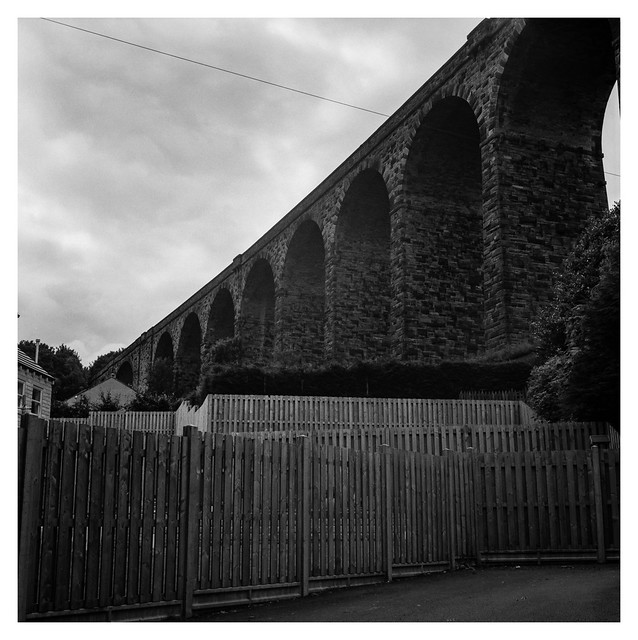
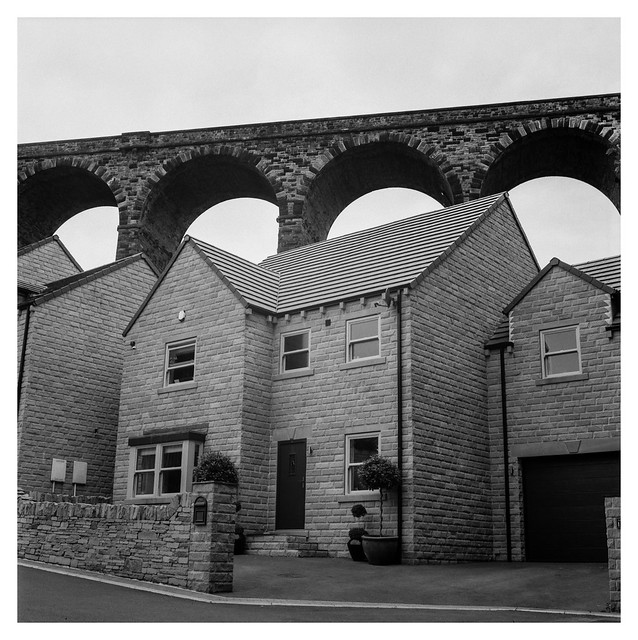
A few more photographs of Emley Moor transmitter, this time made with my Canon Sure Shot Supreme. I bought five rolls of Agfa APX 100 a few weeks ago to see how it looked in 135 format – I’ve shot it once before, but that was 120 (plus it was an expired roll) – and the first roll I’ve developed has been a little hit and miss.
The whole roll looks slightly over-developed, with overly bright results and, while some frames have little grain, others look like they’ve been shot with agrainy high-asa emulsion. I don’t think that this is an exposure issue as the camera used hasn’t suffered in that way on anything else I’ve shot with it, so it’s either the film and developer combination, or something that has occurred as a result of my scanning and post-processing.
I shall be interested to see the results from the next roll when I shoot it.
It’s one of those horribly humind days here today. I had plans of finishing work for the week and getting on with a few things I wanted to do. But then, literally just as I was about to down tools for the day one of my sons infomed me that his internet wasn’t working. All the other network connected devices in the house were operating as expected. Cue the next 1.5 hours of me faffing around trying to find a solution.
At first I thought it might just be a case of resetting the router, but that failed to resolve things. Then I tried swapping his homeplug for one from a working device. No luck there. I tried deleting his PC from the router so it would reconnect. Nada. Eventually I found out that, for some unknown and annoying reason, the plug socket in which his homeplug was inserted was at fault. Despite it looking like it was fine – the homeplug lit up and flickered as though connected, and it had been working perfectly well for years up until today – for some reason it now wasn’t. Connecting the homeplug to another socket six inches away resolved the issue.
And now, here I am, hot, sweaty and pi**ed off at having to start my weekend in this way.
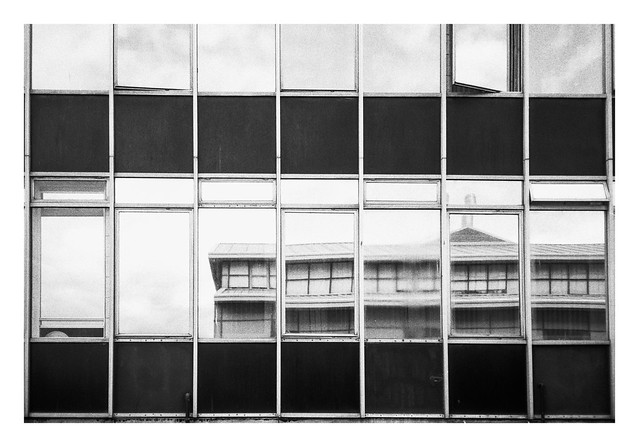
Here are a coiple of photos of windows on office blocks for no real reason other than I uploaded them both to Flickr today.
This telephone box at Shireoaks is slowly being engulfed by ivy. Perhaps it wants to make a call?
It was slightly awkward to make the shot as, firstly the sun disappeared behind the largest cloud in the sky, and then a guy in a van pulled up behind our car and asked if we could move as we were blocking a gate (although there were no signs or markings stating that this wasn’t allowed – it wasn’t a gate that vehicles could pass through, and it could be easily entered be people). As a result I had to grab the shot pretty quickly as soon as the light re-appeared.
I’ve been meaning to visit the Emley Moor television tower for some time now so, while on a week’s leave from work recently, I decided to take the opportunity.
The transmitter is visible from miles around (although not from where I live, it being fully obscured by all the hills around Sheffield) and can easily be seen from the M1 or A1 roads whenever we’ve driven north. As well as it being an impressive sight, it also provides a pang of nostalgia for my childhood where, on days I was up early before television had started for the day, there would be a bombastic start-up broadcast announcing that “Yorkshire Television was broadcasting from the Emley Moor, Belmont and associated transmitters of the Independent Broadcasting Authority“, accompanied by a stirring orchestral piece that gave the impression that a bunch of Spitfires and Lancaster bombers were fighting off an attacking German force or something, so much like a WWII movie theme it sounded.
Although I’ve seen the tower on numerous occasions, this was my first close visit since one time I went to one of my friends’ relatives houses who lived close to it. That would have been the better part of forty years ago! My, how time flies!
It took a little over half-an-hour to drive there (most of the trip being on a fast route up the motorway) and there’s a small car-park beside the road near the transmitter. I’d planned some potential shots in advance from the comfort of my PC by using Google Street View. As the cameras on the Street View cars have super-wide-angle lenses though, it’s difficult to know exactly what your own shots might look like, and unless I moved away a considerable distance from the tower (it’s already quite a distance from the road as-is), it was impossible to fit it into the frame with the 80mm lens on my Yashica Mat 124G, so the first couple of pictures here show only the base of the tower. Well, towers actually – the thin metal mast is a temporary structure that was constructed in 2018 to maintain broadcasts while the main tower undergoes maintenance. The upper sections of the metal mast were lowered into place by helicopter apparently.
The concrete tower is 1,084′ tall and the metal mast 21′ shorter. The concrete tower is the tallest free-standing structure in the United Kingdom and was built in 1969 after the previous mast (the second one built on the site) collapsed due to an accumulation of ice. Although not open to the public, there is a lift that takes people to the equipment area that operates at the top of the tower. It apparently takes seven minutes to reach the top in the lift.
The official name of the structure is The Arquiva Tower, after the company that operates it, but it is commonly known as Emley Moor.
I had to drive further from the tower in order to get the full structure in the frame, and even here I’ve had to correct some very noticeable converging verticals. I like the way it towers over the farmhouse in this shot.
Another wide shot from even further away. I like the cyclist that has just entered the bottom left of the scene. Because of the angle of view, the temporary tower appears to be much taller than the main structure in this picture.
In all it was a nce trip. There isn’t an awful lot to do at the tower given it’s privately operated with no public access, but it’s very impresive to behold from close up.
Yashica Mat 124G & Ilford Delta 400 (@800asa). Ilfotec DD-X 1+4 8 mins @ 20°.
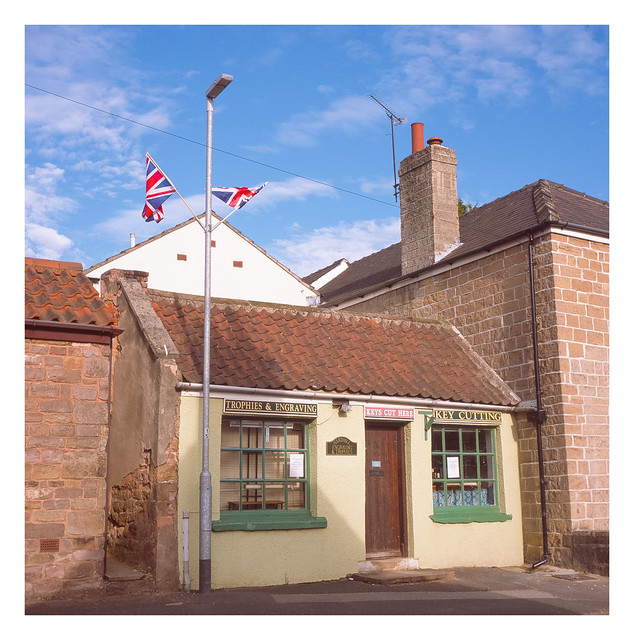
This small trophy and key-cutting shop was bathed in some nice light on the same evening I made the scarecrow photos I posted yesterday.
While I’m having more success scanning E6 film when using Vuescan instead of EpsonScan, I still find I have to tweak the colours somewhat. I think a purple / magenta cast is a factor of the film emulsion when shooting Provia and Velvia, but it still seems to be somewhat overbearing still in my scans, so I tweak the colours to try and get them as close to the original transparencies as I can. I’m mostly successful I think, but I’ve not quite nailed the reds yet.
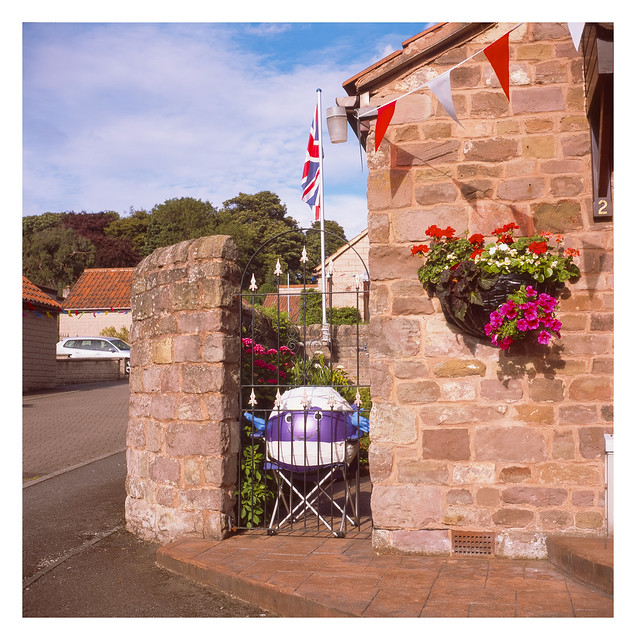
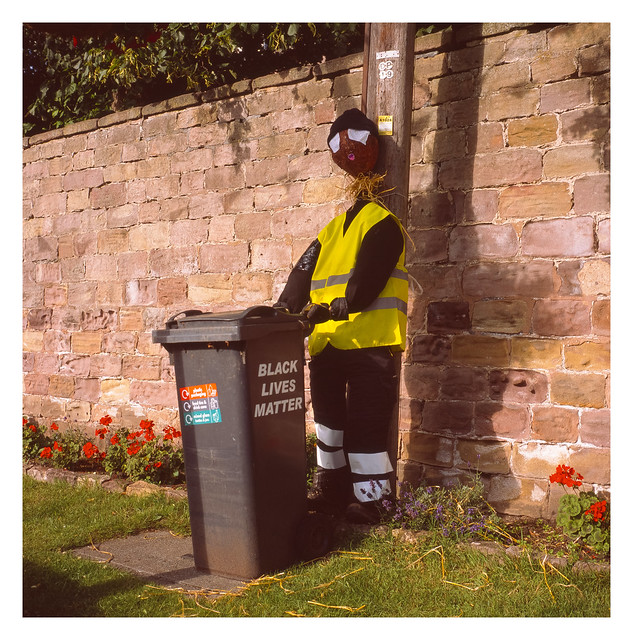
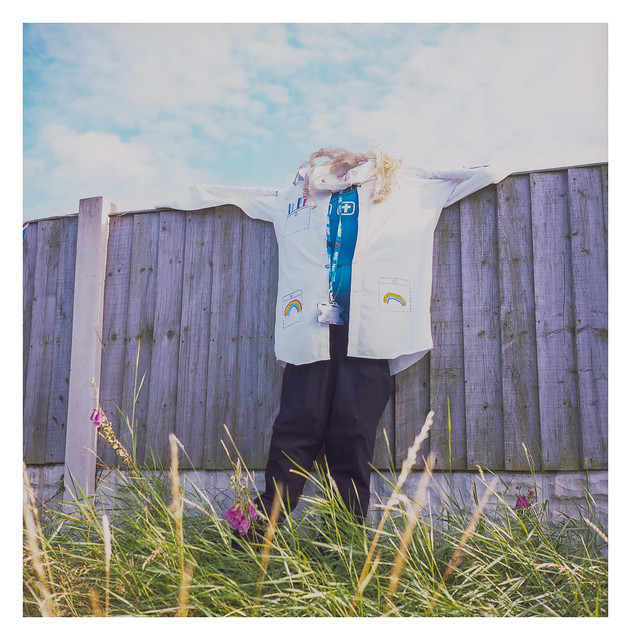
A few weeks ago we drove through the village of Harthill (the same day I made the photos of the person magnet fishing, the house with the pointed roof, and Shireoaks station) and noticed a whole series of “scarecrows” dotted about the place. I call them scarecrows as it seems a reasonable term, although that wasn’t their purpose. They had been installed as part of the village carnival – held virtually for this year – in celebration of key workers during the Covid-19 pandemic.
I didn’t have any film left in the camera or on me when we encountered them, so I drove back out to the village later that afternoon to photograph some of them before they were removed.
Four photographs today that I made at Shireoaks railway station a few weeks ago. My wife popped into a nearby shop, so I decided to finish my roll of HP5+ at the nearby empty station.
It was a hot afternoon and the wrong time to be making photographs. The wrong time if you base everything you do on “rules” that is. It’s generally accepeted that midday is not the best time to make photos. This time of day, particularly in mid-summer, means the sun will be high overhead casting harsh illumination onto scenes. The light will be very bright, with harsh highlights and shadows. But is this always necessarily a bad thing?
It’s all very well seeking out golden hour, when the light can be undoubtedly beautiful, and I’m a great lover of low sunshine and the warm light and long shadows it provides, but sometimes it isn’t possible or desireable to catch these conditions. And what if you want a photograph to depict bright midday conditions?
While these photos are of a mundane scene – a small, modernised, rural railway station devoid of travellers – they record the time I was there perfectly. Maybe there will be better images to be had in different light or circumstances, but these provide a visual record of my memories of the time. and looking of them I can feel the heat of the platform, the smell of warm concrete, the whole sense of a hot day. I’m glad they were taken in the “wrong” light.
I scan all my medium format black & white and reversal images using an Epson V550 flatbed, while 35mm is scanned on a Plustek Opticfilm8100. Ive always left unsharp mask on when scanning 120 film as I thought the results were good. Untill a week or so ago when I was testing out Vuescan.
Vuescan allows image sharpening, but it has a simple on/off checkbox rather than the levels of control afforded by Epsonscan and (moreso) Silverfast so I decided to test a few things to see how the various scanning options on each piece of software compared – plus no sharpening of the scan at all with sharpening applied later in Lightroom.
At first it looked like the sharpened images from Epsonscan had better resolution of detail, but after a lot of scanning, re-scanning, and playing around with the sharpening control in Lightroom I decided otherwise. The sharpened images from Epsonscan were displaying a level of noise and “grit” that I decided I didn’t really like, whereas unsharpened scans from the same software processed in Lightroom were much more appealing, showing a much nicer rendition of detail and grain.
It’s striking how, after years of thinking you had something just how you wanted it, you can all of a sudden change your mind.
I think I’ll stick to Epsonscan for my 120 B&W scans. Vuescan is great, and does a much better job on reversal film, but it lacks the tweakable visial histogram that Epsonscan has, and that makes a big difference to my final results. At least until I find a better way… 🙂
Today’s shot was scanned on the V550 and sharpened in Lightroom. If you look at the full size image on Flickr you might find a black cat that was keeping an eye on me. At least I think it’s a cat. It could possibly be two spots of strategically located dust that look like eyes. Or something more sinister… Eek!
My wife and I went for a walk a few weeks ago and, when it turned out we needed to book to enter our original destination, instead took a walk beside the picturesque section of the Chersterfield Canal that joins Shireoaks and Turnerwood.
On the way up to Turnerwood we passed a man swinging some sort of weight on the end of a cord into the canal and then fishing it back out.
After reaching Turnerwood, we turned around and re-traced our path back along the canal. The man was still there, casting his weight into the water of the canal. My curuosity piqued I asked him what it was he was doing.
It turns out he was “magnet fishing”. This practice involves the use of a powerful neodymium magnet to try and grapple metalic items from the bed of the body of water. Looking it up later I saw reports of people “catching” somewhat less-than-desirable items such as live hand-grenades and unexploded bombs that have lain submerged since the 2nd World War.
At my time of asking the man about it, all he’d found was a 3′ length or rebar though.