I’d estimate I was perhaps halfway up the side of the valley when I made this photo, climbing from the River Derwent at the bottom up to Over Owler Tor – the highest point on my walk that day. The house that can be spied beyond the gate sits on the main Sheffield to Hathersage road.
Thighs aching, I walk My ascent up the valley To my origin
A saw this tree as I was beginning my climb back up the side of the Hope Valley towards where I’d parked the car. A small cluster of Wood Sorrel – sometimes known as Fairy Bells – had found a home in the mossy surface of the tree trunk.
On this April day My eye was drawn to flowers At home on a tree
I had to pause before making the photograph in todays post. The sunlight was getting increasingly bright when I found the tree and the contrasts of light and shadow were pretty strong – perhaps too much? But it caught my eye and I felt there was a picture to be had. I think I’d have ignored it if I’d been shooting digital (and definitely if I was using slide film!), but I had HP5+ in the camera back and I thought it would handle the extremes.
It didn’t let me down and, despite the dynamic range of the scene, there is still detail in both highlights and shadows.
Out of the coner These twists of wooden lightning Spark up from the earth
A lone gate leant against a drystone wall. I’m not sure where it came from – I didn’t see an empty gap – so it’s possibly a backup gate, or maybe one that’s gone feral and escaped its bounds…
In spite of a chain This gate has escaped its place And rests in the sun
This follows on directly from my post a couple of days ago about my walk over the fields near Aston. Another four photos from the middle(ish) section of the walk.
It was dry on the day of the walk and the ground was firm, but there were reminders of how the conditions can change when wet weather has occured, both in the shape of these tractor tracks, and also the signs of footprints in the dried surface of the footpath.
Across another field the path splits – turning right and heading south along the western edge of the mortorway, or left where I walked up an incline to the bridge across the M1. Just before crossing the bridge I made a photo of a farm track where it ran through a stand of trees.
Crossing the motorway in the crisp spring light, I made another picture, this time of the road heading north. A little further up is the junction where the M18 splits to take drivers north-east to Doncaster, Robin Hood Airport, and on to Goole. The M1 itself bends westwards to split the gap between Sheffield and Rotherham, crossing the River Don over Tinsley Viaduct close to the Meadowhall shopping mall, before turning back north to Barnsley, Wakefield and Leeds.
After crossing the motorway, the footpath cut to the right and south towards a nearby farm. The farm had a large open-sided barn which made opportunity for another couple of pictures.
I did make one final photo on this roll of Delta 100 a little further on where a line of poplars framed a nice wooden door and cottage. Sadly the film snapped while loading it onto the spiral and so that frame was lost.
I’ve more photos still to come from this walk, but they’re colour pictures so I’ll post them another day.
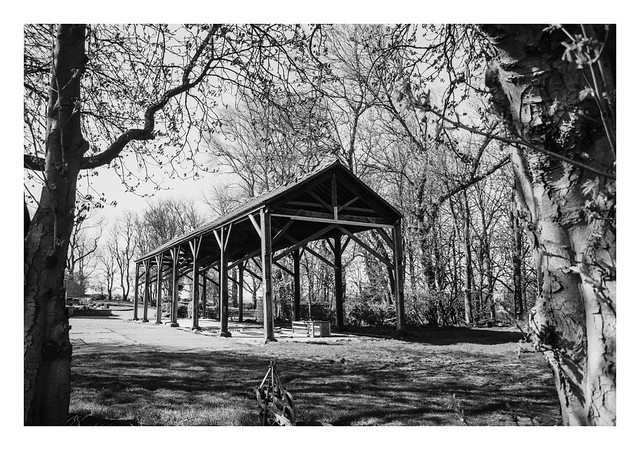
A big wooden barn It’s sides open to the wind Contents blown away?
A week ago I posted a couple of photos of trees stood beside a drystone wall at the edge of Padley Gorge. In that post I mentioned that I had another photo made at the same location yet to come, so here it is today.
A gap in the wall Reveals an excited birch Waving its branches
A couple of weeks ago I went for a walk along a previously unexplored path. The route took me from Aston, a village / district on the easternmost edge of Sheffield, north over the fields towards Penny Hill Wind Farm, then cuting to the east to cross the M1 motorway on a farm bridge. From there, back towards the south, across the M1 at the busy Junction 31 roundabout, and through Aston again to where I began.
There will be a number of photos to come from this walk in the next few days and I shot both black-and-white and colour images. Today’s post features a quartet of photos from the first half of the walk.
This first image is the lane from Aston down to a farm at the bottom of the dip. In the distance, at middle-left, one of the large wind turbines at Penny Hill can be seen peeking above the trees.
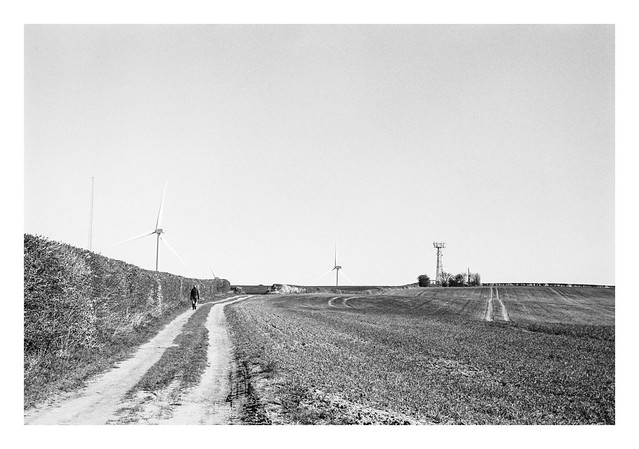
Climbing the hill past the farm up to the top of the ridge brings the turbines into more prominence, as well as a mobile transmitter and another antenna of some sort over on the left of the frame – at night this one can be seen lit with red aircraft warning lights.
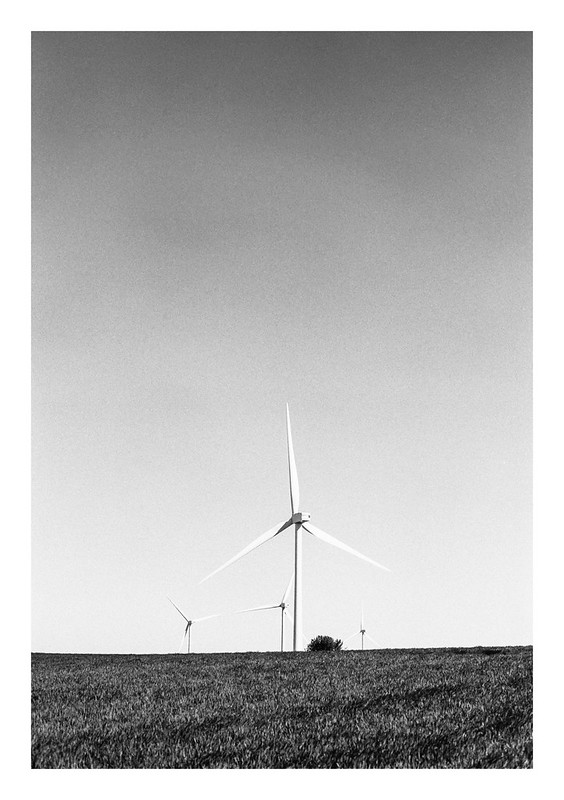
Approaching the mobile tower, the turbines now take prominence along the top of the ridge, although they are still quite some distance away.
Heading east across the fields towards the nearby motorway, I turn and make a photo of the path along which I have walked.
Out across the fields Feeling the bite of the air Crisp and cold and bright
I used to live not too far from Orgreave when I was younger and still lived at home with my parents. Orgreave was the site of a coal mine and coking plant and was a location made infamous when, during the 1984-84 UK miner’s strike, it was the site of clashes betweek striking miners and police – an event that bacame known as the Battle of Orgreave.
Some of my friends witnessed the events that took place, watching from the vantage point of the railway bridge above where the clashes took place. I missed it all by dint of me being on a week-long school trip.
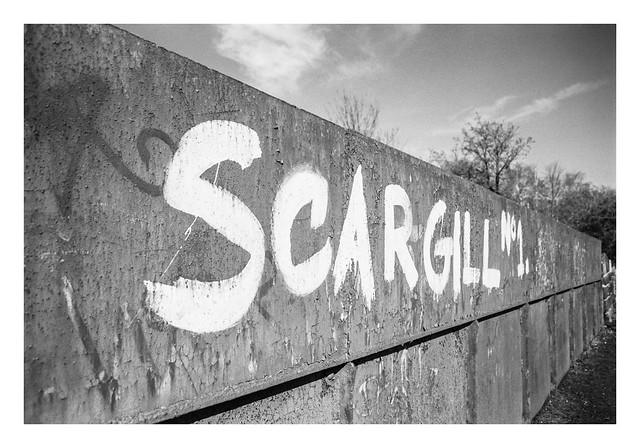
During the whole period of the miner’s strike, a variety of industial action took place across the coalfields of the UK, and graffiti appeared in support of the striking miners. So it was with some amazement to find a few weeks ago, while out for a walk with my dad, that some of the graffiti I remembered seeing back when I was a teenager is still present and highly legible.
If anyone could be said to be at the head of the conflicting sides during the dispute, then it would have to be Margaret Thatcher, then UK Prime Minister and leader of the Conservative Party – also known a The Tories – for the government, and Arthur Scargill, leader of the powerful National Union of Mineworkers (NUM). It is these opposing forces celebrated and denounced in graffiti form here.
I’m not sure what paint was used, but it has certainly stood the test of time!
Back when we were young Youthful adventures happened In places like this
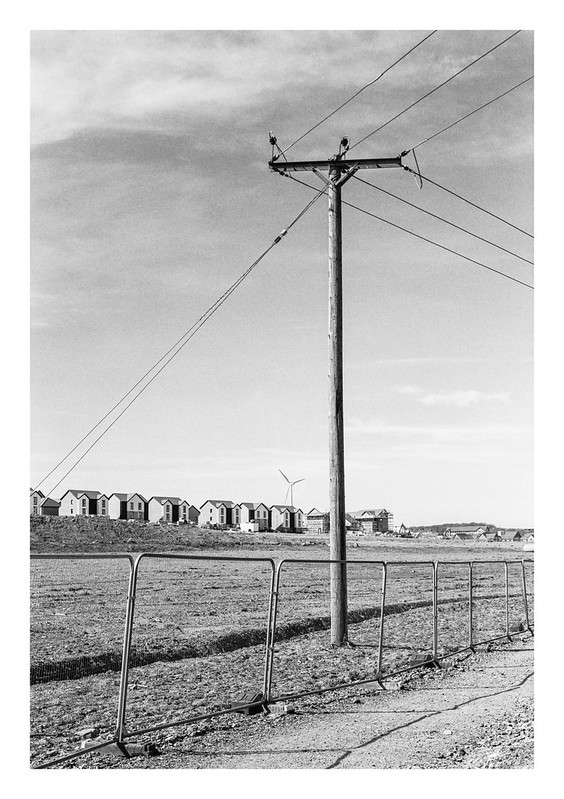
In 1975 an exhibition named New Topographics: Photographs of a Man-Altered Landscape was held in the International Museum of Photography in New York City. It featured works by a number of photographers – the Americans Robert Adams, Lewis Baltz, Joe Deal, Frank Gohlke, Nicholas Nixon, John Schott, Stephen Shore, and Henry Wessel, Jr., and the German couple Bernd and Hilla Becher. Each photographer exhibited 10 photographs.
New Topographics presented a different way of photographing landscapes, eschewing the traditional natural environments and instead presenting images of scenes with a clear human footprint, such as industry, suburbia, gas stations, parking lots and the like.
While I only came across the term in recent years, and at no point set out to be a “new topographer”, it’s clear that many of my photographs fall into the style. I’ve no doubt found influence in the works of photographers who were in turn influenced by the works of the artists presented in the original exhibition, although of the ten, I only have photobooks by Stephen Shore (though there are undoubtedly works by the others collected in other books in my collection).
It’s a style that doesn’t appeal to all. For many, the subjects of such photographs are ruinous blots on the landscape, detracting and imposing on the traditional bucolic scenes more often considered as landscape photography. But I have a place in my heart for both.
Grass fields and blue lakes Overlooked by new homes It was once a mine
“Spooky Gang” reads this partially complete graffiti on a concrete barrier beside the River Rother. In the background, up on the hill, Treeton church looks down upon the scene.
Down by the river On concrete blocks is written Spooky graffiti