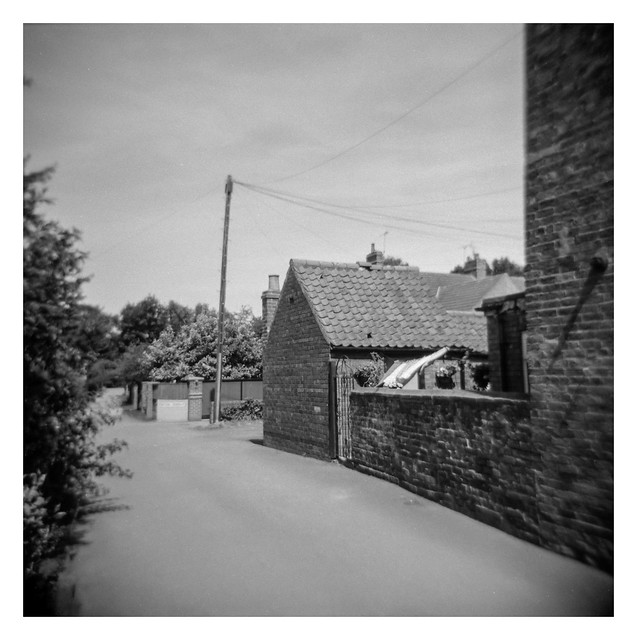
I was going to post different photos and maybe write a longer piece today but my broken ankle is aching and I don’t want to be sat at the PC any longer than I have to.
The picture I’ve chosen instead was taken while walking to the railway station about a month ago on one of the hottest days the country has ever faced (since records began, at least). The following day was even hotter, breaking the aforementioned records in more than one location.
The day was already very hot even at the time I made this picture, sometime between 7 and 8am, but the scene caught my eye and so I stopped momentarily to take the shot.
Olympus Trip 35 & Kodak Colorplus. Lab developed. Home scanned and converted with Negative Lab Pro.
A few days ago, after I’d broken my ankle, I wondered if I might need to ration out the photos I upload given that I might not be able to go out and make more for a few weeks. As a result I uploaded some photos that I might have otherwise left on my hard drive. One of the photos was the one published here today.
For some bizarre reason, it’s managed to be selcted for Flickr’s Explore selection. I posted about my thoughts on which of my pictures are selected for Explore in this post a few weeks ago. My thoughts on this picture are much the same. I generally post a lot of photos to Flickr and yet it always seems to be the ones that are what I’d consider less sucessfull that seem to be picked to go into Explore. Perhaps it’s just mye eye? Maybe everyone else sees this as some sort of masterpiece of subject, light and composition? I suspect not though, and it’s just that the Flickr Explore algorithm is inscrutable.
Another set of photo’s of All Saint’s Chapel at Steetley. These were all taken on the same visit when I shot some pictures with my Olympus 35 RC. If I had to choose, despite liking black and white photos , I think that in this case the colour images are the better set. That’s not to say I don’t like these, but I don’t think they hang together as cohesively. Some of the individual frames are also identical compositions to the 35 RC shots but, again, don’t really work as well I don’t think.
The Holga is a great camera and one which I usually really enjoy my results from, but I don’t think this set is amongst the better ones. I’m sure I will do better next time.
Walking through Birmingham a couple of months ago, I passed through this open space on the way to my destination. The modern tower rearing up above the treeline was quite striking, I thought, so I made the picture. It’s got several layers to it: the foreground grass, the people, the trees, and then the rising architecture beyond, which I though looked interesting.
As I mentioned in my last, somewhay concise, post, I suffered an injury yesterday. A broken ankle to be precise.
It was the first of five days leave I have from work (or seven including the weekend) and I’d taken a trip to Manchester with my wife and her sister. They were off to see a show while I planned to just wander around the city taking pictures. And all was going to plan for several hours. I visited Real Camera to have a browse (and ended up buying a couple of rolls of expired slide film, because, of course, I really need more film to add to the already packed drawer that I’ve commandeered in the freezer), had some passport photos made in the old-style analogue photo booth in the Fred Aldous store (not for my actual passport, but just because I could. The photos are now stuck on the side of the fridge along with loads on Instap pictures). I treat myself to a nice burger and fries for my lunch and, of course, I took pictures. I had a couple of cameras on me – my Olympus 35 RC loaded with one of my two remaining rolls of Portra 800, and my Canon Z135 compact containing some Ilford HP5+.
After wandering around for a few hours I decided to visit the art gallery an it was when I left the gallery that disaster struck. Just outside the main entrance, down a short flight of steps, there were some benches in the shade of the building. Thinking it would be nice to take the weight off for a few minutes I headed down and, as I stepped down the bottom step my right foot twisted awkwardly beneath me with a distinctive snappining sound.
I had an immediate sickening sense of dread and planted myself straight on the bench to take the weight off my legs. There was no actual pain as such, just an odd, numb tingling sensation, the sort you get if you bang your elbow, so I decided to stand up and see how bad it was. Luckily I was able to bear weight and, after messaging my wife to tell her what had happened and that I was taking an ealier train home, I set off limping back to the railway station. Walking was awkward but not especially painful and I managed to get to the station without issue. Unfortunately the next train was cancelled so I had to wait around for over half-an-hour for the next train, which I rather not have had to do, but I guess that’s life (and my luck).
When I got back to Sheffield I took a taxi from the station to the Accident & Emergency department where I spent around four hours waithing for x-rays and to speak with the nurse about the prognosis. I managed to buy myself an actual analog newspaper from the station before getting the taxi as I suspected I might be in the hospital for a while and my phone battery wouldn’t last out. It was a good decision and I read the paper front-to-back while I waited to be seen by various people.
The x-rays showed I had broken a fragment of bone from the bottom of my fibula. While this is painful, I was told that it would have been worse had the break occurred further up the bone close to where the tibula meets the bones of my foot as it would likley have restricted my mobility more severerly and would take longer to heal. The injury I have should be healed within four-to-six weeks, and I was given a large plastic “walking boot” to wear if I need to go out. Thankfully, there is little to no pain while I’m at rest, and I was able to sleep perfectly well last night. The ankle feels sore while I walk about, but again not too bad, and I can move it around quite freely, so I guess I should count my lucky stars that it wasn’t worse than it is.
I think my main upset is that it’s kinda ruined my days off – I had things planned that I’m now unable to do because, while I need to use the ankle to encourage it to heal, this probably doesn’t stretch to full days out on my feet. I also can’t drive for a while, so I’m at the mercy of the goodwill of others if I want to go somewhere. My planned trips out into the Peak district this week, and to Lincoln Steam Rally the following weekend (the first time it has been on in three years) have fallen by the wayside, so I’m frustrated that the opportunity to photograph heather while it’s in bloom, or see the vintage vehicles at the rally will now have to wait another year. There are worse things in life though, so maybe I’ll just count my blessings and enjoy the next fews days away from work by watching TV, reading books, and playing videogames with the spare time I’ve got. At least I have a good excuse for avoiding chores!
I’ve got four full rolls of 35mm film that I’ve yet to upload (or, in some cases, scan), including the roll of Porta 800 from yesterday that I almost finished in Manchester (but ended up using the last two frames photographing some hospital buildings while waiting for my wife to pick me up). So I should be able to feed the blog until I’m back on my feet at least.
Finally, today’s picture of a chair in a shady spot under a tree looks like just the place for a chap with the busted ankle. Maybe with a cold beverage. If only this were my back garden and not in a churchyard several miles away, eh? 🙂
A very quick post today as I’ve only just gotten home after a very long day (mostly due to an injury I’ve sustained). I’ll maybe post more details tomorrow, but for now, here’s a mock Tudor house I photographed a few weeks back.
Olympus 35 RC & Kodak Gold 200. Lab developed. Home scanned and converted with Negative Lab Pro.
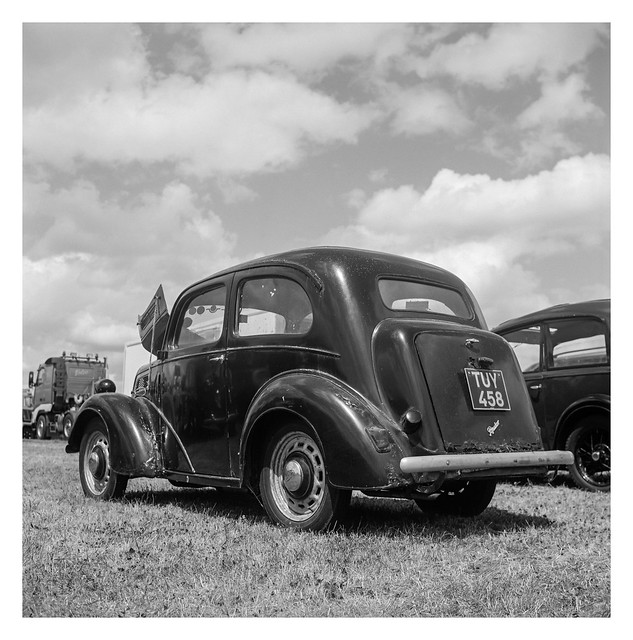
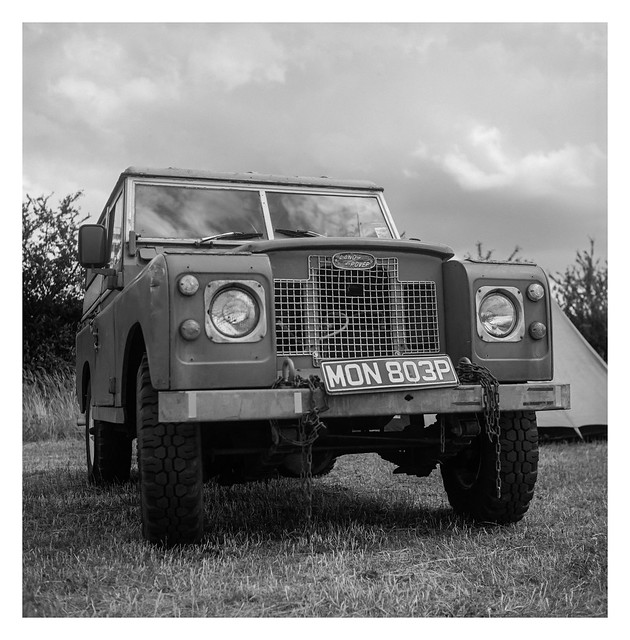
Rather than upload these one-per-day, as I usually do, I thought I’d lump them together in a single post. All were shot with my Yashicamat 124G on Shanghai GP3 film – I like this film a lot. It can occasionally suffer from production problems (I’ve had the backing bleed through on some shots I once took), but it’s quite low cost and produces really nice results.
First, a few pictures of vintage vehicles. The Ford Popular in the second image can also be seen here in colour.
Then a couple of miniature traction engines (and their owners)…
And finally, a trio of full size traction engines…
I’m kinda eking out some of these Kodak Gold photos at present. This is not because I’ve run low on stuff to publish, but because most of the shots I’ve processed recently have been from a visit to a steam rally and I figured I might as well pop those on the blog all at once rather than via my usual drip-feed approach, so those should be up here tomorrow.
In the meantime though, heres a picture of a big white house looking resplendent in the summer sunshine.
Olympus 35 RC & Kodak Gold 200. Lab developed. Home scanned and converted with Negative Lab Pro.
While I was in Hornsea a few weeks back I noticed this man photographing something on the other side of the seawall. To be fair, I knew exactly what he was photographing – the waves crashing against the defences – but I wanted in on this sweet ocean action so, after taking a quick candid, I waited my turn and then made my own picture.
The guy in the photo looked like he had a telephoto attached to his camera, which probably benefited the scene when compared with the fixed 42mm glass on my Olympus 35RC, but the best camera (and lens!) is the one you have with you, right?
Olympus 35 RC & Kodak Gold 200. Lab developed. Home scanned and converted with Negative Lab Pro.
As I’ve stated before on the blog, I’m not an expert when it comes to motorised vehicles, so I can’t provide a huge amount of information on the lorry pictured here today. It was built by Richard Garrett & Sons out of Leiston in Suffolk, and this particular model would have been made possibly quite early in the 20th century, but perhaps a little later in the 1920s.
The thing I’ve learnt today is that an undertype lorry has the engine under the chassis, which had the advantage of allowing a more enclosed cab. Overtype lorries look more akin to a traction engine, with the engine sitting over the chassis, usually in front of the drivers position. This resulted in longer vehicles for the same carrying capacity.