While sat on a bus at some traffic lights, I was surprised to see this guy walk into the middle of the road and start playing his trombone at the traffic. I managed to get a quick photo – maybe not the best picture ever, but at least I caught the moment for posterity. 🙂
Nikon F80, Nikkor 28-80mm f.3.5-5.6 AF-D & Kodak Gold. Lab developed. Home scanned and converted with Negative Lab Pro
I have a bit of a habit of photographing giant ice creams, the big plastic display things that you see outside ice cream parlours and the like, especially in seaside towns. I’ve featured them on this blog on a number of occasions.
So, just to mix it up, here’s a giant ice lolly. I can only imagine the wails of distress form the giant child who dropped it…
Nikon F80, Nikkor 28-80mm f.3.5-5.6 AF-D & Kodak Gold. Lab developed. Home scanned and converted with Negative Lab Pro
On our first day in Malaga, while walking around the port, we saw this cruise ship berthed. The Seabourn Sojourn is chartered and operated by Seabourn Cruise Line and is the flagship of their fleet. She took her maiden voyage in 2010, leaving Greenwich, London and cruised the northern European countries before crossing the Atlantic to cruise the Caribbean and Panama.
Since then, she has carried round-the-world cruises, and also operated between the US and Cuba. In 2020, during a world cruise, she made it as far as Hawaii where she was held in quarantine due to the Covid pandemic, with passengers unable to depart.
The ship has 229 suites and, from a quick glance at the Seabourn website, cruises might be a touch out of my price range except maybe for a very special occasion…
Nikon F80, Nikkor 28-80mm f.3.5-5.6 AF-D & Kodak Gold. Lab developed. Home scanned and converted with Negative Lab Pro
This old building is the Chapel of the port of Malaga, and is tucked away between modern shops and restaurants at the side of the port. It was built in 1531 apparently.
Nikon F80, Nikkor 28-80mm f.3.5-5.6 AF-D & Kodak Gold. Lab developed. Home scanned and converted with Negative Lab Pro
A mini theme today, with a couple of shots of trees at the Port of Malaga. That cruise ship in the background? Yeah, you’ll be seeing more of that soon.
Nikon F80, Nikkor 28-80mm f.3.5-5.6 AF-D & Kodak Gold. Lab developed. Home scanned and converted with Negative Lab Pro
Following on from yesterday’s post about typos, after a bit of faffing about in Firefox I now seem to have a working spell checker when typing blog posts. Hopefully, from now on, there will be fewer spelling errors in my posts!
I have to thank adventurepdx for suggesting that Chrome has a spellcheck feature which might need to be switched on. While I currently use Firefox rather than Chrome, his comment pushed me to see if that browser had a similar feature and if it also needed to be activated, and it did! I now get a bunch of easy-to-spot wiggly lines beneath my many typos, making them much easier to spot and fix.
So, thanks adventurepdx for throwing me a life ring. 🙂
Nikon F80, Nikkor 28-80mm f.3.5-5.6 AF-D & Kodak Gold. Lab developed. Home scanned and converted with Negative Lab Pro
One of my pet peeves with writing this blog on WordPress is the number of typos that end up in my posts. It’s kinda embarrassing to see them because, generally speaking, I can spell words correctly. Sure, I might have to look an unusual word up sometimes, but most of the time I’m just fine.
So off I’ll go, clacking away on the keyboard, the words falling onto the screen while, unbeknownst to me, I’m actually sprinkling a load of misspelt crap in there at frequent intervals. What makes things worse is that I often don’t notice this until after I submit the post, sometimes only when I re-read a much earlier post, whereupon I feel duty bound to correct them and hide my shame.
Back when I first started this blog, WordPress had a very handy spellchecker built into the editor which would highlight any errors. But then, for reasons unknown, they removed it. I guess there might still be spellcheckers available as plug-ins, but last time I looked (admittedly quite a long time ago) there were only premium versions available. Maybe I’ll look again.
Anyway, I can only apologise for my lack of editorial care and make some sort of half-hearted promise that I’ll try to do better in this regard.
I have checked this post carefully for typos. 🙂
The picture today contains no typos. I like the abstract nature of it.
Nikon F80, Nikkor 28-80mm f.3.5-5.6 AF-D & Kodak Gold. Lab developed. Home scanned and converted with Negative Lab Pro
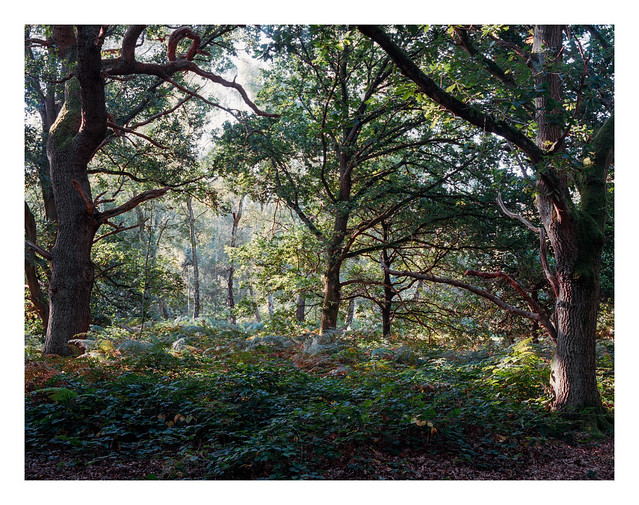
I’ve never visited Sherwood Forest before, despite it being only half-an-hour’s drive from where I live. I’ve visited Clumber Park and it’s surrounding woodland on many occasions though, and I guess that’s all part of the original much larger area of forest.
The trip I took last month was mostly intended to photograph the Major Oak but, if I’m honest, it’s not all that photogenic and, due to the fences that surround it, the compositions are a bit limited. I’m sure that, under good conditions, there are many good photographs to be had, but I feel that the other trees (including many other ancient oaks) withing the forest are perhaps better subjects.
Today I’ve posted a few other pictures from the trip. I think I might try to return in a few weeks when tthe autumn colour is in full effect.
Bronica ETRSi, Zenzanon 75mm f/2.8 PE, & Kodak Ektar. Lab developed, home scanned, and converted with Negative Lab Pro.
The Major Oak is a large and ancient oak tree which resides in Sherwood Forest. It is thought to be in the region of eight-hundred to eleven-hundred years old. It’s trunk is eleven metres in circumference, and it is estimated to weigh twenty-three tonnes. It is named after Major Hayman Rooke (1723-1806), who carried out a survey of trees in the area in 1790.
The tree is perhaps most famous due to its association with Robin Hood who, along with his band of Merry Men, was said to shelter beneath the tree and occasionally hide inside its trunk.
In its old age, not that differently to people, the tree requires some additional support to keep it from taking a fall, and the boughs are supported in multiple places by supports that were first installed in the 1970s, and with chains at the crown of the tree that were placed in the early 20th century.
The tree is quite a tourist attraction and is around fifteen minute’s walk from the Sherwood Forest visitor centre. While the tree itself is fenced off to prevent damage, there are tables and benches in an adjacent clearing where people can sit and admire it. I was there quite early in the day and didn’t see many people apart for the odd dog walker and jogger, but I was quietly amused whe and ice cream van pulled up from one of the service tracks. I guess the tree is a good place to do business even if you’re not an outlaw!
Bronica ETRSi, Zenzanon 75mm f/2.8 PE and Ilford HP5+. Ilfotec DD-X 1+4 9mins @ 20°.
I was quite please with this picture of West Burton power station. I like the framing, and I’m a fan of industrial subjects in photographs, but most of all – thanks to the position of the clouds when I took the shot – I like the way that some of the cooling towers and some are light, like some massive game of chess or something.
Bronica ETRSi, Zenzanon 75mm f/2.8 PE and Ilford HP5+. Ilfotec DD-X 1+4 9mins @ 20°.





 Steel City Snapper photography