35mm · Film photography · Photography

A Walk With a Camera – Eyam to Stoney Middleton (part 1)

This year (and hopefully more to come) I’m planning on taking a bunch of walks / hikes with a camera. This is not a particularly new idea – I do this all the time already – but my methodology previously has been more based on random choice. Not quite stick a pin in a map, but certainly unguided insofar as points of interest on the walks I chose. Some of these self-directed walks were good and there were plenty of things to see along the way (and it’s always great when you come around a corner to find an interesting scene before you). But I’ve also been conscious that I might have been missing out on stuff that I would have seen if I’d only gone by a different route.

So the hikes I’m undertaking this year are based on guidebooks, or the recommended walks that can be found in the Ordnance Survey (OS) app that I subscribe to. Some of the walks are quite short – just a few miles – while others are longer, although none are too taxing, and nothing that can’t be achieved within the course of a day out.

I’ve also started to purchase some equipment for these outings. I’ve discovered how uncomfortable the wrong clothing can be in the right conditions. I want to be able to keep warm or cool as appropriate, and be able to stay dry in the UK’s changeable weather, so I’ve been investing in some proper outdoor clothing – base-layers, mid-layers, waterproof shells and the like. I’ll probably have to buy more stuff as the conditions change through the year, but at the end I should have a wardrobe of clothing to suit most conditions that I’ll encounter. I’ve also bought a pair of hiking poles. I wondered if these might have been overkill, but the first time I used them they were a godsend.

One thing I want to buy is a good quality backpack. Not necessarily a photography backpack, but one that will serve that purpose as well as giving me space to carry other provisions. Until then I’ll make do with the backpack I already own.

Anyway, this has been a somewhat lengthy preamble. TLDR – I’m going to go for some walks, take pictures along the way, and write about it here. 🙂

The initial hike I chose is the first walk in my OS Peak District Outstanding Circular Walks book: Eyam and Stoney Middleton.

This first walk sits in the “short walks” category of the book, with hikes of less than 2.5 hours (although I don’t think they accounted for photography in those timings 🙂 ). It’s only 3.5 miles, with a height gain of 660 feet (although, to be fair, that gain is pretty much all in one leg-busting uphill section).

The day of the hike was typically British overcast weather. This isn’t the sort of day that inspires photography to be honest, but I’ve also decided hereon that I will make the best of the conditions I have rather than take my usual approach of moaning about it, so it was on this damp and grey day that I arrived in the village of Eyam to begin my walk.

There is evidence of human settlement at Eyam dating back to the Ancient Britons but it was in the 17th century that the village gained fame. In 1666 the Great Plague of London, an outbreak of Bubonic Plague, took place. During the outbreak a bolt of cloth containing infected fleas was delivered to the tailor in Eyam, resulting in a local outbreak of the disease. Although there is some debate about the numbers affected, nearly three hundred villagers are recorded as having lost their lives as a result. A number of measures were introduced by the village to attempt to halt the spread, including a requirement that families isolate and bury their own deceased members. The most important however, was likely the decision to quarantine the entire village to prevent outside transmission. It is this sacrifice that give Eyam its fame.

I began my walk down Church Street, the main road through the village. It’s lined with houses in a variety of styles, from stone built cottages, through to the grand looking Eyam Hall, which now serves as a wedding venue.

Country campervan
Who lives in a house like this?

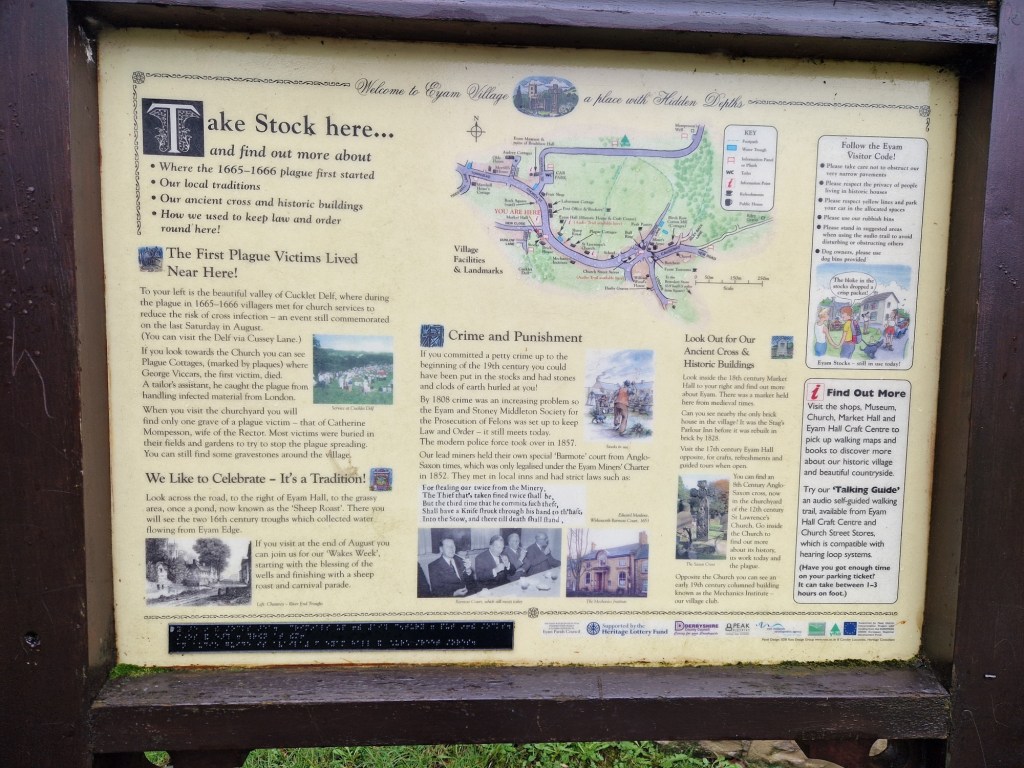
A map, an information board, and a set of stocks sit just to the right of frame in the image above.
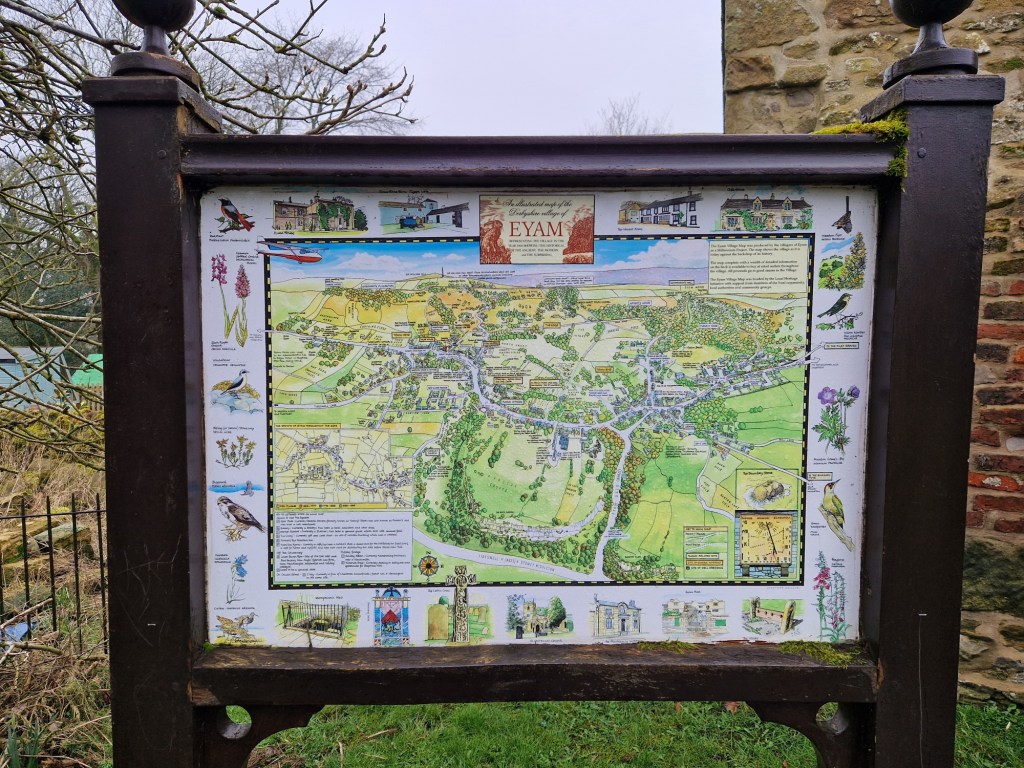
Eyam Hall probably looks nicer in good light, but it’s still an impressive presence on a dull day.

Eyam Hall

A village shop is present and doing business, but what I assume to be the post office was closed.

A local shop for local people
Out of business

The door to the Mechanic’s Institute was open and there was some activities taking place inside (although not mechanics, I don’t think).

Eyam Mechanics Institute

Further down the village I reached the point where I would take a right onto Lydgate and head along the footpath that leads to the neighbouring village of Stoney Middleton.

Lydgate

The footpath was a little muddy on the day, and I was glad of my hiking boots, but it was easy to traverse. Not far out of Eyam I could see the ruin of a farmhouse in the middle of a field.

Gateway to ruin

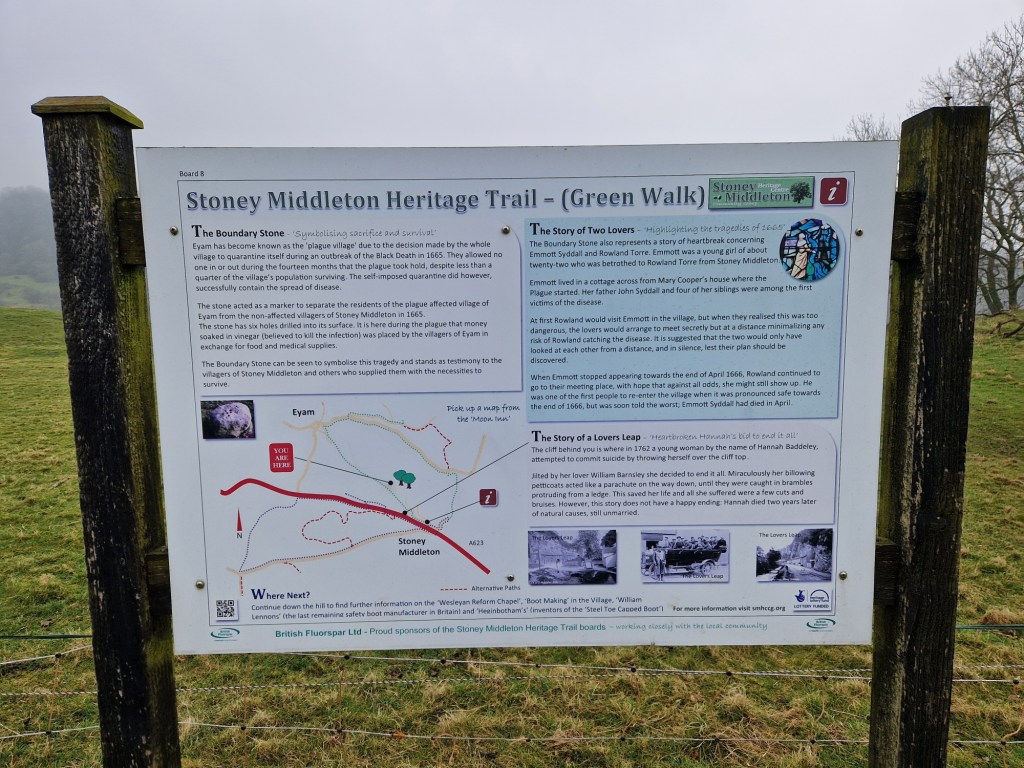
A little further along the track sits the Boundary Stone. This boulder was used to exchange money for goods between the villages of Eyam and Stoney Middleton. There are a number of holes in the top of the stone and these were filled with vinegar in order to sterilise the money.

The Boundary Stone

There are a number of information boards present along this footpath, denoted as the Stoney Middleton Heritage Trail, which contain interesting facts along with some tragic stories.
As the footpath crests the ridge before a steep descent to Stoney Middleton, a tree had fallen. It’s surprising how little of a tree’s structure is underground sometimes, and this one had it’s work cut out to find purchase for so long in the stony soil.

Fallen

I’ll end this first part of the post with a picture of the path down into Stoney Middleton, which you can just see emerging from the murky day at the bottom.

The path to Stoney Middleton

Olympus XA3 & Ilford HP5+ (@800asa). Ilfotec DD-X 1+4 10mins @ 20°

Taken on 9 March 2024

Film photography · Medium Format · Photography

Expiryment #4: Kodak Portra 400NC (expired 2007)

Despite my hopes and promises of doing one of these posts each month, I seem to have failed miserably when it comes to doing so – the last post in this (very occasional!) series was back in November 2022.

I did shoot another roll of expired film last summer but I was unhappy with the results and ended up converting the pictures to black and white. While they looks pretty nice after the conversion, these posts are aimed to be about keeping to the original results from the film used with a minimum of post processing. Converting to monochrome was a step too far.

No such worries with the next roll though, some 120 format Kodak Portra 400NC that expired in 2007. 2007 doesn’t feel like that long ago but it was prior to the global financial crisis and is fast approaching twenty years ago!

Portra 400NC was discontinued by Kodak in 2010, when the current range of Porta films (160, 400, and 800) was introduced. Kodaks description of 400NC was: “Offers fine grain, low contrast, and colors and skin tones that look real and natural in a variety of lighting situations.” There is a brochure online on Kodak’s website which covers the full rang of (as was) Portra films from this period. There’s a strong hint that it was aiming for the wedding photography market…

I don’t photograph weddings and, even if I did, there’s no way I’d risk a seventeen year old expired roll of unknown provenance on such a once-in-a-lifetime event. For the sort of subjects I normally photograph however, I was willing to take the risk.

Despite the limited number of shots, I decided to shoot it with my Fujica GW690 6×9 medium format camera, giving me just eight potential pictures from the roll. The first outing was to my favourite seaside haunt of Mablethorpe. Normally when I visit Mablethorpe I will wander around all day making photographs. However, this year, I took my dad along for a day out, so knew from the outset that I wouldn’t be shooting as much. In the even I only used three frames on this outing, and one of those was a misfire when the camera was in my bag! I’ve since started to avoid winding the film in the GW690 after taking a shot to prevent this expensive mistake from reoccurring. Unfortunately, the Mk I GW690 that I own doesn’t have the shutter button lock that the later models do.

So the first two shots from the roll were of beach chalets / huts that stand along the beach promenade. The weather on the day was bright, but a layer of thin high-level cloud, robbed the light of contrast. Nevertheless, for outdated film the results were pretty good.

Seaside life
Compact and bijou

The second batch of shots – the remaining five on the roll – were shot one misty morning at Rother Valley Country Park. While I find the park a little uninspiring due to over-familiarity, cold misty morning usually provide some nice pictures, and this occasion bore that out.

The first shot is a little dull perhaps, but the light was nice. It’s just a suburban street I walked on my way to the park. You can just make out the mist hanging over where the lake is in the middle of the shot though. There’s a line of pylons that run between the houses and the park. The towers are out of frame, but the powerlines themselves can be seen.

Early in suburbia

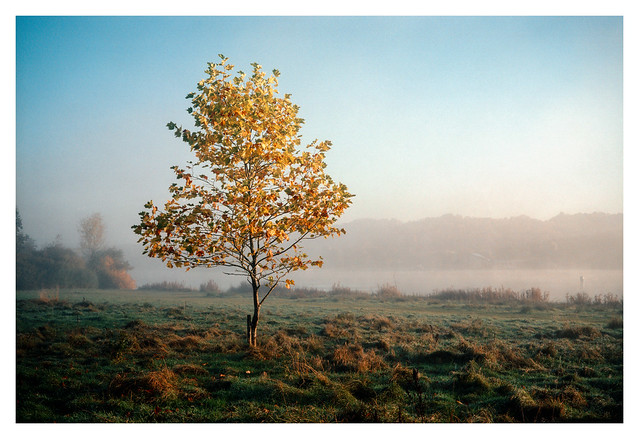
The next shot is one of my favourites from last year, a beautifully autumnal scene of a small maple tree, it’s leaves turning but not yet fallen, nicely separated from the background by the mist. I’m not sure if the colours are true to life, but they look gorgeous, so I’ll take that as a win.

This year's autumn

The mist was already burning off under the gaze of the morning sunshine when I took the next picture. A simple landscape scene of the lake with the boating centre on the far bank. There’s still enough mist left to provide some pleasant atmosphere to the photo though.

Lakeside

I took another photo very similar to the one above which had a couple of swans in the frame, but the one above is the best, I think.

The last shot is another lone tree, but this time I shot directly into the light. It’s not as good as the other tree picture, but I do like the way the tufts of dew and cobweb covered grass are illuminated at the bottom of the frame. The lens of the GW690 shows no signs of flare, even in this challenging scene.

Backlit in the cobwebbed grass

So, apart from a wasted shot, this was another expired film success. When I shoot old colour film I’m not really expecting accurate colours, just pleasing ones, and this delivered on that.

Overall outcome: Success!

Expiriment #5 coming soon (Yeah, I know…)…

Fujica GW690, Kodak Portra 400NC (expired 2007). Shot at 160asa and lab developed for box speed. Home scanned and converted with Negative Lab Pro.

Taken on 30 September and 25 October 2023

Other posts in the Expiriment series:

Expiriment #1: Ilford HP5 (expired 1982)

Expiriment #2: Kodacolor VR400 (expired 1989)

Expiriment #3: Truprint FG+ (expired 2003)

35mm · Film photography · Photography

Morris Minor in a car park

Another delve into the archives and another shot that I haven’t posted before (or I can’t find it, if I have).

I remember this being quite an unexpected find – a vintage Morris Minor sat all on its lonesome on the top deck of a multi-story car park. It was a chance encounter too as I only climbed to the top floor to see if there might be a decent view to be had from up there.

I’ve been to Photo North in Leeds today and didn’t get back until early evening, which is why I’m dipping into the archives as it somehow seemed easier than writing about one of my more recent pictures.

Morris in a pen

Minolta SRT 101b, Rokkor 50mm f/1.7 & Kodak Tri-X (expired circa 2000-ish). Ilfotec DD-X 1+4 8mins @ 20°

Taken on 31 August 2020

35mm · Film photography · Photography

Guitar

I Have a couple of longer posts to come about a walk I took with my camera, but I need to write them first. So, today, let’s have a dig into the archive for something that I haven’t posted here before (I hope!)

I quite like this shot, and I’m not sure why I haven’t shown it before. It’s not perfect – the framing could be better, and use of a polarising filter would have removed the reflections, but the guitar against the dark background is quite appealing, I think.

A place for broken guitars

Minolta SRT 101b, Rokkor 50mm f/1.7 & Kodak Tri-X (expired circa 2000-ish). Ilfotec DD-X 1+4 8mins @ 20°

Taken on 31 August 2020

35mm · Film photography · Photography

Outside the scrapyard

From the footbridge across the railway line, the space outside the scrapyard can look a little like a lunar landscape, or a cratered battlefield. It’s very much an industrial space with a scattering of industrial skips and a gritty, oily surface with a scent of oil and chemicals. Beyond it is a second railway bridge that leads to the northern end of Rother Valley Country Park, and there is a footpath that skirts the edge of the scrapyard and this open area (or, as the figure in the first picture is doing, you can just cut the corner).

It’s not a pretty place, but there are photographs to be had. The skips catch the light and, when the angle is right, can be contrasty subjects with interesting shadows.

The puddles, when it has been raining, also offer opportunities to find reflections of the objects present and the surrounding structures.

Lunar surface
Two skips and a tyre
Pylon puddle

Olympus XA3 & Ilford HP5+ (@800asa). Ilfotec DD-X 1+4 10mins @ 20°

Taken on 3 March 2024

35mm · Film photography · Photography

Two bridges

I took the following two pictures while walking to Woodhouse Washlands where I shot the photos that I’ve shared here during the past week.

The first bridge crosses the railway line that comes from Sheffield, via Darnall and Woodhouse, towards Chesterfield and onward destinations. A scrapyard sits just at the other side of the bridge, along with footpaths to Rotherham Road, Rother Valley Country Park, plus some other trails through the floodplain.

Just to the right of the the bridge is a somewhat pointless bike gate. That aint stopping anyone!

Railway bridge (and pointless bike gate)

The second is of the railway bridge which carries the stretch of track running between Rotherham and Chersterfield across the River Rother (from which Rotherham takes its name, translating from the Old English Homestead on the Rother). This line joins the line crossed by the footbridge pictured above a little further south. It’s not obvious from the picture, but the river bank in the foreground was quite slick and muddy!

From here I followed the course of the river downstream through the section of floodplain that lies south of the Mosborough Bypass (which marks the southern edge of Woodhouse Washlands). Before the bypass, I had to cross Ochre Dyke and Rotherham Road. The dyke is spanned by a small bridge. Or it normally is…

On this day I found that the bridge had been removed and the foundations for a replacement were now in evidence. The water looked jumpable, but I thought it might be prudent to walk around. Unfortunately, following a lot of rainfall, the route was blocked by swampy, submerged grass, and I would have had to make a significant backtrack to get around. So I decided to risk the jump after all.

Despite not looking too bad, it was quite a hard landing on the far bank, resulting in a muddy knee, a hand prickled on a bramble, and a pain in the joint just above my knee that has flared up on occasion ever since. I’m no longer young, it seems…

Arches

Olympus XA3 & Ilford HP5+ (@800asa). Ilfotec DD-X 1+4 10mins @ 20°

Taken on 3 March 2024

35mm · Film photography · Photography

Circus Circus

I went to the cinema a few weeks back (to see Dune Part II, I think it was). In one of the car-parks at the shopping mall where the cinema resides, was a circus. The sky was heavy with dark cloud, but the sun was shining through and illuminating things nicely. I’m glad I had the XA3 in my pocket.

Circus-2
Circus
Big top
Circus lorry

Olympus XA3 & Ilford HP5+ (@800asa). Ilfotec DD-X 1+4 10mins @ 20°

Taken on 6 March 2024

Film photography · Medium Format · Photography

Flood control

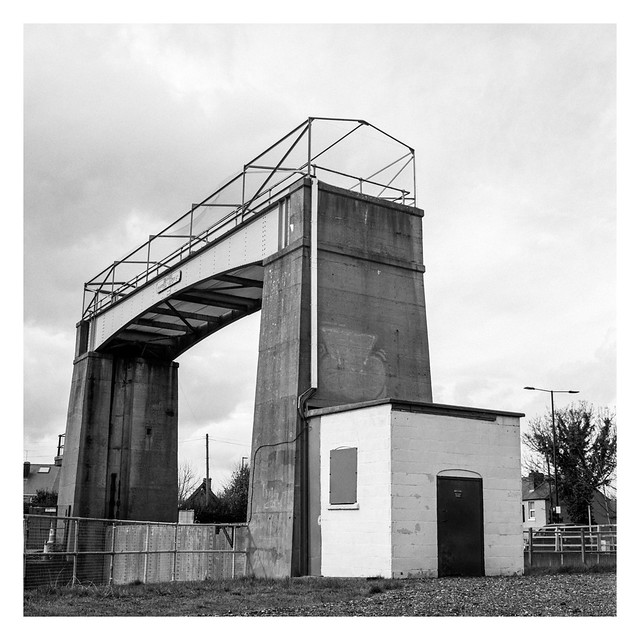
The Woodhouse Mill regulator stands at the northern end of Woodhouse Washlands beside the B6200 Retford Road. It has been there for as long as I remember – unsurprising as it was commissioned a decade before I was born!

Although I know it has been used on many occasions, causing the expected flooding of the washlands, I’ve never actually seen it in use.

Woodhouse Mill flood barrier
Flood barrier

Yashica Mat 124G & Kodak Tri-X. Ilfotec DD-X 1+4 8mins @ 20°

Taken on 3 March 2024

Film photography · Medium Format · Photography

Raised manhole

There are a number of these raised manhole covers to be found on Woodhouse Washlands. They stand, like strange tumuli atop their mounds of grassy earth.

I expect they are raised to prevent them from flooding if the washland is submerged when the river is high as they probable provide access to sewage pipes – there is a sewage treatment works at the northern edge of the wetlands, just across the B6200 road that marks the boundary.

Manhole

Yashica Mat 124G & Kodak Tri-X. Ilfotec DD-X 1+4 8mins @ 20°

Taken on 3 March 2024

Film photography · Medium Format · Photography

Washlands when wet

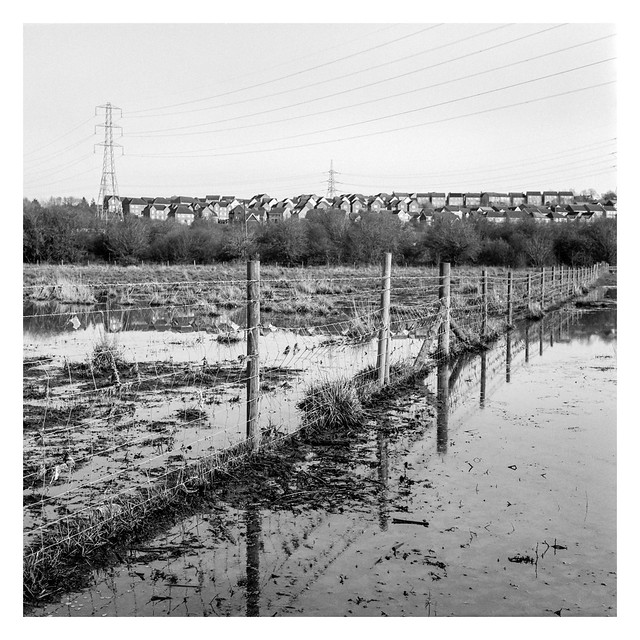
One of the interesting features about Woodhouse Washlands is how it can change noticeable when flooded. As it’s a floodplain (with a flood barrier at the northern end to boot), this is to be expected and, to be honest, it becomes somewhat challenging to navigate without getting wet and muddy in these circumstances. It does allow for different photographs to be found though. What were previously just grassy fields, now become ponds.

Reeds
Fence and flood

Yashica Mat 124G & Kodak Tri-X. Ilfotec DD-X 1+4 8mins @ 20°

Taken on 3 March 2024