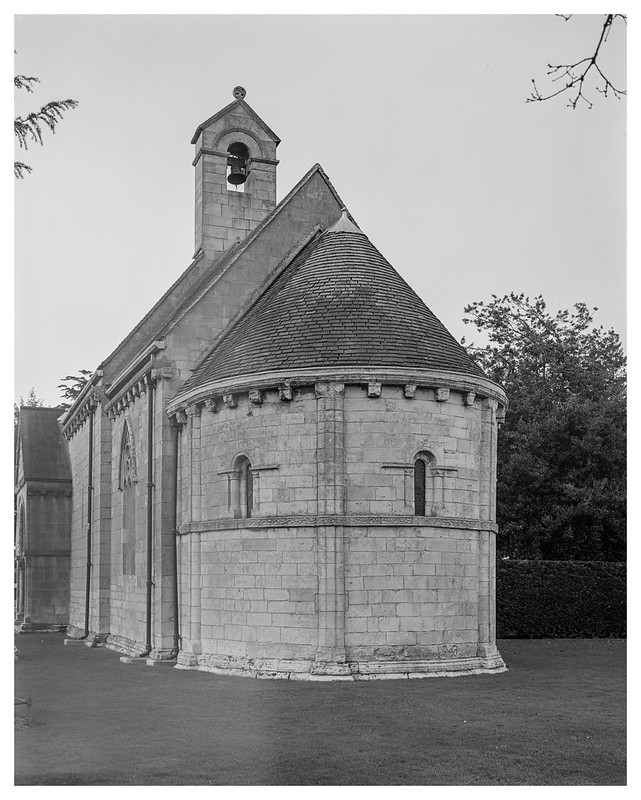
This ruined structure sits beside the River Moss in Eckington near Sheffield. The main flow of the river runs to the right of the scene in the picture but there’s also a separate stream that runs behind the building which leads me to think it was a water mill of some kind. The building is depicted on Ordnance Survey maps but not named. There are the remains of mineworking in the area, with a pumphouse (named the Seldom Seen Pumphouse) a little further up the valley, so it’s possible that this building may have formed part of those activities.
Since taking posession of my Chroma 4×5 camera I’ve exposed 12 sheets of film. Two of those were complete write offs due to, ahem, user error. Some shots have looked good – not necessarily artistically so, but technicaly pleasing (at least given my current level of skill with the camera) – but quite a few have been beset by light leaks. When I developed four sheets the other day I was disappointed to see more light leaks. Two of the shots had significant leaks, the other two less noticeable, but the defect looked very similar to some of the other frames that had suffered similar problems.
My initial though was that there was a problem with one of my film holders, but on sharing the images with some other large format users, they all pointed to the problem being caused by light getting behing the film holder when it was in the camera. One way to test for this is to put a light source inside the camera in a darkened room and see if light can be seen escaping. By doing this I was able to see than no light was getting out behind the film holder but that there was a very fine strip of light visible where the camera back is magnetically attached to the body. The gap appears to be razor thin – a small fraction of a millimetre – but if light is getting out, then light can get in too.
I wondered about trying to finagle a fix – maybe putting strips of tape in the join, or maybe a shaped piece of light seal foam, but then I contacted the guy who manufactures the camera and he very kindly offered to take a look at it and see if he can identify the problem. So I now need to find a sutable carton, pack it up, and get it shipped across to him for a (hopefully!) fix.
So I’ll be shooting smaller formats for now. Not that I was ever going to give up on 135 and 120 in any case.
Here are two of the affected shots from the Chroma. The first one has little impact, but that’s possibly due to the busier nature of the scene. The second shot shows the light leak more noticeably on the left side of the image. Other shots are much more badly affected than these. While I’m disappointed by the light leaks, I can at least see than my ability to get things properly focused with the camera and its movements is improving. Still work to do, but much improved on before. I’m also impressed by just how much detail the 4×5 film can resolve.
Sorry, no time to say anything much today – been spending time dealing with a problem and have no time to write. Normal service (such as it is) will be resumed shortly.
After yesterday’s photo of the gate with the “Keep Out” sign, here’s another gate which is unlikely to be keeping anyone out. Even in it’s supine state the undergrowth is still getting through, much less any man or beast who wants to pass through the gap it has left somewhere.
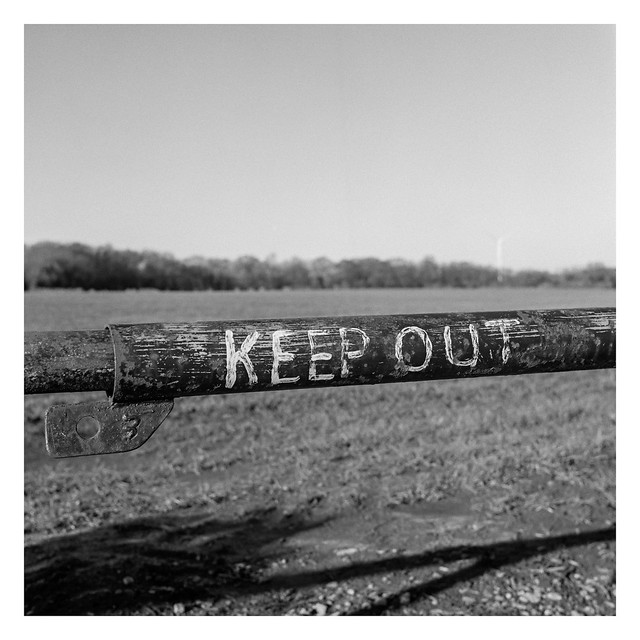
A metal gate with handwritten “keep out” sign warns passers-by not to venture into this farmer’s field. Nothing to stop me photographing it from the roadside though.
I think, had I had my close-up lens with me at the time, a shot focusing just on the warning might have been more interesting. But I didn’t so this is what I got.
This tyre was dumped in the verge of the road next to where I entered the field to take the photo I posted here yesterday. I spotted it as I entered the field and made a mental note that it might be worth making a picture on the way back to my car.
It was a little awkward to get a good angle on it without a lot of the road itself creeping into the shot, as you can see on the right of the frame (and I’ve cropped it a bit to remove even more). The best angle for a good composition would have been to stand on the road itself but the location is on a tricky bend on a slope and the risk of getting wiped out by an unsuspecting or inattentive driver wasn’t one that appealed, so I took the photo while standing on the verge instead.
This abandoned farmhouse is an interesting subject to photograph, but you need to pick the right time of day, and I don’t think I did that here. At this time of year the sun is low in the sky and there is a wooded area beside the field where the structure stands (off to the right of the photo). As a result, the building had only limited direct light falling on it. Later in the afternoon when the sun will cast light directly onto the walled side of the building would be better, or even perhaps earlier in the day and photograph it form the other side.
I rarely have the luxury of picking what time I get to photograph such things unfortunately, and even then I’m at the mercy of the weather, so sometimes it’s a case of taking whatever I can get and making the most of it.
A couple of people commented that this image looked like an overhead shot of rice paddies. It is an overhead shot, just taken from a couple of feet overhead, and it isn’t paddy fields, but a frozen puddle at the edge of a farm field. It’s odd how the brain interprets things sometimes, especially without the information that the photographer has regarding the actual subject matter.
The spread of ivy on this tree gives it a strange, unbalanced, top-heavy appearance. It stands within easy eyesight of a road I travel sometimes and I’ve thought about photographing it on more than one occasion while driving past, but this was the first time I’ve done so.
Almost four weeks ago I went out for a walk to get some fresh air and to try and clear myself of the cold I had (having read that light to moderate exercise could help). Being me I also took my Olympus Trip 35 with the intent of finishing the half-shot roll it held. The latter task was achieved. The cold-curing part didn’t work out so well and I had to take a couple of sick days, although I think that would still have been the case had I not gone for the walk. Even now I still have the cough and don’t expect to see tha back of it any time soon.
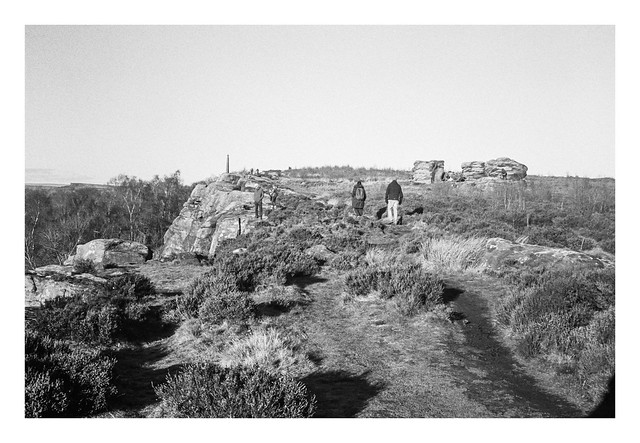
At least I got some photos, including the two shared here today. The first is the wooded area below the crags of Birchen edge, and I think this picture has turned out very nicely. The second was taken after I climbed atop the edge. On the edge of the rocks can be seen Nelson’s monument, a three metre high gritstone obelisk that was erected in 1810 to commemorate Admiral Nelson. The three large boulders to the right of the image are called the Three Ships, named after Nelson’s ships: Victory, Defiance and Royal Soverin, each of which has their name carved into one of the outcrops.