Another of my rescued 4×5 sheets. Of the eight I shot I’ve managed to recover four to an extent that I’m happy with, or at least happy enought to publish. I only managed to fix one of the HP5+ sheets – the others being beyond the limits of my Photoshop skills or, perhaps more likely, my patience.
The picture today, of a Westland Wessex helicopter is one of the least affected images, but not perfect. This one was affected by the loose tripod as much as by the light-leak. The original image on the ground glass included all of the tarpaulin-covered object that is now partly cut off at the bottom left side of the frame whereas the negative included a lot of additional scenery on the right side which I’ve cropped out. It still works as a picture though.
This version of the Wessex is the HC2 which was designed as a troop transport, able to carry 16 troops.
The Avro Ashton fuselage featured in yesterday’s post can be seen in the background.
Another rescued large format photo. A number of the images were less badly affected by the light leaks than others, this one included, and it’s difficult to see it at all now (although, again, there has been some cropping involved).
The aircraft in the picture is an Avro Ashton Mk 2 jet airliner (or the fuselage of one, at least). The Ashton was developed in the 1950s as an experimental aircraft using the airframes from Avro 689 Tudor II piston-driven airliners and was never intended to go into commercial service. Only six were built. The fuselage here is from the second of the six aircraft.
The photograph presented here today, of a post-war DeHaviland Dove passenger aircraft, is one of the 4×5 frames I shot at Newark Air Museum last Friday.
The eagle-eyed amongst you might have noted that this is not a 4×5 aspect ratio picture. This is because it was affected by the light-leak and the loose tripod column I moaned about the other day. The light leak has been largely recovered using graduated masks in Lightroom. It’s still there, but you’ll prbably only spot it if you look very closely (or know where it is). The composition has been, well, not rcovered, so much as salvaged by way of a significant crop. The full frame has the aircraft nose off-centre by a significant margin and one of the propellers fully in-shot. In the end I decided that this panoramic format was the best option.
It isn’t the picture I envisioned, but it’s better than no picture at all.
Apologies for the somewhat curtailed post yesterday. I wasn’t a happy man.
Following a pleasant day out at Newark Air Museum on Friday, I set about developing four of the large format photographs I’d shot. After the process was complete and I saw the images as I hung them to dry I was met with immediate disappontment. There were significant faults on the photographs, taking two seperate forms.
Firstly, the scenes I’d been careful to compose were all out of kilter. Objects that were perfectly framed or centred were no longer in the positions I’d intended when I made the pictures. I can lay the blame for this on two factors: First, the tripod centre column was not tightened fully, so I think I must’ve caused it to rotate slightly when inserting the film holders. Second, because I was having difficulty getting the film holders fully into place, requiring additional force and exacerbating the problem with the untightened tripod.
Secondly, despite me thinking the issues I’d had previously with light leaks were behind me, they clearly are not. Each shot exhibited problems with light leaks. I think the proble lies with the camera rather than the film holders or my technique as the light leaks are identical on each shot, despite using several different holders. Upon developing the other four sheets today I sufferd the same issue, more light leaks in the same configuration, except these are worse as the HP5+ is more sensitive than the Fomapan 100 used in the original four shots, making the effect much more pronounced.
Obviously this was a huge disappointment, and to say I was unhappy is cutting it light. It was a 70-mile round trip, plus entry costs, added to the spoiled film. The worse part is that it was the first nice day I’ve had for ages when I’ve had chance to go somewhere farther afield with a camera. I don’t get as much time to do this as I’d like so to have the time wasted to a large degree (and that includes two one-hour film developing sessions) is probably the hardest part to bear.
To try and be positive, I did have a nice day at the museum and took time to look at the exhibits without a camera in front of my face all the time. I also had my Sure Shot Supreme with me and shot about half-a-roll of HP5+ with that, so those will hopefully turn out ok, meaning it won’t be a complete bust, photographically speaking.
I’ve looked at the Fomapan 100 shots again to day and have managed to Lightroom / Photoshop a lot of the light-leaks form the shots and, with some cropping, got a few pictures that are probably worth posting. But they’re not the shots I intended. Whether I’ll be able to recover anything from the more severely spoiled HP5+ photos, I don’t know. I haven’t even bothered to scan them yet, such is my disappointent.
The photo below wasn’t a disappointment – this was taken at Hooton Pagnell a couple of months back and is the entrance to the church. It was quite a tricky exposure, but one I’ve been fortunate enough to make a good job of. Sometimes things work out ok, thankfully.
Bronica ETRSi & Zenzanon 75mm f/2.8 PE & Ilford Delta 100. Ilfotec DD-X 1+4 10 mins 30 secs @ 20°
As I’ve been posting pictures of churches over the past few days, I might as well post another. This one wasn’t shot on 4×5 large format, instead it’s a small-by-comparison 6×45 medium format ratio. Despite the smaller negative, the Bronica ETRSi still produces very nicely detailed photographs, such as this one of All Saint’s church in the village of Hooton Pagnell.
I managed to get out and make more photos today. Amazingly, given my usual poor luck when it comes to the weather, it was a beautiful spring day – all blue skies and (later on) fluffly little cumulus clouds. I had a momentary mini panic this morning when I woke to see the lovely conditions but without having a clue where to go to take advantage of them. In the end I decided to visit Newark Air Museum and take some large format photographs of the old aircraft they have there. I exposed 8 sheets of 4×5 and also managed to finish off a roll of 35mm HP5+ in the Canon Sure Shot Supreme that I had in my coat pocket. I’ll try and develop some of the 4×5 pictures tomorrow all being well.
Bronica ETRSi & Zenzanon 75mm f/2.8 PE & Ilford Delta 100. Ilfotec DD-X 1+4 10 mins 30 secs @ 20°
Another church, and another named after St. Peter just a couple of days after I posted a photo of its namesake at Elmton.
Quite a difference in architecture between the two buildings though.
When dust-spotting the scan I spotted a lone pigeon hiding in the scene. Can you spot it? You’ll probably need to click through to Flickr to see the full resolution version in order to find it though.
I’m now very much looking forward to the four days off work that the extended Easter weekend will bring. I’m hoping to do some more photography if the weather remains decent.
I can’t say that I know very much about this building beyond that it was renovated in recent years for community use and that, in the past, it was almost certainly and actual school building.
It’s an attractive structure though.
Although this picture below was shot on 4×5 sheet film, I have a very similar picture that I shot on a Ricoh GR III back in the summer of 2021. While the large format film photo is sharper and has more detail, there’s not a lot in it considering the GR III is an APS-C crop-sensor camera. This should all be balanced out by the fact that my large format negatives are scanned at home using an Epson V700 flatbed scanner at 2400dpi. It produces scans that meet my needs admirably, but I doubt it really compares to something like a Nikon Coolscan or, at the top end of the scale something like a Flextight or a proper wet-mounted drum scan.
I don’t shoot film for it’s sharpness though. I like nice sharp images, and 4×5 certainly provides that over and above medium format, and certainly 135 format, but it’s really about the experience, how I feel when using and shooting film, and the pleasure I get when I see the results. So, while I like the pictures my GR III makes, and it’s a very convenient camera to carry, it’s not usually the one I reach for when I want to go and make photos.
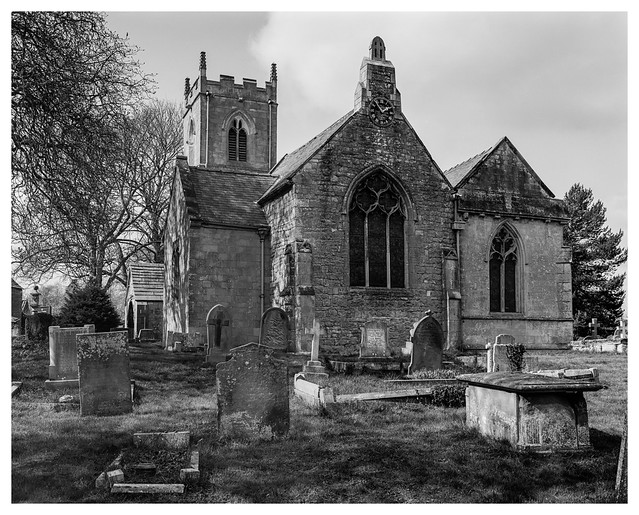
The picture today is of St. Peter’s church at Elmton. The church (including a similar photo on 35mm film) has featured on the blog before (here, here, here, and here).
On this occasion I had my 4×5 large format camera with me. I only have one lens for this camera at present – a Fujinon 135mm f/5.6. The lens is roughly equivalent to a 40mm focal length on a 35mm or full-frame digital camera. It’s a nice focal length and one I use a lot – many of my compact cameras have focal ranges that are similar, so the field of view it affords is one that I am used to, and I’m a regular proponent of the “zoom with your feet” school of thought.
Sometimes though, a fixed prime lens has it’s downsides – noteably when the ol’ zooming with your feet option doesn’t work. I’ve yet to find a way of zooming backwards through walls, or floating up and over unavoidable obstacles obstructing my field of view. I’d an idea of getting a picture of the church incorporating the low tower, either side on, or from the fron of the building but, alas, the 135mm wasn’t wide enough for this and the church is a little awkwardly positioned in terms of available longer vantagepoints.
And so the composition you see below was the best I could get on the day. I might have gotten something different from the other side of the church, but that would have meant most of the visible part of the building would have been in shadow. I think this composition still works though. You can just see the tower peeping up at the left of the structure, and the rear of the church has plenty of interest, including the weathered gravestones. The angle also means I got some nice contrast and relief shadows that I wouldn’t have had from a side-on view of the church.