4x5 Large Format · Film photography · Photography

A new 4×5 camera

If you’ve followed this blog during the past six months, you’ll probably know that I took my first steps into the world of large format photography this year. Just before Christmas I bought a used Chroma 4×5 camera along with a lens and a bunch of film and other accessories. While I’ve had successes with the Chroma, I’ve also had issues in the form of light leaks.

I should note that I don’t believe that this reflects on teh quality of the Chroma camera itself, not the company that produced it – the owner was very kind and helpful when I spoke with him, despite my camera being second-hand and not having been bought direct from him. Rather I think that my own camer has been damaged in some way at some point.

It’s now boxed up unitil such a time that I can try to pin down and rectify the source of the light leak. I’ve made a number of attempts to do so, but without success, and the cost of wasted film, developer, and – perhaps most importantly to me – time, has become too much for the time being.

I’ve not stopped wanting to shoot large format though, so had made enquiries to borrow a camera from someone I know. While that was taking place, I spotted a used Chamonix 045N-1 camera for sale at a specialist retailer, and was tempted. While it was more than I had been considering spending, it was a good price. Plus I should get my bonus this month. And so, worried that someone else would get the jump on me, I took the plunge and bought my second 4×5 camera.

The 045N-1 is, I believe, the entry-level 4×5 camera in Chamonix’s range. It has been superceded by the N-2 camera, but still remains very capable. It’s easy to set up, and while it lacks a couple of features that my Chroma has, it’s a much more solid camera and as a result easier to use. Some things that I found a little fiddy with the Chroma, are notably improved here – as you would expect given the higher cost. The camera feels completely solid, while there was always a bit of wiggle with my Chroma and, given how much difference a tiny amount of movement can make in terms of fine focus, this adds a great deal of confidence that what I see is what I will get when taking pictures. Inserting film holders is also much better with the Chamonix – they slide into the camera back with a buttery smoothness which, again, gives me confidence that I’m not knocking my composition out of whack.

I took the camera out for some test shots yesterday. Not too far from home as I was still slightly paranoid that the light leaks I’d had with the Chroma might not be the camera’s fault and instead produced by one of my film holders or something, so I drove out to photograph a few places I’ve visited before. The camera was pleasant to use, although I’m sure I’ll get more adept at setting it all up as I use it more – I was still a bit fingers-and-thumbs on this outing.

I developed the four sheets I took this morning and it was a great relief to see that, despite using the camera in very bright, direct sunlight, there were no signs of any light leaks when I pulled the negatives from the developing tank.

Here are a couple of the resulting images. Perhaps not prize winners, but I’m happy with them.

Again
Kiveton Park Station

Chamonix 045N-1. Fujinon NW 135mm f/5.6 & Ilford HP5+. Ilfotec DD-X 1+9 15 mins 45 secs@ 20°

Taken 3 June 2023.

35mm · Film photography · Photography

Beetle

As a child, VW Beetles were a commonplace sight, whether parked on the street or seen driving along roads, their passage announce by distinctive air-cooled engine sound. Sometimes I would be overjoyed to see one that had been painted to look like Herbie.

But over time they faded from view and it wasn’t until the new, much worse looking (in my opinion), New Beetle arrived in the late 1990s that the cars began to be widely seen again, on British roads at least. The New Beetle lasted from 1997 to 2011, when it was replaced by the sleeker-looking Beetle A5, which itself was finally retired in 2019.

The original Beetle design is a classic and as a result there are still many being maintained, so it’s easy to find one (or several) at classic car shows, and they also turn up in customised form. There’s a customised green Beetle often to be found parked near my local fish & chip shop which I’ve thought about photographing but, apart from a digital snap I took a few years ago, I haven’t gotten around to doing so.

When I spotted this pristine Beetle in Lido di Jesolo, I just had to get a few pictures. It’s nice to see one in such pristine condition in the wild.

Beetle
VW bug

Olympus Trip 35 & Kodak Gold. Lab developed. Home scanned and converted with Negative Lab Pro.

Taken 5 May 2023.

35mm · Film photography · Photography

Beach umbrellas

A very noticeable feature of the beach at Lido di Jesolo was the sheere quantity of sunloungers and beach umbrellas. There were thousands of them, probably tens of thousands! It’s someting I’ve noticed in other Italian resorts too (in my relatively limited experience of them), but they really stood out here.

Hotels have their own section of beach with sunloungers for their guests, although I think they can be hired by non-residents too. Some of the hotels are directly adjacent to the sand, but others might be a street or two further inland.

We visited in early May, before the main Italian holiday season begins, so most of the loungers were unoccupied while we were there. I expect it is a sight to behold at the height of the season!

Beach furniture
Sunloungers and parasols
Sunloungers and parasols in bloom

Olympus Trip 35 & Kodak Gold. Lab developed. Home scanned and converted with Negative Lab Pro.

Taken 5 May 2023.

35mm · Film photography · Photography

Living on stilts

This interesting building sits atop the EuroSpar supermarket in Lido di Jesolo. It was pointed out to me that it was designed by Stefano Pujatti of ELASTICOFarm. This doesn’t mean much to me being somewhat unfamiliar with the world of modern architecture, but I was happy to see more pictures of the structure and find out more about it via this link: https://www.elasticofarm.com/architecture/le-batiment-descendant-lescalier/

I had no idea that the swimming pool was there on the occasions we visited the supermarket!

Above the EuroSpar

Olympus Trip 35 & Kodak Gold. Lab developed. Home scanned and converted with Negative Lab Pro.

Taken 5 May 2023.

35mm · Film photography · Photography

1937

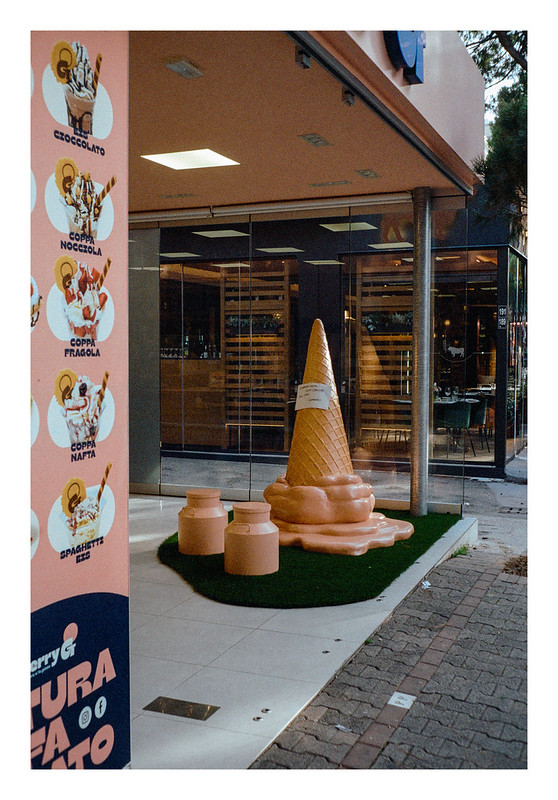
A whole bunch of pictures to come over the next week or two from my recent trip to Lido di Jesolo in Italy with my wife. It was only a short, three-day break, but I managed to get through two-and-a-half rolls of film with my Olympus Trip 35.

As it’s late and I (shock! Horror!) almost forgot to write a blog post today, I’ll keep this one quite short.

This small building was set just back from the beach and, like so many other hotels and houses, was painted a vivid shade. It has “1937” written on the wall in Roman numerals. I guess it’s possible that the building dates back to then, but I suspect it may have some different significance. Whatever the case, I felt it made for a nice colourful subject, and I like the leading lines formed by the strips of matting in the foreground..

1937

Olympus Trip 35 & Kodak Gold. Lab developed. Home scanned and converted with Negative Lab Pro.

Taken 5 May 2023.

35mm · Film photography · Photography

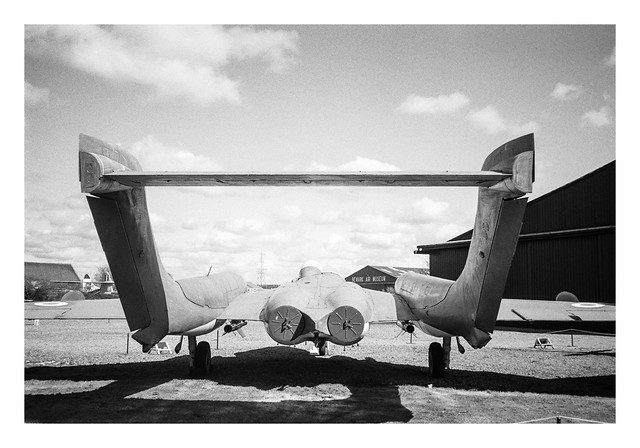
Sea Vixen

I thought I’d throw in another air museum photo before moving onto something new tomorrow.

Today it’s the back end of a DeHaviland Sea Vixen, a twin-boom carrier-based fleet defense aircraft that was introduced in the 1950s and saw service into the 1970s before being replaced by McDonnel Douglas Phantoms.

The asymetric cockpit is an interesting feature.

Today I went for a drive out to Rufford Abbey (although most of my time was spent wandering the surrounding Rufford Country Park). It was a nice day and the place was very busy, but I shot a couple of rolls of film with my Texas Leica (the Fujica GW690). The first roll was a little loosely wound when I removed it from the camera, so I’m expecting there may be some light leaks, but I took care to ensure the second roll was tightly wound on the takeup spool before closing the camera back and that came out fine. I shot half the second roll at Rufford Country Park, and the remaining frames at a couple of places I stopped off at on the way home. Pictures to come at some point (although I’ve got loads of other stuff before then!).

Tail

Canon Sure Shot Supreme & Ilford HP5+. Ilfotec DD-X 1+4 9 mins 30 secs @ 20°

Taken 7 April 2023.

35mm · Film photography · Photography

Vulcan

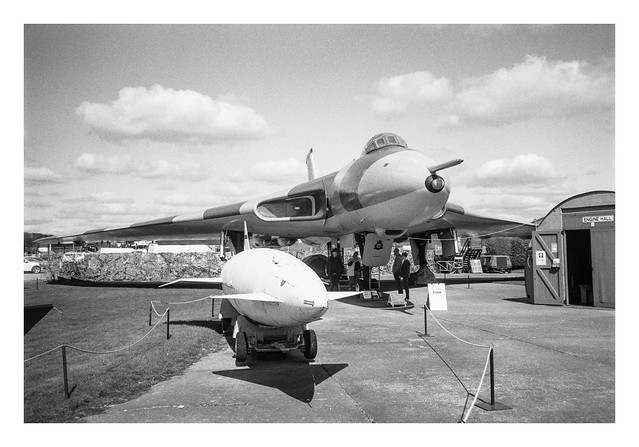
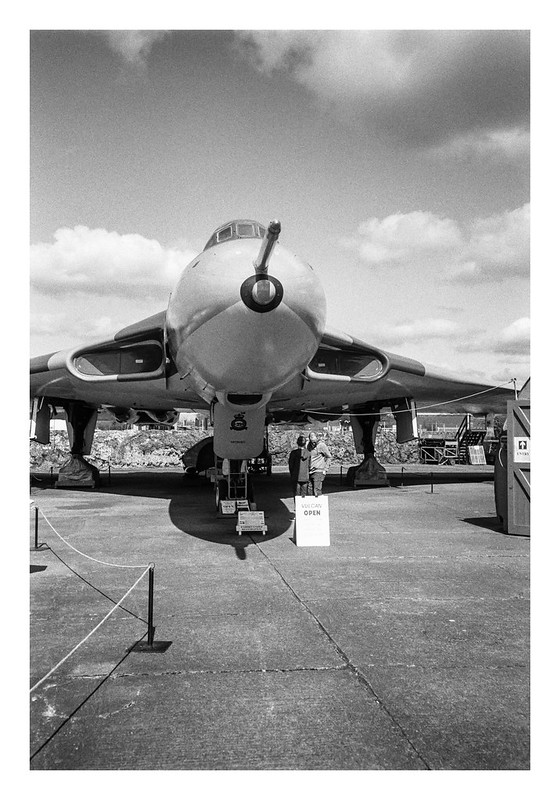
The Avro Vulcan bomber is a truly impressive aircraft. It’s huge delta wings span almost 100 feet and it’s an imposing feeling when you walk beneath. The Vulcan was one of three aircraft that formed to so-called V-Bombers – the other two being the Vickers Valliant (two Vs in one!) and the Handley Page Victor. – Britain’s nuclear capable bomber force from the 1950s to the early 1980s. In the mid-1960s the V-bomber fleet counted almost one-hundred-and-sixty aircraft, with Vulcan making up the largest part with seventy aircraft in service.

Seeing one of these fly is a majestic experience, the noise of the engines and the shape of the huge delta wings was unforgetable and I remeber seeing them in flight sometimes as a child, and was also fortunate enought to see one of the (then) surviving airworthy aircraft making a display flight at an airshown in the 1990s.

Sadly, none of the surviving Vulcans is in airworthy condition any longer, although there are three which are taxiable, and the one pictured here at Newark Air Museum is on static display (although it is possible to go inside the aircraft).

Live long and prosper! (I had to get that in! :))

V bomber
Under Vulcan's wing

Canon Sure Shot Supreme & Ilford HP5+. Ilfotec DD-X 1+4 9 mins 30 secs @ 20°

Taken 7 April 2023.

35mm · Film photography · Photography

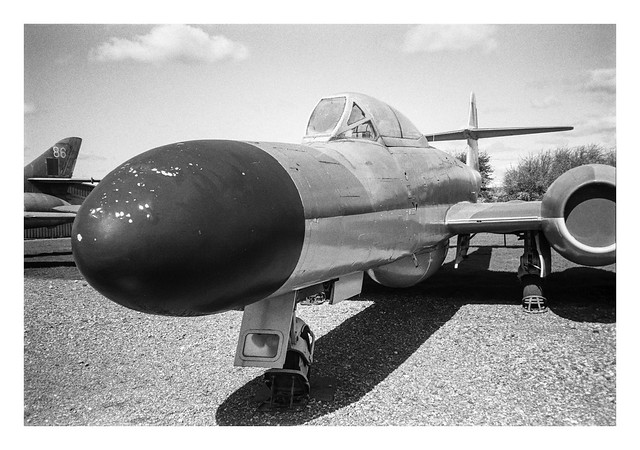
Meteor

A couple of days back I posted about the Shooting Star (or the Lockheed T-33A, as it was formally known), today I have a picture of a Meteor. A Gloster Meteor NF-14.

The Gloster Meteor was the first British jet fighter, and the only one to see service during World War II. Several versions were produced, and the NF-14 was designed as a night-fighter variant to supercede the DeHavilland Mosquito. The NF-14 entered service in 1954 but was already being replaced by more advanced aircraft just a couple of years later.

Gloster Meteor NF.14

Canon Sure Shot Supreme & Ilford HP5+. Ilfotec DD-X 1+4 9 mins 30 secs @ 20°

Taken 7 April 2023.