Another set of photo’s of All Saint’s Chapel at Steetley. These were all taken on the same visit when I shot some pictures with my Olympus 35 RC. If I had to choose, despite liking black and white photos , I think that in this case the colour images are the better set. That’s not to say I don’t like these, but I don’t think they hang together as cohesively. Some of the individual frames are also identical compositions to the 35 RC shots but, again, don’t really work as well I don’t think.
The Holga is a great camera and one which I usually really enjoy my results from, but I don’t think this set is amongst the better ones. I’m sure I will do better next time.
As I mentioned in my last, somewhay concise, post, I suffered an injury yesterday. A broken ankle to be precise.
It was the first of five days leave I have from work (or seven including the weekend) and I’d taken a trip to Manchester with my wife and her sister. They were off to see a show while I planned to just wander around the city taking pictures. And all was going to plan for several hours. I visited Real Camera to have a browse (and ended up buying a couple of rolls of expired slide film, because, of course, I really need more film to add to the already packed drawer that I’ve commandeered in the freezer), had some passport photos made in the old-style analogue photo booth in the Fred Aldous store (not for my actual passport, but just because I could. The photos are now stuck on the side of the fridge along with loads on Instap pictures). I treat myself to a nice burger and fries for my lunch and, of course, I took pictures. I had a couple of cameras on me – my Olympus 35 RC loaded with one of my two remaining rolls of Portra 800, and my Canon Z135 compact containing some Ilford HP5+.
After wandering around for a few hours I decided to visit the art gallery an it was when I left the gallery that disaster struck. Just outside the main entrance, down a short flight of steps, there were some benches in the shade of the building. Thinking it would be nice to take the weight off for a few minutes I headed down and, as I stepped down the bottom step my right foot twisted awkwardly beneath me with a distinctive snappining sound.
I had an immediate sickening sense of dread and planted myself straight on the bench to take the weight off my legs. There was no actual pain as such, just an odd, numb tingling sensation, the sort you get if you bang your elbow, so I decided to stand up and see how bad it was. Luckily I was able to bear weight and, after messaging my wife to tell her what had happened and that I was taking an ealier train home, I set off limping back to the railway station. Walking was awkward but not especially painful and I managed to get to the station without issue. Unfortunately the next train was cancelled so I had to wait around for over half-an-hour for the next train, which I rather not have had to do, but I guess that’s life (and my luck).
When I got back to Sheffield I took a taxi from the station to the Accident & Emergency department where I spent around four hours waithing for x-rays and to speak with the nurse about the prognosis. I managed to buy myself an actual analog newspaper from the station before getting the taxi as I suspected I might be in the hospital for a while and my phone battery wouldn’t last out. It was a good decision and I read the paper front-to-back while I waited to be seen by various people.
The x-rays showed I had broken a fragment of bone from the bottom of my fibula. While this is painful, I was told that it would have been worse had the break occurred further up the bone close to where the tibula meets the bones of my foot as it would likley have restricted my mobility more severerly and would take longer to heal. The injury I have should be healed within four-to-six weeks, and I was given a large plastic “walking boot” to wear if I need to go out. Thankfully, there is little to no pain while I’m at rest, and I was able to sleep perfectly well last night. The ankle feels sore while I walk about, but again not too bad, and I can move it around quite freely, so I guess I should count my lucky stars that it wasn’t worse than it is.
I think my main upset is that it’s kinda ruined my days off – I had things planned that I’m now unable to do because, while I need to use the ankle to encourage it to heal, this probably doesn’t stretch to full days out on my feet. I also can’t drive for a while, so I’m at the mercy of the goodwill of others if I want to go somewhere. My planned trips out into the Peak district this week, and to Lincoln Steam Rally the following weekend (the first time it has been on in three years) have fallen by the wayside, so I’m frustrated that the opportunity to photograph heather while it’s in bloom, or see the vintage vehicles at the rally will now have to wait another year. There are worse things in life though, so maybe I’ll just count my blessings and enjoy the next fews days away from work by watching TV, reading books, and playing videogames with the spare time I’ve got. At least I have a good excuse for avoiding chores!
I’ve got four full rolls of 35mm film that I’ve yet to upload (or, in some cases, scan), including the roll of Porta 800 from yesterday that I almost finished in Manchester (but ended up using the last two frames photographing some hospital buildings while waiting for my wife to pick me up). So I should be able to feed the blog until I’m back on my feet at least.
Finally, today’s picture of a chair in a shady spot under a tree looks like just the place for a chap with the busted ankle. Maybe with a cold beverage. If only this were my back garden and not in a churchyard several miles away, eh? 🙂
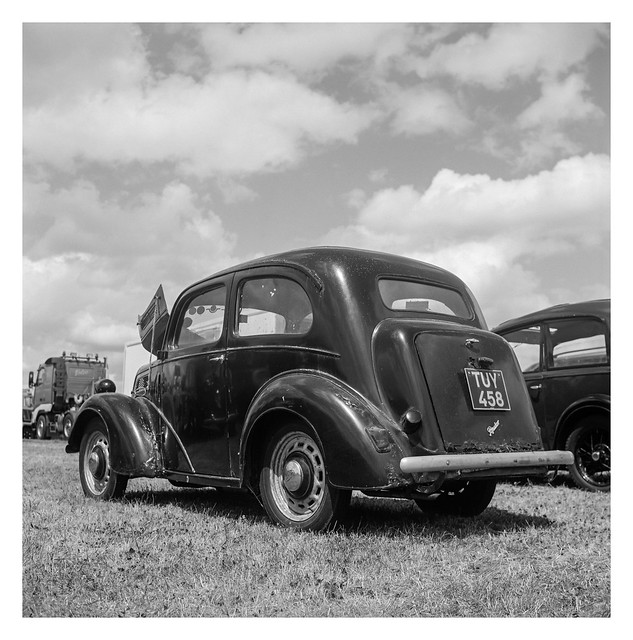
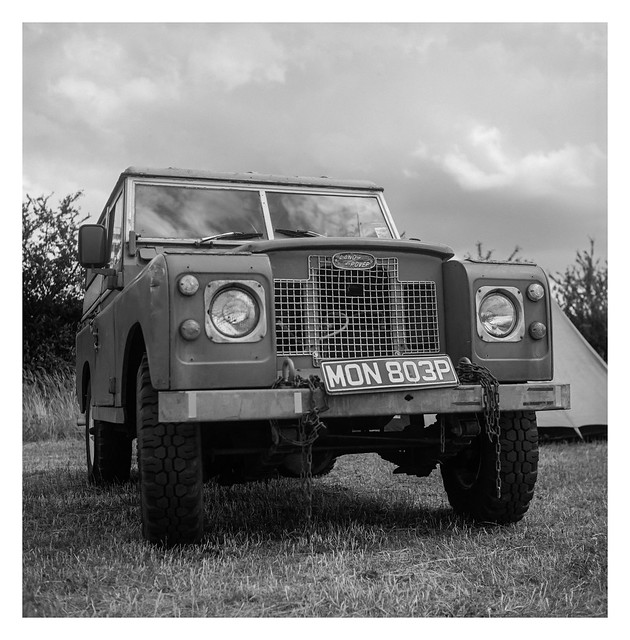
Rather than upload these one-per-day, as I usually do, I thought I’d lump them together in a single post. All were shot with my Yashicamat 124G on Shanghai GP3 film – I like this film a lot. It can occasionally suffer from production problems (I’ve had the backing bleed through on some shots I once took), but it’s quite low cost and produces really nice results.
First, a few pictures of vintage vehicles. The Ford Popular in the second image can also be seen here in colour.
Then a couple of miniature traction engines (and their owners)…
And finally, a trio of full size traction engines…
If there’s one thing that there are a lot of at a steam rally, it’s traction engines. Sure there are vintage vehicles of all types also on display, but I think it’s probably these coal-fired mechanical marvels that draw the crowds more than anything.
Yashicamat 124 G & Kodak Ektar. Lab developed. Home scanned and converted with Negative Lab Pro.
I think that the car featured in the photographs today is a Mercedes Benz 190 SL. I have worked this out by my usual detective pathway of looking at pictures online until I find one that appears t match. This means that I could be wrong about the model – sometimes there are subtle differences only apparent to an enthusiast (something which I am not). But, while not a car enthusiast, I do think they can make fine subjects for a picture of two, as usually becomes apparent around this time each year when I visit vintage rallies on the hunt for such things and subsequently flood my blog with the results.
Yashicamat 124 G & Kodak Ektar. Lab developed. Home scanned and converted with Negative Lab Pro.
The annual Sheffield Steam Rally returned this summer after a two-year gap due to the pandemic, so I headed out to take some photos. I was blessed with some nice weather that really suited this roll of Kodak Ektar I shot with my Yashicamat 124G.
As well as the traction engines, vintage cars, tractors, motorbikes etc., there were a few old caravans on display too. I have a bit of a fondness for caravans as they bring back happy memories of staying in my grandparent’s caravan several times each year when I was younger. Their caravan was much larger than the one in today’s photograph – a six-berth – whereas the one here was (if I remember correctly) a three berth model. The caravans in the picture are also “tourers” that can be towed from place to place by a family car, whereas my grandparent’s was a static caravan that remained on the site permanently. Given their small size, seeing how beds are somehow conjured almost from thin air by converting seating and other parts of the interior fittings is quite impressive.
The pastel colours of the caravan on this sunny day really work well with the Ektar, I think.
Yashicamat 124 G & Kodak Ektar. Lab developed. Home scanned and converted with Negative Lab Pro.
Three horses on a carousel. I’m very happy with the colours I got when scanning this roll of Ektar. It’s the first time I’ve shot this film in a while and, based on the images I got, I hope to shoot more.
I’m less happy with the Fuji Velvia 100 that I’m attempting to scan this eveneing however. Despite having satisfactory results with this film scanned on my Plustek in the past, tonight the scans are a disappointment. Compared with the actual transparencies, the scans look dull and underexposed in comparison. I normally have a good success rate scanning 35mm E6 transparencies using this method, but something is off-kilter.
I usually use Vuescan when scanning slide film, but am resorting to Silverfast this time to see if I can get something I prefer using that method instead. Fingers crossed…
Yashicamat 124 G & Kodak Ektar. Lab developed. Home scanned and converted with Negative Lab Pro.
I wonder what this wooden groyne looked like when brand new? And when it actually was brand new? It would be interesting to know how many years of being pounded by waves, pebbles, and sand it took to reduce it to this somewhat broken-toothed appearance.
I like this photo. It has a clean, minimal feel to it. The sky is clear of cloud (bar a couple of barely discenible whisps) and the lines of the horizon, fence, and bench add an element of structure. The man sits slightly off-centre, adding a small sense of discord to the picture.
I wonder what the man was thinking about as he sat there, looking out across the North Sea? When I see picture that I have taken such as this, I sometime wonder if I should have spent more time taking in the view myself, rather than trying to photograph it. I sometimes feel that I’m spending too much time trying to capture a moment to be enjoyed later when the reality is right there in front of me. But the camera, it draws me…
At Hornsea, where the wooden groynes meet the sea wall, concrete steps have been placed to allow people to bypass the wooden structures. The sun was bright and contrasty by the time I made these pictures and, as I had a roll of Fuji Acros in the camera at this point, I thought that these steps might make for decent subjects.