My Olympus OM-1 camera has suffered an annoying fault for a while now. After firing the shutter the mirror will sometimes lock up. Advancing the film drops it back down but the shutter remains locked and the only way to release it is to advance the film a second time (which shouldn’t be possible with the OM-1). When this second stroke of the advance lever takes place the camera also fires the shutter. After this it can be used normally again for the next shot. The problem means that every other shot is wasted – or mostly wasted as the problem tended to be intermittent.
Fot no real reason at all, I decided to look at the camera again today (without a film in it) and discovered that the issue now occurs on ever shot taken. I like the OM-1 – it was the first SLR I bough when I got back into shooting film cameras again – so I decided it would be worth trying to get it fixed. As the person who I’ve used for repairs and CLAs in the past has now retired, I tried a local repair shop that I’ve heard works on analogue cameras.
Upon phoning the shop, the guy there was quick to tell me that the repair would be costly and that I’d be better off using digital cameras. Rather than slam the phone down in disgust (:)) I explained that I enjoy the experience of using film cameras and that I’m not unaware of the issues that come with using vintage gear. He then mentioned that he’d had a box of stuff come into the workshop, including an OM-1 camera, which he would let me have for £40 sold-as-seen. £40 is a good price for an OM-1 these days so I headed over to the shop to take a look, figuring I could always turn it down if it looked like it might not be working properly. As it turned out, the camera appeared to be working as expected, including the meter, and was in great cosmetic condition so, after chatting with the guy for a while, I headed home with the camera – an OM-1N to replace the OM-1.
The camera probably needs new seals fitting, and it’s missing the hotshoe. I’d though that I could just swap over the hotshoe from my OM-1 (they just screw on and off with a thumbwheel), but it wouldn’t fit and it turns out that the design must have been slightly revised between models. Still, I’ve not once used the hotshoe on the OM-1, so I won’t miss it, and I’m more bothered by the empty screwhole on the top of the camera than any loss of functionality.
The other difference is that this replacement is expecting the original 1.3v mercury battery to power the meter accurately, whereas my OM-1 had been converted to meter properly using readily available 1.5v batteries. This means that I’ll either have to get it converted, or adapt zinc-air hearing aid batteries instead (I could use Wein cells, but these are much more expensive than the hearing aid cells). It’s a bit of a faff, but nothing insurmountable though.
I’ll get the seals replaces when I get the chance and then take it out for a test run.
Today’s picture is from back in 2018, when I took my original OM-1 with me on holiday to Sorrento, Italy.
I discovered that someone had a few rolls of expired film available free of charge today, so I took up their offer to take it off their hands. It involved an hour driving to the other side of the city and back during my lunch-break, but it was a nice day and good to get out of the house and away from my desk. The lady with the film told me that it had been in the fridge since it was bought and it’s only the fact that the fridge broke down that they remembered it was there. It’s been there a while as the one roll with an expiry on the packaging is dated 2005. The other two rolls are in un-dated wrappers but I’m assuming a similar vintage. Given its storage, I might even be tempted to shoot a roll at box speed to see how it fares.
The dated roll is Tudor branded 200asa colour negative with 24 exposures, Tudor being a company that re-packaged films rather than manufacturing their own I believe. I’ve not opened the box yet, but when I come to shoot it I’ll look up the DX code to see if I can find out who manufactured it originally – possibly Fuji though.
The other two rolls are Truprint FG+, another 200asa film, and again with 24 exposures. Truprint was a mail-order photo lab and rolls of their film would be supplied with the returned prints. Although I don’t know for sure, I believe that the film might be rebranded Ferrania FG+.
As I’m taking about expired film, here’s a photo made on out of date Superia 100 at the Lincoln Steam Rally three years ago. I’m not sure if there are actually 34 plugs in this tin…
It wasn’t me who took this picture. It’s a scan of one of the hundreds of 35mm slides I’ve picked up at auctions and other places over the past few years. Despite it not being mine I think it’s worth making photos like this available to be seen, if just for the historical and social interest they offer.
This photo depicts Donner Pass Road in Truckee, California, USA. You can see the same location on Google StreetView here. The slide is un-dated but I’m assuming that it was probably shot sometime in the 80s or 90s – perhaps one of my American readers can spot tell-tale signs in the shape of the cars and trucks present?
I had no idea of the location from first glance BTW. It’s only the fact that, from looking closely at the scan, there’s a sign for Truckee Mall in the background.
I really enjoy looking at old slides such as this, seeing the view through someone else’s eyes, wondering what it was about the scene that made them press the shutter, and wondering who they were, what they were doing there, and where they are now.
The latter question is always somewhat sad to consider as I expect, in many cases, that the photographer is no longer with us and this is the reason that the slides are now in my posession. Either they had no one to pass their old photographs on to, or perhaps their next-of-kin just didn’t feel the attachment to keep hold of them, and so they drifted off in a stream of stuff to be sold and wondered at. I wonder if this will happen to my photographs when I’m gone?
Anyway, here is someone’s view of Donner Pass Road photographed at some undisclosed point in time. Whoever you were, I like your picture.
Kodachrome slide. Un-dated. Original photographer unknown.
I was pleasantly surprised to hear today that Kodak is introducing a new 120 film choice. Or rather an existing film in 120 format in the guise of it’s consumer grade Kodak Gold. I’ve wished for a lower-cost alternative to Kodak (and Fuji’s) pro-grade films for medium format use so this is great to hear. Of course, here in 2022, Kodak Gold in 120 format is more expensive than Portra or Ektar were just a few years ago, but that seems par for the course at present.
I quite like Kodak Gold in 135 format (although I’ve tended to use Colorplus more), so I’ve splashed out on a pre-order of the 120 format Gold to see how it fares. Hopefully it’ll be in my hands sometime in early April. All things considered though, if colour film maintains its high price point then I’m likely to err even more strongly to my preferred black and white choices purely from an affordability standpoint, with my colour film use limited to where I know it’ll really be worthwhile. I tend to shoot much more black and white anyway so my current stocks of colour film are likely to keep me going for a while yet.
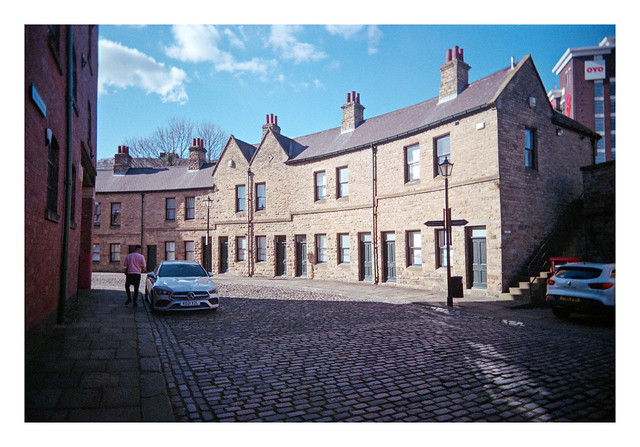
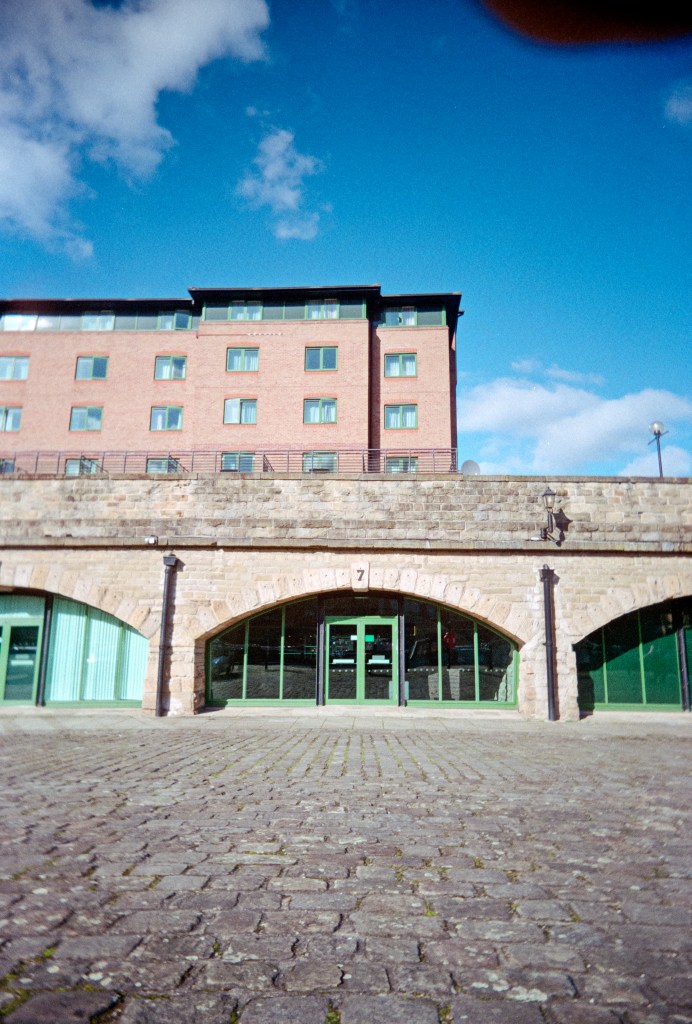
Another colour photo from the Reto Ultrawide & Slim today, and one which exemplifies how much of a scene is omitted when seen through the camera’s viewfinder. In this shot I had composed the scene to include the main arch and the smaller arch to the right. The leftmost arch, the person walking into frame left, and the rear of the car on the right were not present in the viewfinder. I guess I will begin to factor this in as I become more familiar with the camera over time.
Reto Ultrawide & Slim & Agfa Vista Plus 200. Lab developed.
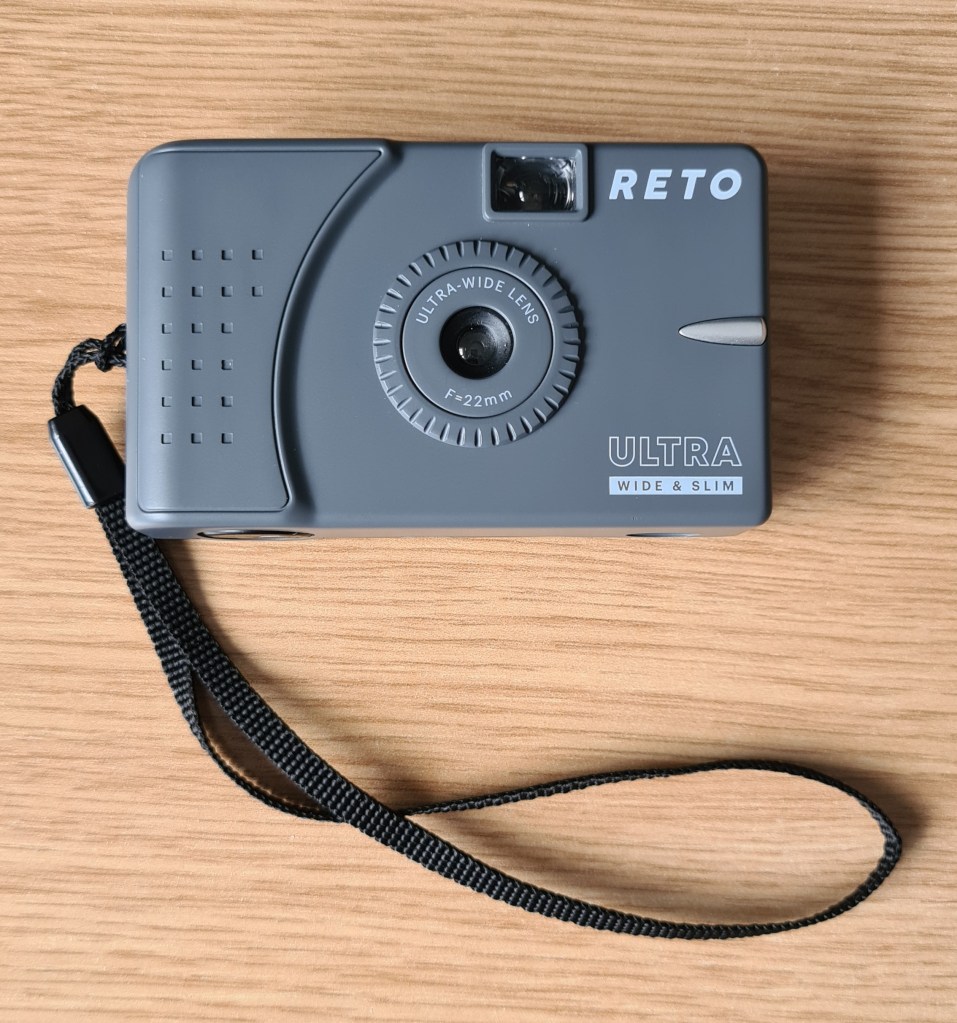
A month or two ago I became aware that a new film camera was about to launch. As with most new film cameras these days, this was not to be an SLR, rangefinder, or fully-featured compact point and shoot, but something rather more basic in the shape of the Reto Ultrawide & Slim.
There have been a number of other back-to-basics cameras launched in the last year or two, but these have mostly been in the form of re-useable disposable cameras (if that makes sense – basically the same features as a standard disposable film camera, but with the facility to re-load with normal rolls of 35mm film. More cost effective and flexible in the long term, and also better for the environment.).
This wouldn’t have been possible without the 22mm lens.
In terms of build, the Reto Ultrawide & Slim (UWS) is probably no more advanced than the aforementioned cameras. It’s almost completely made of plastic, including its lens. But in this case, it’s the lens that matters because, while most other cameras of this ilk use 35-40mm focal lengths, the Reto UWS packs a very wide by comparison 22mm lens, making it something of a stand-out amongst it’s competitors.
This one managed to find its way into Flicke Explore!
The camera itself is not a new design. It’s a clone of the Vivitar Ultrawide & Slim which was released back in the 1990s, manufactured by Chinese company Sunpet and marketed under the Vivitar brand. The Reto version isn’t even the first clone and another version produced under the Superheadz brand was also available for a while. Despite the different variants, all the cameras appear to be identical in terms of functionality, with the only differences being cosmetic.
In terms of specs, the camera uses the aforementioned 22mm lens – this is an uncoated 2-element design fixed at f/11 and constructed of resin. The shutter is likewise fixed to a single speed of 1/125 sec. The focus is fixed and reaches from 1m to infinity. Controls on the camera consist of a shutter button, a film-advance wheel, a film-release button, the rewind crank, and a switch to open the camera back for loading and unloading the film.
The fixed aperture and shutter speed are likely to dictate the film you choose to shoot. On bright days then a 200 or even 100asa film is probably fine (all the shots here are on 200asa colour negative film), but faster film will be a necessity when the light isn’t as good, probably going beyond 400asa in the conditions we often find here in the UK.
The person exiting frame left was definitely not visible in the viewfinder when the shot was made.
The build quality of the camera isn’t something that inspires confidence. The almost fully plastic build is very lightweight (the camera feels like it would blow away in a light breeze) and I’ve seen a number of places advising that it’s best to limit film to 24exp rolls as longer lengths can put unwanted strain on the advance mechanism (which I presume is also mostly plastic). I guess that time will tell as to how well it’s construction fares – so far I’ve put two rolls through mine, a 24exp roll and then, being the daredevil that I am, a high-risk 36exp roll. Neither posed any problems, although I could feel the tension (literally!) when winding on the final few frames from the longer film.
In terms of use, there’s not a lot to say. Loading film is easy – the rewind ratchet is a very simple design and is basically held in the camera by a plastic lug, but it works well enough. The shutter button is responsive and the shutter itself makes a quiet but satisfying click when fired. The advance wheel also works well, with the caveat that it did feel much tighter towards the end of the 36exp roll of film I shot, and I expect this might be a potential point of failure. Rewinding the film is likewise straightforward. The door release switch works fine, but I find that it doesn’t spring the door open and I have to pick at it with a fingernail to get inside.
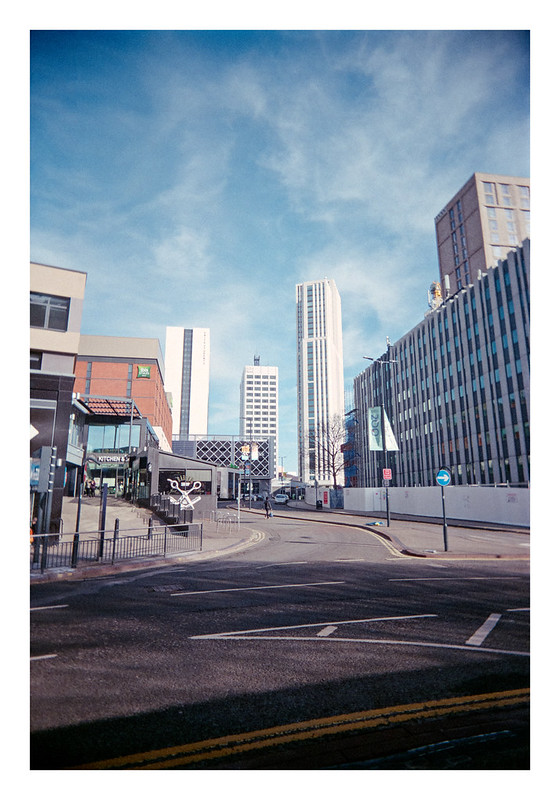
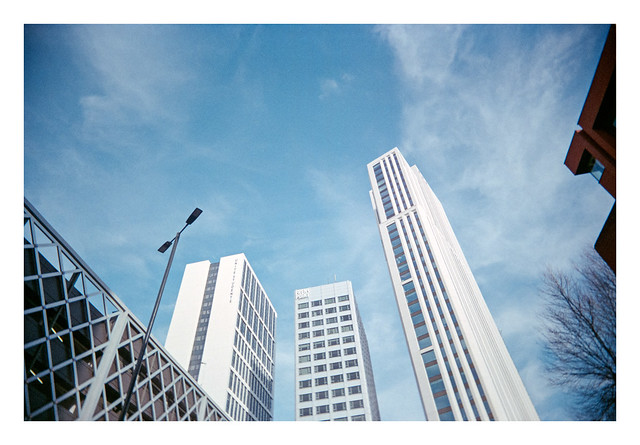
So, most importantly, what are the photographs like? Well, that will always be a subjective opinion, but in my case I’m very happy with them. The lens has some notable shortcomings in the amount it vignettes (although nothing like as much as a Holga 120 or something like that), and also the drop off in sharpness at the edges of the frame. Both these things could also be said to add charm to the resulting images though. In the centre of the frame the lens is plenty sharp enough and equals some more advanced and fully featured point-and-shoot cameras I’ve used. It’s the 22mm focal length that is the big draw here though. Coupled with the f/11 aperture and deep depth of field, it can allow interesting compositional choices to be made and I expect that I will continue to use it for this reason.
Beyond the build quality there are a couple of other downsides to be aware of however. The first is the viewfinder. While it’s bright and easy to use, even for a spectacles wearer like myself, its coverage does not represent the full field of view of the lens, meaning that it’s very easy to get unwanted elements creeping into the edge of your compositions. This includes fingers! The lens is also very prone to flare apparently, although I deliberately chose my shots to try and minimise this. I have also found that the first roll of film I had developed had scratches on a number of frames but, giving the benefit of the doubt, I’ll wait to see if it’s repeated on the next roll before laying the blame on the camera for this. The scratches were rectified easily enough in Photoshop.
Finger alert!!!
Is the camera worth buying? Again that’s a very subjective question. If you live for crisp, sharp, high quality results with a range of controls and features to aid your photography, then probably not. If you enjoy the simple creative options that ‘toy’ cameras such as this offer, then you’ll be fully in your element. At £30 it’s relatively cheap to buy (although that doesn’t mean it’s actually worth that amount) and problably more affordable than the older Vivitar version which seemed to have been fetching much higher prices due to its popularity. I’m so far happy with mine and glad I bought it.
There are undoubtedly a lot of reviews and first impressions of this little camera popping up online, but here are a couple from my fellow bloggers Jim Grey and adventurepdx that are worth reading.
Reto Ultrawide & Slim & Agfa Vista Plus 200. Lab developed.
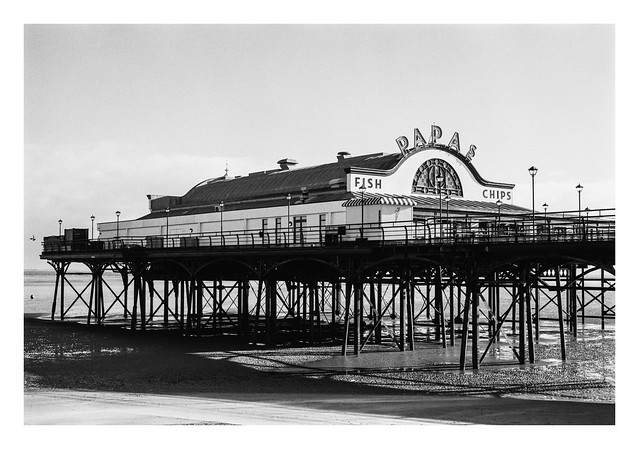
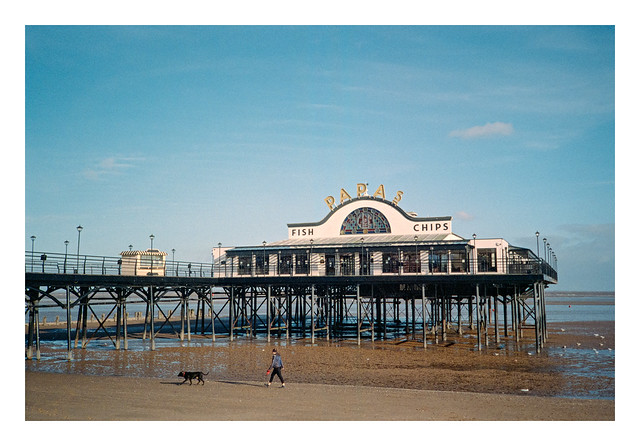
Papa’s has been featured on the blog before, back in 2019. It’s one of those subjects that presents itself as a great photo opportunity, with lots of detail and interest, set against the backdrop of the beach and sea beyond. I had fish and chips the day I visited when making the previous post. I had fish and chips again on this occasion, but it was much colder this time around so instead of eating them on the pier, I walked back to my car parked a short distance away on the promenade and ate them while I sat and looked out at the incoming tide.
There is something comforting about eating in the car like this. It reminds me of when, as a child, we would sometimes drive to a place named Sandilands not far from Mablethorpe in my grandparent’s car. My grandma would always stay in the car, but grandad would come down on the beach with us (us being some variant of my sister, my cousins, and myself) where we would collect the big white pebbles that were scattered around, and which my grandad placed on the ground around the base of their caravan as decoration. When it got cold, we would go back to the car and eat snacks and watch as the sea came in.
Olympus OM-2N, Zuiko Auto-S 0mm f/1.8 & Ilford Delta 100. Ilfotec DD-X 1+4 12mins @ 20°. / Olympus XA3 and Kodak Colorplus (expired 2012 and shot at 100asa)
Along the promenade at Cleethorpes I passed these two rubbish “bins”. One, south of the pier, jauntily named “Hammy the Haddock” (although Hammy sounds more like a pig’s name). The other, to the north of the pier didn’t have a name that I noticed, but as it’s a repressentation of our planet, I assume it’s called “Earth”.
It’s possible that there may be more of these designs further down the promenade to the south, but I didn’t walk much beyond Hammy on this visit. They are nicely designed pieces of functional street furniture and I can easily imaging children (and even adults) being excited to put their rubbish into either one rather than dropping it on the ground.
It’s contents might not be as edible as Pizza Hut’s… But who knows? Has anywone done a comparison. I mean, wooden frames and cloth seats might not sound as good as a hawaian or a meat-feast, but perhaps it’s a yet-to-be-discovered delicacy?
Enough of this nonsense!
It’s quite a simple picture, just a shed stood in the sunshine, it’s deckchair innards waiting patiently for the warmer weather and the visitors it will bring. I like it’s simplicity though, just an angular block of white painted planks with the winter sunshine adding some nice contrast. Of the three photos I loaded to Flickr today, this one got the least likes so far, but it’s the one I like best. There’s no accounting for my taste I guess…
The big wheel that stands on Cleethorpes beach has features in a number of photos on the blog recently, often in the distance. Today there a couple of closer shots.
The obvious thing to note about the structure is that the seats have been removed while the ride is closed over the winter months. Without these though it presents a cleaner profile against the blank backdrop of the blue sky day.
Cleethorpes has a fairly long, straight run of beach with the pier stood maybe about halfway along its length. The pier, and the big wheel and helter-skelter that stand not too far away are prominent landmarks wherever you stand on the shore.
Being situated at the end of the Humber estuary, the beach at Cleethorpes is aluvial in texture, the sand being a dark muddy brown as it’s probably made up in a significant part by deposits from the estuary. The upper parts of the beach are sandy in a more traditional way and I wonder if this sand has not been artificially placed there for tourists. On the day I visited there was an excavator spreading sand around the upper part of the beach down past the pier. I have a photograph of that too, so I might post it on here at some point.