Another set of beach-chalet photos today, this time in black and white. Cery few of these were occupied on the day of my visit, which is not surprising given we are now into autumn (it was mid-september when these shots were taken). There were a few people still making use of them though, including a chap sat enjoying the sea air with three of his dogs – some picture of them to come shortly.
I have vague memories of us hiring one of the chalets (one of the ones with windows) when I was a young boy – possibly my parents and my grandparents were present on that occasion, although the recollection is vague.
While the structures are pretty basic in design, they had power and water, so it was possible to make cups of tea and other refreshments, as well as being a useful shelter from the elements (whether hot sun or, this being the UK, pouring rain!) and somewhere to store the accutrements of a day at the beach without having to lug it around everywhere all day. They also had a set of curtains, so you had the luxury of being able to change out of wet, sandy swimming costumes and into dry, clean clothes without the risky maneouvering that would be required when attempting to do the same thing on the beach wrapped in just a towel!
They can look a little grim when photographed in monochrome in cloudy conditions, but when they’re all occupied by familys enjoying the warm sunshine in the height of the summer, they have a certain British charm. It always amazes me just how much chalets and beach huts can cost at some of the more up-market resorts around the country, where they can be priced at tens-of-thousands of pounds to buy outright!
On the promanade above the beach at Mablethorpe sits this odd little structure. It houses a camera obscura. It has never been open when I’ve visited, unfortunately.
The past few years that I have visited Mablethorpe in September, the funfair has been closed. Whether this is because the customers who would partake of the larger rides are all back in school by this time, or maybe they only open at the weekends – this year I visited on a Friday whereas it’s been midweek most other times. Or perhaps, in this pandemic year, they are staying open for longer, seeking to eke out whatever income they can following a summer season that will have been heavily affected by the lockdown at its beginning, and then – to some extent at least – smaller numbers of visitors than usual (although it will be interesting to see if the loss of foreign trips has resulted in larget numbers of tourists, perhaps balancing things a little). Whatever the case, it’s hard not to feel sorry for the businesses and workers who rely on the summer season at resorts around the country who will have seen their incomes affected. I hope they are able to survive.
Today’s photos were made in the still-open funfair. There were few other visitors to be seen, although it was still early in the day.
People walk on the wide, sandy beach where it stretches northwards from Mablethorpe towards Saltfleet, Donna Nook, and then on to Cleethorpes, Grimsby and the Humber estuary beyond.
I’ve spotted what might be light leaks on a few frames from this roll. Might need to give the OM-2n a once over – I suspect it has no light seals at all at present!
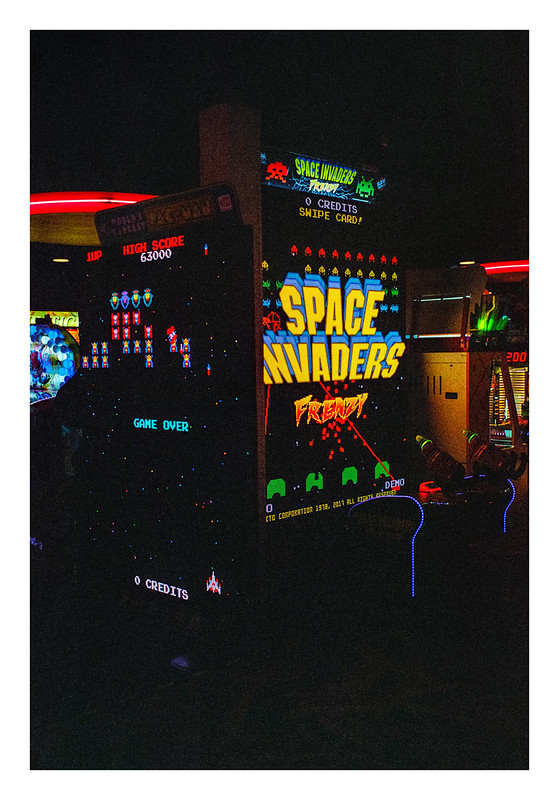
A couple of pictures to continue the seaside theme today, albeit with nary a grain of sand, nor a splash of salt-water in sight. Both these were made in that other stalwart of the seaside resort – the arcade. This one has been open as long as I can remeber (it’s definitely older than me), although it’s changed considerably since what was (to me and my own personal nostalgia, at least) its heyday.
Back then it was full of bleeping, blooping video games. At first the older titles like Space Invaders, Asteroids, Night Driver and such, but later expanding significantly as the craze for such games grew and grew. A few years later it was possible for show-offs to display theit skills on the Don Bluth animated laser-disc games like Dragon’s Lair and Space Ace, the huge cabinets given pride of place next to the street to draw the crowds.
This arcade is a sizeable place and it used to have some full-sized fairground rides within. A ladybird ride for the younger customers was near the ntrance, but a set of dodgems awaited the bigger kids right at the back of the place. Along one wall were a series of fairground stalls in the form of coconut shies, shooting ranges, ball games, and – perhaps most memorably – a place where you could make artwork by squirting plashes of colourful paint onto a sheet of paper that would then be spun at high velocity on a turntable to create amazing, psychadelic works of art. I remember with fondness the smell of the lacquer that would be applied to hold the image in place, and also the disappointment you’d get when it turned out that some of the paint had stuck to the inside of the card cover, ruining it when you later opened it.
I still love visiting Mablethorpe, and suspect I will for as long as I live, such were the happy memories formed there when I was a child, but each time I go I also feel a certain disappointment that things are not as I remember them in my youth, that the bleeps and bllops of the arcade games of old are mostly gone, the old stand-up cabinets replaced by larger “event” machines offering experiences that cannot be had on home consoles. Much of the floor space is now given over to fruit-machines and devices that let you win lengthy strings of tokens to be exchanged for prizes. It’s not the same as it was. But then, not many things are. Sometimes you really want a time-machine though…
Anyway, one of today’s images shows a couple of retro-games. Not the originals, but still enough to bring a smile to my face when I saw them.
In other news, my zines arrived today! This is the first time (other than the odd print) that I’ve ever had my photos published in physical form. The zines were made ostensibly for me to take part in a zine-swap with a group of other photographers, but I’ve got a whole bunch of them – it was the same price to get twenty-five copies as it was to get ten, so I went for the maximum. I can hopefully use the spares for other zine swapsies (plus I’ve already promised copies to a few people). I’m very happy with the quality of the materials and the reproduction of the photographs – I decided to go with a heavier weight 150GSM paper for the pages, with a 170GSM soft-touch laminated cover and it has a very nice feel to it. There are a few things for me to take away for the next time, but for my first go I’m more than happy.
Not the originals, but still nice to see the old alien foes in their natuaral environment.
I made a few pictures of this vintage Chevy on the way to Mablethorpe the other week, some with my Canon Sure Shot Z135, and some with my Zeiss-Mess-Ikonta 524/16. I photographed the same car before when I passed by last year, using the Zeiss on that occasion too, but with some Ektar (and in bright sunshine). The conditions this year were more subdued, the same layer of thin, high cloud that would be present most of the day, obscuring the sun so that much of of the light was diffused, removing much of the contrast. Despite this, I still like how both these images turned out.
I think the car is a Chevy Townsman from the early 50s, but I’m happy to be corrected by someone more knowlegeable about such things.
EDIT: I’ve been informed my fellow blogger, Jim Grey, that it’s actually a Chevrolet Sedan Delivery. Thank you Jim.
This is the Z135 shot, taken on Kodak Gold 200, scanned on my Plustek 8100 as a linear tiff and then converted with Photoshop and Grain2Pixel.
And this is the Zeiss shot, this time taken on Kodak Portra 400, scanned on my Epson V550 as a linear tiff and converted with Photoshop and Grain2Pixel.
It seems like it’s almost the law that you must make photographs of launderettes if you see them. That, or petrol stations (often at night). So, taday I’ll share a photo of a launderette.
I can see the appeal though, there’s something interesting about the places. They often have a sense of faded glory about them, many of them having fallen away as more and more people bought domestic washing machines. There’s still a demand though, whether it be for full service washes, or when you need to launder a bulky item like a quilt that simply won’t fit in the machine at home.
I remember my mum taking me in a launderette on a number of occasions when I was little. It was fascinating place for a young boy, full of buttons, dials, coin slots, washing powder dispensers, and a long row of heavy-duty washing machines and tumble driers full of other people’s clothes spinning round-and-around. The air would be filled with the warm scent of detergent and fabric conditioner and, if I was good, I would get a hot-chocolate in a plastic cup from the vending machine mounted on the wall.
I think the lunderette in my post today probably does good trade. I expect that seaside towns, particulalry those with large camp and caravan sites, have a strong demand for laundry services.
In other news, I shot another roll through my Lipca Rollop II yesterday, this time with a makeshift felt skirt fitted to the lens standard to attempt to combat the light leak. Alas, it didn’t work, three frames show the same arc of light as before. Now I need to decide what to do with the camera – when it works (usually when focussing on items further away) the lens is sharp and produces very nice images. Unfortunately, despite this, the fault means I can’t rely on it fully. I’m not sure that I want to pay for a repair as I have another, fully-working, TLR anyway, so I might sell it on as a working, but faulty camera.
I’d wondered if I’m manage to make my annual trip to Mablethorpe this year. The lockdown of a few months ago had made it seem unlikely for a time, but as restrictions loosened, so it started to look like I might make the trip after all.
As I had a week off work in early September, I decided that would be my chance, so made the trip on the 11th. The weather was forecast to be partially sunny, but in the end was just bright, with a skein of high cloud that mostly removed any contrast and shadows, Not ideal for colour film, which I feel savours blue-sky days. Still, in a country like the UK you have to make the best of what you get when it comes to the weather. In the end though, these shots have come out quite well despite the conditions.
I took a bag full of film with me on the day. Well, around six rolls anyway. In the end, I only shot two-and-a-half of them though due to the light. Today’s photos were from a roll of Kodak Gold 200 that I’d already partially shot, but there will be some images on Ilford Delta 400 (better for the conditions I had) and, possibly, Portra 400 to come over the next few days too.
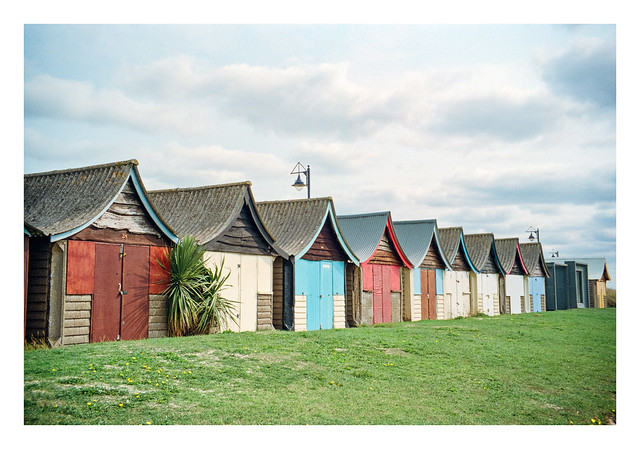
I managed to catch a little sunshine for this shot, as evidenced by the shadow cast by the palm. It required me waiting for some time with an eye on the moving clouds though, and the brightness was only fleeting.
For the best part of the last two years, whenever I’ve shot colour negative film, I’ve sent it off to be developed and scanned. While I have the means to scan it at home, I was never satisfied with the colours I achieved using Epson Scan. I tried a number of other tools to see if I could improve my results and managed to do better with Silverfast for 35mm when I bought my Plustek scanner, but the images still didn’t look quite right. So I resigned myself to getting lab scans of all my colour negative stuff.
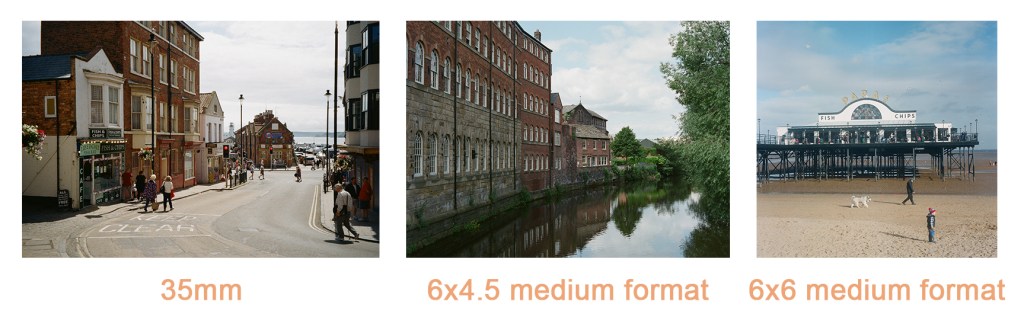
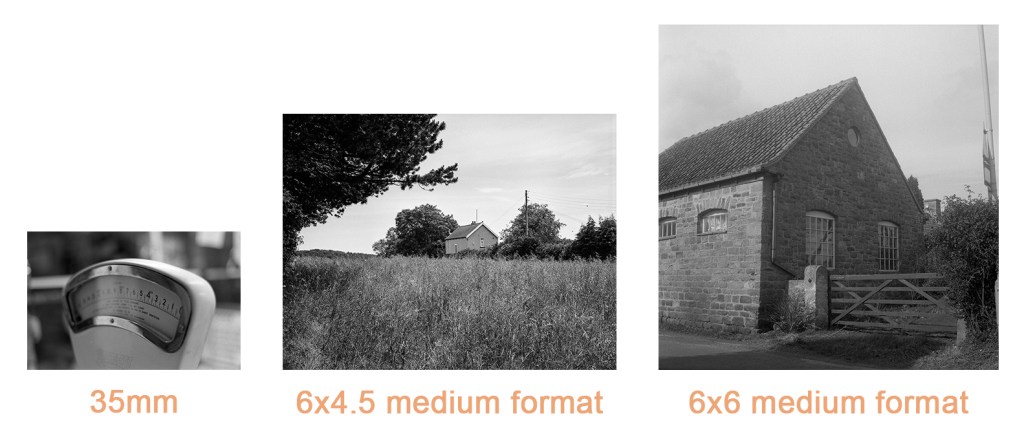
While I’ve been mostly happy with my lab scans, one point of frustration is the way they size the images. The labs I’ve looked at tend to offer scans in small / medium / large options which, on the face of it seems fine. However, what I came to realise was that a scan was based on a particular number of pixels on the short side of the image. This results in a bewildering situation where, for any given scan “size”, it seems medium format scans will be smaller than 35mm scans (or the same size, if shooting 6×9). This is clearly disappointing if you want to benefit from the added detail that medium format allows. The image below shows comparisons of three different image ratios and how the larger medium format images lose out when scan size is determined by the number of pixels on the short edge.
By comparison, when I scan at home I get larger scans for the larger formats, as can be seen in the example below with each image being scanned at a uniform DPI setting and not limited to a specific number of pixels per side:
This discrepancy in image sizes made me want to home scan my negatives. While I don’t think my Epson V550 or Plustec 8100 really compare with the abilities of something like a Noritsu of Fuji Frontier, the ability to control the settings means I can get much more detailed results than what the labs I’ve tried will supply. While I’m sure that there are labs out there who will provide higher resolution scans, many of them also charge a considerable amount for the service, putting them out of my price range unfortunately.
I’d seen very good word of mouth over the past year about Negative Lab Pro, but that costs in the region of £60, which isn’t something I want to pay right now (although I’ve been tempted), so it was with interest when someone alerted me to a new Photoshop plugin called Grain2Pixel recently. Grain2Pixel is used to convert negative scans to positives and is currently free of charge (although I believe a more feature packed version is in the works which will require payment).
In order to use the plugin, you have to make linear scans of your negative, e.g. it still looks like a negative after scanning. The plugin accepts TIFF and DNG files, so you can scan with a digital camera if you like. Once launched in Photoshop, you select your scans via the plugin’s interface, choose any settings you want to apply such as automatic colour correction, and then run the process. The process is straightforward and you can convert individual images or a batch.
I’ve tried a number of different film stocks with it and have been getting good results on the whole. Some that I’ve tried, such as Kodak Ektar and Kodak Portra 160 have looked great directly out of the plugin. Some others have been a little more tricky – Kodak Gold 200 and Kodak Portra 400 seem to have a blue / cyan cast no matter what settings I use. Despite this though, the results are still good and I am able to tweak the results further in Photoshop or Lightroom to get results I’m usually very happy with, with the extra benefit of having much higher resolution images.
The plugin can be found, along with instructional videos, here: https://grain2pixel.com/ There is also a Facebook group for the plugin which gets regular traffic and is useful if you need help.
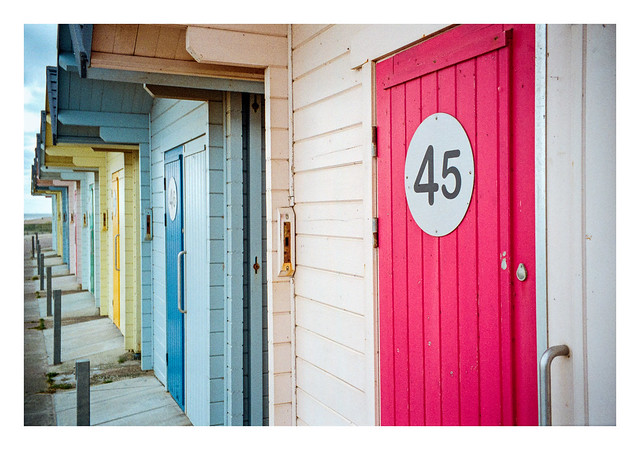
All three of todays photos have used Grain2Pixel for initial conversion. I’ve then tweaked the results in Lightroom to add additional contrast etc. They were scanned on my Plustek Opticfilm 8100 using Vuescan to create the linear TIFF files.