Switching cameras and film for the next bunch of photos from this trip…
You can just see the north sea in the shot, but I took this one because I liked the weather-vane goat.
A view north from the top of Spurn with rough conditions (although they didn’t seem so bad further down the point). The “promontory” jutting out to sea is actually the remnants or concrete wartime structures that have fallen as the cliffs recede due to coastal erosion.
A few miles out to sea stands a large offshore wind farm, something that has become a common sight from the North Sea coastline.
I wasn’t the only photographer on Spurn Point that day…
I wonder how much time has passed since this section of brick wall fell into the sea? I’m quite impressed at how well it is maintaining its structural integrity. Perhaps it will become a large and intricately patterned pebble some day.
More groyne remnants…
And another view of the remains of man’s efforts to hold back the tides…
Among the other debris, there were a number of lobster pots washed up on shore (or shortly about to)…
There are lots of pieces of chalk scattered across the seaward beaches of Spurn Point. These have most likely been transported south from the exposed chalk cliffs at Flamborough, almost fifty miles up the coast (although the entire Holderness coast is under laid with a bedrock of Cretaceous chalk, this is mostly covered by glacial till).
Nikon F80, Tamron 28-300mm F/3.5-6.3 Di VC PZD on Fujifilm Acros. Ilfotec DD-X 1+4 9mins @ 20°.
Today’s shots were also taken with my GW690, although on a different roll of film: Some Kentmere 400. Unlike the Fomapan 400, there were no defect on this roll, plus I avoided any potential bromide drag by using standard development with regular inversions. I’ve shot a couple of rolls of Kentmere 400 now and both times I’ve found it gives quite bright results and I have to drop the highlights a little. Not sure if it’s a feature of the film, or the way I’m developing it.
The first four shots were taken around the tip of Spurn Point showing the beach and dunes beside the estuary opening. In the shot of the dunes you can just make out an old sea fort dating back to the first world war in the distance. There are two forts: Bull Sand fort, and Haile Sand fort. I think the one in the picture is the former. The structure in the fourth shot is the sea traffic monitoring station. I’m not sure if it’s still manned at all, but the radar is active and the tubular antenna at the top of the building was constantly rotating.
The next four shots are of groynes and other sea defences, or what remains of them at least. These are no longer maintained, with the land now left to natural forces. You can see the battering that the man made defences have taken from the tides. I particularly like the final shot where pebbles have been jammed between the boards of a groyne by the force of waves and resulted in what reminds me of some sort of aquatic abacus.
Spurn Point is a location I’ve wanted to visit for a long time. It’s a spit of land that extends from the Holderness coast in Yorkshire into the mouth of the Humber estuary. It is a slender piece of land three miles in length, widening at it’s southern tip, but being less than 50 metres wide at it’s narrowest point.
At times during its recorded history, storm tides have breached the neck, cutting off the tip and forming an island. The last breach was, I believe, back in 2013 which destroyed the single road to the tip making it passable only by foot or all-terrain vehicles (such as a Unimog truck that ferries tourists to the lighthouse and back).
The Holderness coast, and Spurn, are subject to significant coastal erosion (spurn being the beneficiary of the material eroded from further up the coast) and this has affected the geography of the location over time with various settlements lost to the sea in past centuries.
Spurn has been used for a number of purposes over it’s history, including coastal defence, lifeboat station, and the location of lighthouses and traffic control for shipping passing in and out of the Humber. It is now owned and managed by the Yorkshire Wildlife Trust and attracts a large number of visitors keen to experience the creatures, particularly birds, that make their homes there.
There are two lighthouses still standing on Spurn, both now decommissioned – Smeaton’s high light, and Walker’s low light. The Walkers lighthouse stands in the mud flats to the west of the strip of land, it’s light aparatur removed and replaced by a water tank. Smeatons light stand on the land of the spit and is open to tourists, and you can climb the narrow staircase to where the light was once installed. Other noteable structures include the lifeboat crew houses, which are also empty, the tall shipping control tower with its still active radar, the old lifeboat jetty, and various structures remaining from wartime.
I made pictures with three cameras across four rolls of film, so I’m going to split them into batches. This first set were shot with my Fujica GW690 (Texas Leica) on Fomapan 400. Sadly, the pictures were affected with a defect giving a lot of white speckles on the final images. This was also compounded by bromide drag when I developed them, although I’ve Photoshopped the worst of this away. Despite these setbacks, they still have a certain charm to them, I think.
I received my invitation to take part in this year’s Emulsive Secret Santa last week. I was wondering if it would still be going ahead as Emulsive.org, the site from whence it originally sprang now seems to be defunct, having not been updated for quite some time.
So I was glad to get an email inviting me to this year’s gift exchange although, due to the current tariff situation in the US, the swap has been split into US and rest of the world sections this time around. Registration closes tomorrow, after which people will be provided with the details of their recipients and the task of finding a suitable gift begun (timescales are quite tight this time, so it’s likely that some folks will be receiving a late Christmas gift, but that’s not so bad – January can be quite glum, so a nice present arriving in the mail will cheer things up somewhat).
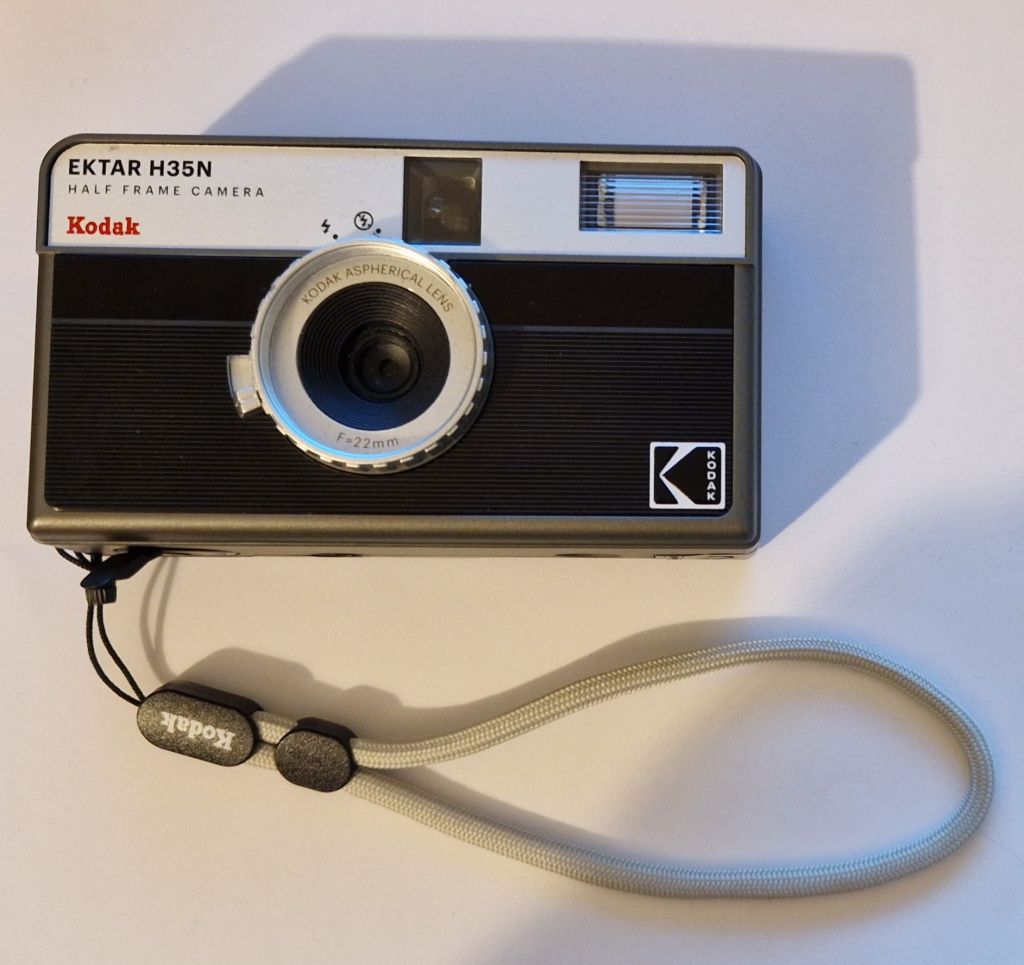
I was very fortunate last year to receive not only a bunch of 35mm film a lovely notebook, and other goodies, but also a Kodak H35N half-frame camera, and it was with this that I shot the pictures in today’s post (although I already posted a few others about six weeks ago).
The camera itself (branded Kodak, but actually made by RETO) is a relatively simple affair with a 2 element 22mm f/8 coated lens (part glass, part acrylic), a 1/100sec shutter speed, a built-in flash, and a built-in star filter. For it’s basic spec, the camera produces reasonable pictures if you don’t mind noticeable softness at the narrow ends of the frame. I didn’t feel any need to scan them at high resolution because the detail simply isn’t there, but at smaller size they look nice and, as is the case with any camera, it’s what you do with it that counts.
The camera design has a clear lineage to the old Kodak Instamatic models. It’s very lightweight and doesn’t feel like it will take much rough handling (but for the price, that is to be expected), but it works perfectly well in use and I didn’t have any sense that it would break – something my other RETO-made camera, an Ultrawide and Slim, does suffer from in regard to advancing the film. The film advance on the H35N was fine, as was the film rewind crank, which is located on the base of the camera along with a plastic tripod socket.
The top of the camera features the shutter button, frame counter and, because there is a bulb-mode, a cable release socket, which is nice to have and opens the camera up to additional creative possibilities. Apart from bulb, because of the otherwise fixed shutter speed and aperture settings, there is no ISO setting control, and certainly no DX-coding mechanism is required.
I didn’t have a need to use the flash at any point (and didn’t have a battery in the camera anyway – the battery is only needed for the flash), and the star filter feels somewhat gimmicky and not something I would want to use anyway. So I didn’t.
Although I like the pictures I got when using the H35N, I can’t help thinking that I would probably have liked them more if I’d taken them with a different camera – even if it would have meant using twice as much film. However, despite these reservations, I still had fun using the camera, got pictures I like, and it’s made me think about maybe getting a better specced half-frame camera somewhere down the line – maybe an older model like an Olympus PEN, or perhaps a Pentax 17 if I can find one for a decent price.
I’ll post some more pictures from the H35N tomorrow – half-frame gives you a LOT of photos!
Kodak H35N & Kodak Gold. Lab developed. Home scanned and converted with Negative Lab Pro.
I visited the city of Ciutadela twice during our recent holiday in Menorca. The first time was withe my wife, although we didn’t stay long, instead catching the bus across the island to the current capital, Mahon (or Mao as it appears on all the signs).
The second visit I made solo, leaving my wife to read her book beside the swimming pool, while I took the bus so I could explore and take photographs.
I took a whole bunch during this visit, both on film and digital, and below are a few of the latter, taken on the gorgeous (and quiet) backstreets of the city’s old town area. Interestingly, almost all my pictures in this part of the city are in portrait orientation, suiting the narrow streets, I think.
I still have a bunch more photos to share from the trip to Menorca, but I haven’t even started scanning the film photos yet!
I thought I’d finished posting my pictures from the day-trip I took to Hull a few months back but then I remembered this lone medium-format picture I took.
I’d planned on shooting more pictures with this camera – my 1950s Zeiss folder – but when I retrieved it from my bag after I took this shot I noticed that the film advance knob had fallen off! Luckily the bits were in the bottom of the bag but, without a screwdriver, I was unable to make a repair. Later, when I got home I put it together again, but something wasn’t right – the dial was wobbly in a way it hadn’t been before, so I feared that I might have lost some of the mechanism after all.
Then, a few days later, I decided to take another look in the camera bag and there, squeezed right under the padding at its base. was the final missing piece of camera. After fixing it back together properly I then shot the rest of the film on a couple of further outings – although there were further problems to come… I’ll reveal those in a future post.





 Steel City Snapper photography