It seems that, whenever a new building is being built in Sheffield, that there’s a good chance that it it will belong to the university (or one of the universities, I should say, as there are two). This part of the formerly industrial district of Attercliffe has not escaped, and there are several new buildings in place, some new development underway, as well as a host of sports facilities (which is perhaps as it should be, as the area used to be the home of the now demolished Don Valley Stadium that was originally erected for the World Student Games that was held in the city in 1991.
The building in the background in the above picture is the English Institute for Sport. Below is another view. I wasn’t sure if the masts are a structural feature, or there for show, but a quick online search reveals that they support the building’s roof.
Last month I took my Zeiss Mess-Ikonta 524/16 folding camera for it’s first outing in quite some time – about two years, in fact!
It’s quite a nice camera, if a little slow to operate due to its uncoupled rangefinder design which requires focus to be achieved by means of a dial on top of the camera that operates the rangefinder, and then manually transferring the distance on the dial to the lens itself. The lens is quite nice though and gives good results if you set it correctly. Plus, of course, the folding design means it can be slipped into a pocket (ok, a big-ish pocket).
Transferring the focus distance is straightforward enough but, if you’re not paying attention (or haven’t used the camera in a while!) it can be easy to make mistakes where some of the distances have half marks. This is what happened on this outing, and I only realised after I’d taken four or five pictures. I hoped that my use of small apertures might have reduced any focus issues, but on looking at the scans, a few frames are noticeably soft.
The two shots shared here are ok though, as are some others that I’ll share over the next few days. Hopefully I’ll pay closer attention next time I shoot with the camera.
Part one of this walk ended as I passed through a small area of woodland that marked the turning point where the circular route began its return back towards the starting point. Perhaps the most well known landmark on this leg of the journey is Robin Hood’s Stride, but before I got there I took a small detour to Nine Stones Close (also known as The Grey Ladies), a small neolithic stone circle that stands beside a tree in a nearby field.
There’s something fascinating and a little eerie about stone circles, both in their age, and the limited understanding we have as to why they were constructed, but also – in large part – the fact that they feature heavily in a number of fantasy / sci-fi movies and TV shows I’m fond of, notably the 1979, John Mills starring, Quatermass series, The Children of the Stones, and the Doctor Who story, The Stones of Blood. All heady material for the youngster I was back when all three aired.
After admiring the stone circle (you can see some more photos I took here), I set off back towards Robin Hood’s Stride, first passing a couple of lone trees, one dead, one alive.
Robin Hood’s Stride is a gritstone rock formation, notable for the two pinnacles at the eastern and western end. The pinnacles are named “Weasel” and “Inaccessible” and legend has it that Robin Hood was able to jumped between them in, hence the name of the formation. All I can say, is that Robin Hood must’ve had some sort of Olympian-level jumping skills as the two pinnacles are around fifty feet apart!
Unfortunately, when I arrived the sun was to the south, backlighting the rocks to a degree, so I wasn’t able to photograph the whole structure in the best light. I took several other close-up shots of part of the formation though, including some carved graffiti that has been there quite some time.
I climbed to the top of the formation, although it was tricky with my backpack, tripod, and walking poles, but there were nice views. A couple were up there already, eating their lunch.
The view back towards The Grey Ladies was a nice one, though probably not done justice by the XA3 on this occasions. The stone circle can be just made out in the centre of the frame if you look closely.
After a drink of water, and a careful descent, I took another short detour from my route, this time to another rock formation named Cratcliffe Tor. This is a popular spot for climbing and bouldering, and there were signs of this in evidence with dusty powder marks on the stones where people had sought places to get a grip.
Cratcliffe Tor is also the site of a hermitage dating to the 14th century. The small cave is now fenced off as it was being used as a shelter for climbers, but behind the fence it is just possible to make of a crucifix carved into the rock. You can just about see it on the second picture below about a third of the way from the top right of the image.
After visiting the hermitage, I made my way back to my route and began a descent down the hillside east of Robin Hood’s Stride, passing a bench bearing the name of someone called Hillary.
Looking back up the hill, the rock formation can still be seen above the trees. Another name for the location is Mock Beggar’s Mansion as, from a distance in the right light, it looks a little like a turreted house.
In the hilly Peak District countryside, the descent soon turned back to ascent, and I followed a steeper-than-it-looks lane past a couple of houses on the final stretch back to Elton.
A footpath branched away from the lane, taking me through a number of muddy fields. To my right the path was bordered by a fence and trees. A rope swing hung from one.
Another tree had seemingly absorbed a cable as it had grown, resulting in a shape in it’s trunk that reminded me of someone sucking spaghetti!
To the north, Robin Hood’s Stride and Cratcliffe Tor could still be seen peeping out of the ridge line.
I reached the brow of the hill I was climbing and could now see the houses and Church of Elton come into view.
As I walked back through the village to where my car was parked, I passed a man cleaning his car with a jet spray. He turned it off as he saw my approach, but I cheekily asked if he wouldn’t mind spraying my feet with it to remove the thick clods of mud attached to my boots. He was amused by the request, but I soon had clean (wet) boots again. 🙂
Another digital shot today. As mentioned yesterday, I’ve been out all day today meeting up with some film photographer friends. We met up in the village of Castleton in the Derbyshire Peak District and spent the day wandering the village and surrounding area. We were all shooting film, but I also had my Ricoh GRII with me, and took the photo you see here today. The picture here today is of Cavedale, a gorge just to the south of the village. Up at the top on the left is the keep of Peveril Castle, which we climbed to earlier in the day.
I shot a roll of 120 Tri-X, plus most of a roll of 120 Fuji Pro 500H and 35mm Ilford HP5+. The HP5+ was shot using my new 28-300mm zoom lens, so it will be interesting to see how those turn out (and if I’ve managed to mess any of them up…). I’ll post any worth sharing once I have them developed and scanned.
I had, again, planned on writing the second half of my Elton to Robin Hood’s Stride post today, but I ended up working late and now don’t have the time. Tomorrow might not see it written either as I will be out most of the day. Maybe Sunday, eh?
So, in the interests of brevity, here’s an old picture of a toadstool.
Apologies to anyone expecting the second part of my post covering the walk between Elton and Robin Hood’s Stride. That should be here tomorrow – I got waylaid today, unfortunately.
Here instead is another photo taken during the walk but which didn’t feature in the first half of the post published yesterday.
This is the third of these posts, and the second for which I selected a hike from my Ordnance Survey book: Peak District – Outstanding Circular Walks. I was going to be slightly OCD about the routes in this book and do them in order, but I then decided that would be silly and that I should do them in whatever order suited me. In this case, I skipped the second walk in the book because it was a location I’m quite familiar with, and this one is somewhere I’ve never visited before.
The route of this walk is in the Derbyshire countryside to the north of the village of Elton. It’s a short route of just over three miles, with an elevation of 750 feet. While the guide gives an approximate time of 2 hours to complete the walk, because I’m faffing around taking photographs, it took me somewhat longer.
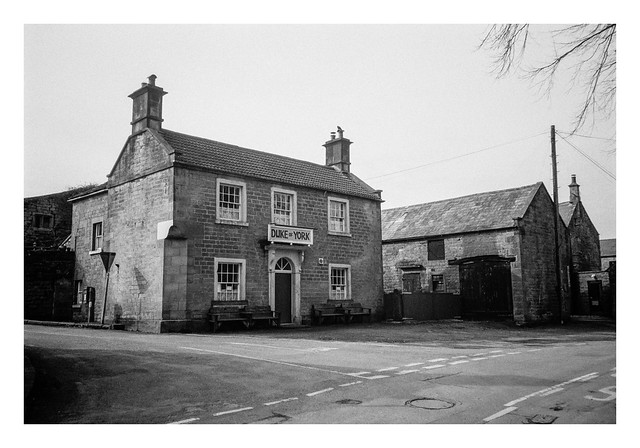
Although Elton isn’t too far, much of the drive there is on smaller roads, so it took about an hour to get there and park up. The weather was a little overcast when I arrived, but with the promise of some brighter spells later. The starting point for the hike is outside the Duke of York pub, across from the village church.
Not long after this, there was a slightly confusing branch of the path in a field that first had me wandering around some farm machinery before wandering off down the wrong fork. It was a little while later, after descending a hill and then crossing a large pool of muddy ground near the entrance to a field that I realised my error. Luckily, re-checking my map, I could see that the narrow road I was now on would curve around and intersect the original footpath, so I stayed on this course. This wasn’t a bad thing as, part way up a hill at a bend in the road, I came across a series of water troughs, fed by a spring.
These troughs are called the Burycliffe Troughs and the spring that fills them has never been known to run dry. Until 1940, these were Elton’s main source of drinking water, and men, women, and children would walk here in all weathers to collect water in buckets and then carry them back up the hill to the village. One enterprising farmer would fill urns of water and transport them in a cart, selling them for a penny a bucketful.
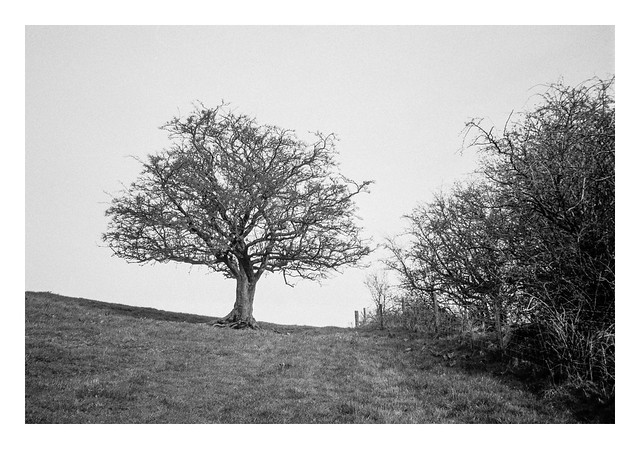
A little further up the road I rejoined my original route and broke off into a field to the left. The path led through another field where this tree stood near the ridge of the hill.
As the path descended, it reached another track, this one leading to a Christian sanctuary / retreat. On the other side of the track a lone piece of farm machinery stood on the grass.
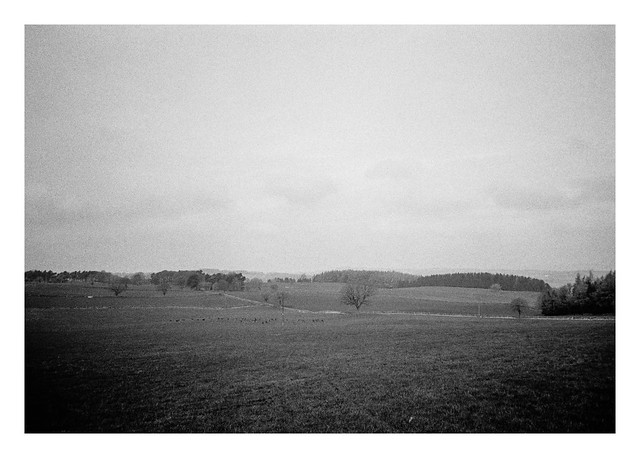
While crossing the next field I spotted a herd of animals off to my left. I soon realised that these were deer. I took a photograph but it should be noted that the Olympus XA3 is not a useful wildlife camera. You can see the deer in this picture though – they are the black pixels about a quarter of the way up the frame. 😀
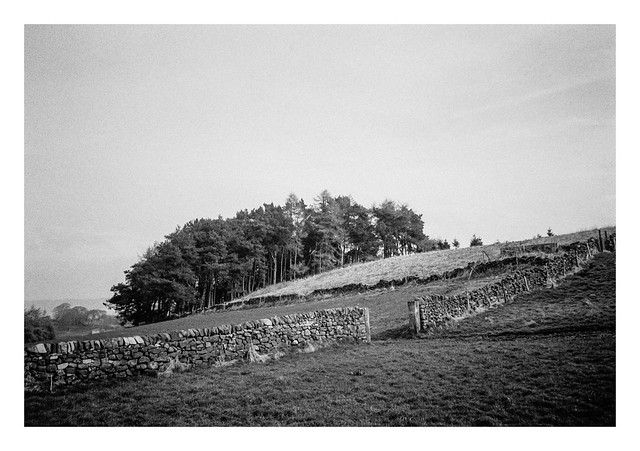
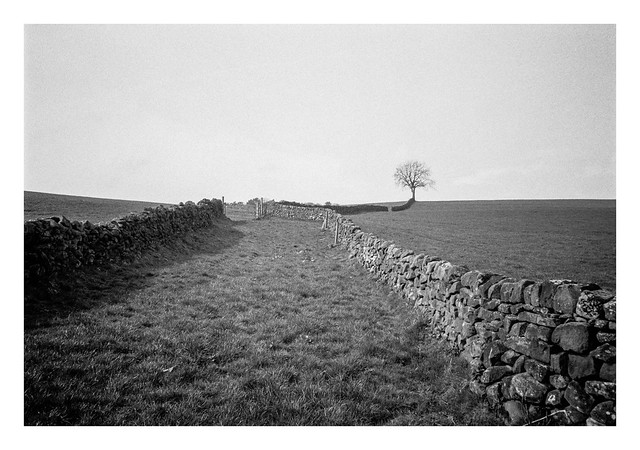
One thing you find a lot of in the Peak District (and, to be fair, a lot of the British countryside) are drystone walls. This arrangement of walls with a lone tree looked like a decent photograph to take.
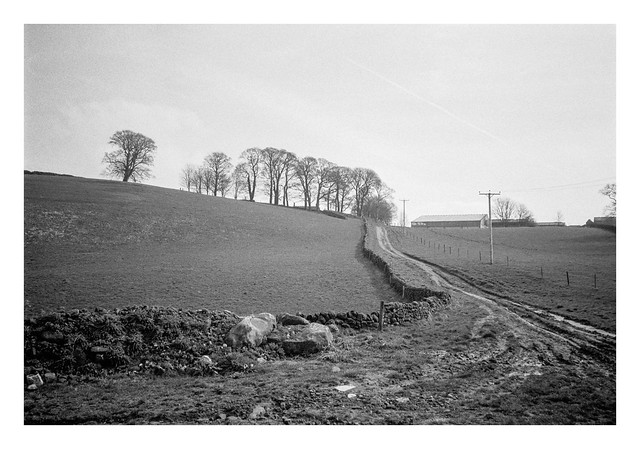
In the opposite direction, a track led to a farm sitting atop the ridge of a hill.
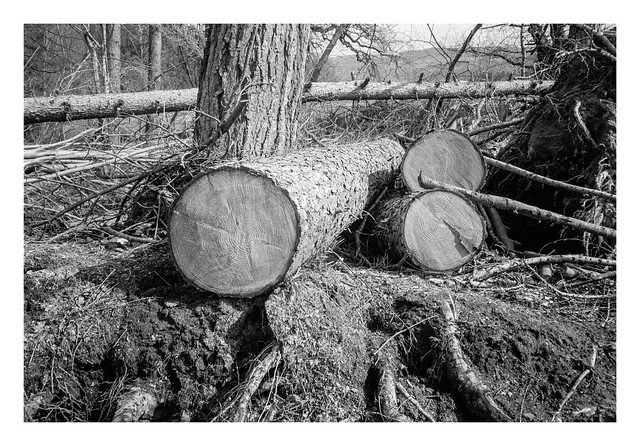
A little further along the route, the path I needed to follow crossed a small stream before curving up and to the east through some woodland. There were signs of forestry activity here, and it marked a good place to park myself on a fallen log and take a drink of water. It also marks the place where I’ll leave the first part of this post. In part two there will be stone circles, rock outcrops, and a hermitage!
Another handy digital post. I’ve been traveling for work today, so still haven’t had time to start my next “Walk With a Camera” post yet. Maybe tomorrow…
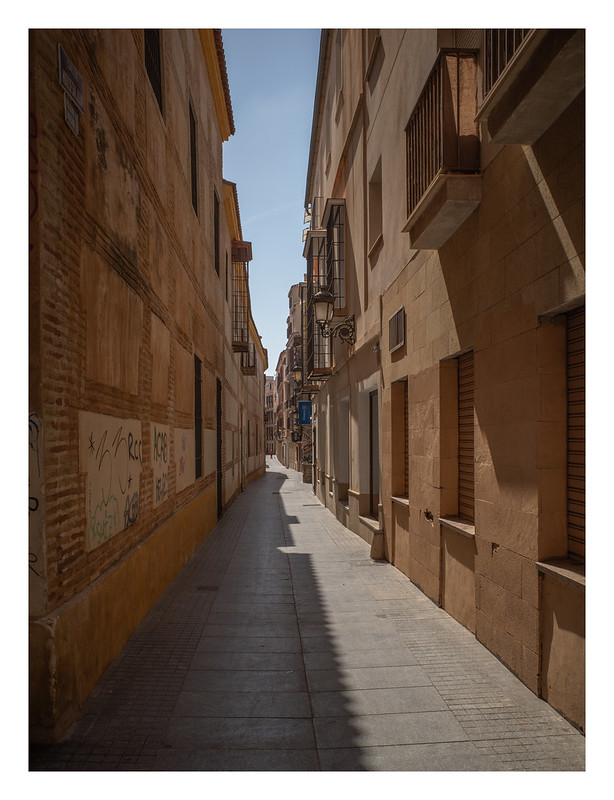
So here’s another shot from Malaga last year. I liked this scene because the three groups of people seemed almost in formation.
This picture was taken in Malaga last year. The place was heaving with crowds of people as the annual Feria de Malaga was taking place while we were there. Everyone was drinking Cartojal, a local sweet wine, and many of the women and girls were wearing flamenco dresses.
I have another of my “Walk With a Camera” posts coming soon, but I haven’t put virtual pen to ink yet, and I don’t plan on rushing it today. I’ve been out mist of the day, firstly seeing The Fall Guy at the cinema with my wife, and then’ when I got home, on a shortish walk to Rother Valley Country Park to test a new lens I’ve bought.
I’ve bought a Tamron 28-300mm zoom lens that will fit my Nikon F80. I think it will be a good choice for when I go on future hikes as it should give me a lot of versatility. The F80 can make use of the image stabilisation on the lens (although I’ve found, slightly annoyingly, that only with a half-press of the shutter, and not with my preferred back-button focusing method). This should prove useful when using the longer focal lengths.
A zoom like this is never going to beat a prime, but as it’ll be used with 35mm film – probably 400asa – then I’m hoping any noticeable shortcomings will be minimal. I only took two shots with it today – all that remained on the roll already in the camera – but they’re at 200mm and 300mm, so should give me some idea of what I can expect when zoomed in. I’ll try the wide angle end on the next roll. I’ll give my thoughts and post some pictures once I’ve gotten them developed and scanned.
Anyway, in lieu of a film photograph today, here’s a digital shot from my trip to Malaga last summer. It’s been hot and humid here in the UK today, so it brought back memories of Spain.