I was pleasantly surprised to hear today that Kodak is introducing a new 120 film choice. Or rather an existing film in 120 format in the guise of it’s consumer grade Kodak Gold. I’ve wished for a lower-cost alternative to Kodak (and Fuji’s) pro-grade films for medium format use so this is great to hear. Of course, here in 2022, Kodak Gold in 120 format is more expensive than Portra or Ektar were just a few years ago, but that seems par for the course at present.
I quite like Kodak Gold in 135 format (although I’ve tended to use Colorplus more), so I’ve splashed out on a pre-order of the 120 format Gold to see how it fares. Hopefully it’ll be in my hands sometime in early April. All things considered though, if colour film maintains its high price point then I’m likely to err even more strongly to my preferred black and white choices purely from an affordability standpoint, with my colour film use limited to where I know it’ll really be worthwhile. I tend to shoot much more black and white anyway so my current stocks of colour film are likely to keep me going for a while yet.
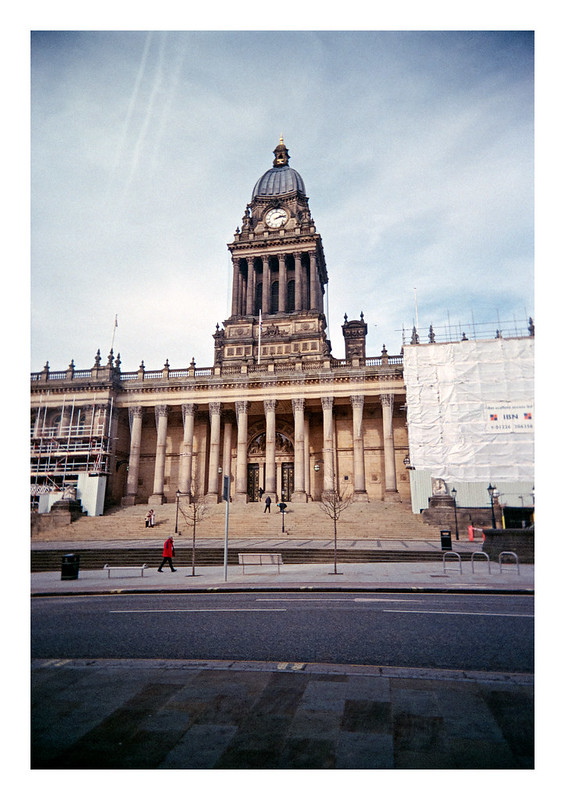
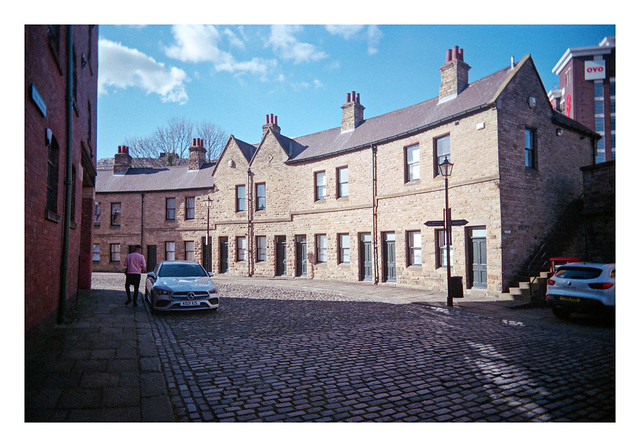
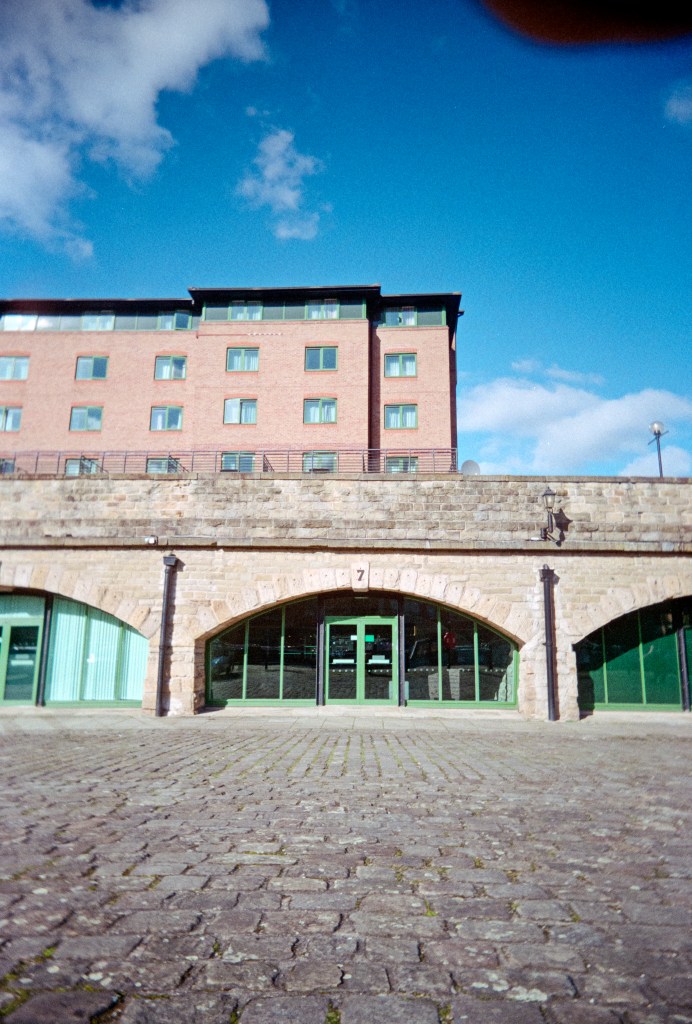
Another colour photo from the Reto Ultrawide & Slim today, and one which exemplifies how much of a scene is omitted when seen through the camera’s viewfinder. In this shot I had composed the scene to include the main arch and the smaller arch to the right. The leftmost arch, the person walking into frame left, and the rear of the car on the right were not present in the viewfinder. I guess I will begin to factor this in as I become more familiar with the camera over time.
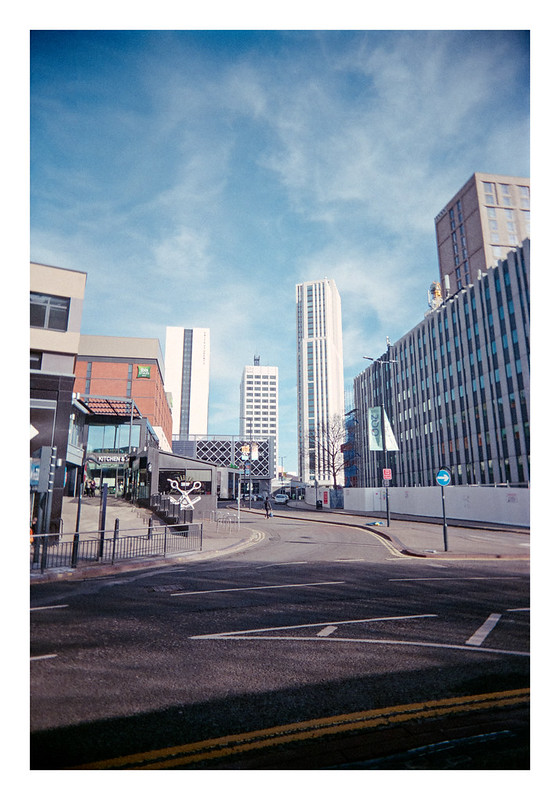
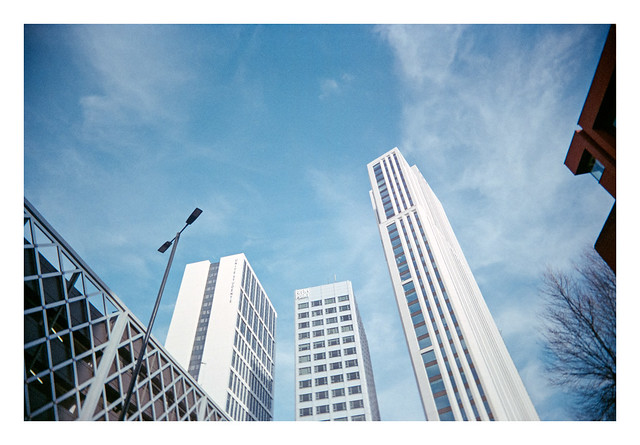
Reto Ultrawide & Slim & Agfa Vista Plus 200. Lab developed.
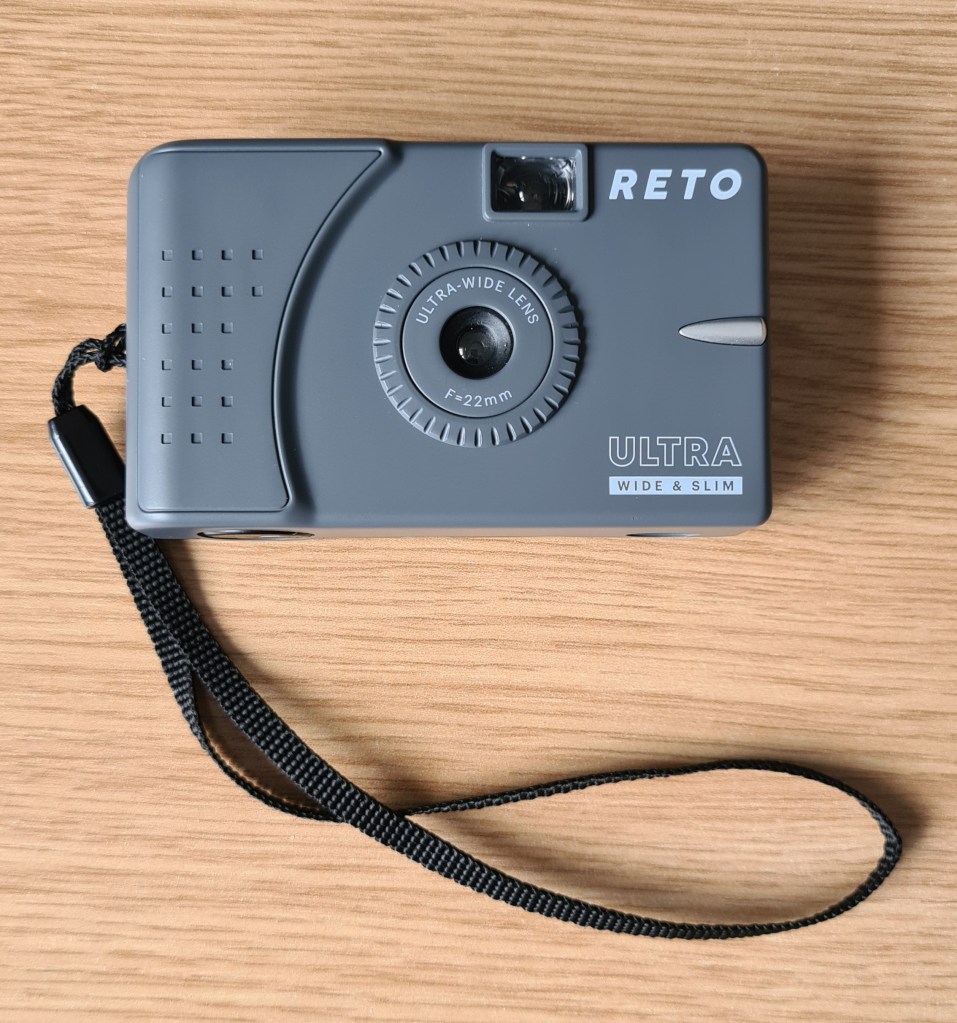
A month or two ago I became aware that a new film camera was about to launch. As with most new film cameras these days, this was not to be an SLR, rangefinder, or fully-featured compact point and shoot, but something rather more basic in the shape of the Reto Ultrawide & Slim.
There have been a number of other back-to-basics cameras launched in the last year or two, but these have mostly been in the form of re-useable disposable cameras (if that makes sense – basically the same features as a standard disposable film camera, but with the facility to re-load with normal rolls of 35mm film. More cost effective and flexible in the long term, and also better for the environment.).
This wouldn’t have been possible without the 22mm lens.
In terms of build, the Reto Ultrawide & Slim (UWS) is probably no more advanced than the aforementioned cameras. It’s almost completely made of plastic, including its lens. But in this case, it’s the lens that matters because, while most other cameras of this ilk use 35-40mm focal lengths, the Reto UWS packs a very wide by comparison 22mm lens, making it something of a stand-out amongst it’s competitors.
This one managed to find its way into Flicke Explore!
The camera itself is not a new design. It’s a clone of the Vivitar Ultrawide & Slim which was released back in the 1990s, manufactured by Chinese company Sunpet and marketed under the Vivitar brand. The Reto version isn’t even the first clone and another version produced under the Superheadz brand was also available for a while. Despite the different variants, all the cameras appear to be identical in terms of functionality, with the only differences being cosmetic.
In terms of specs, the camera uses the aforementioned 22mm lens – this is an uncoated 2-element design fixed at f/11 and constructed of resin. The shutter is likewise fixed to a single speed of 1/125 sec. The focus is fixed and reaches from 1m to infinity. Controls on the camera consist of a shutter button, a film-advance wheel, a film-release button, the rewind crank, and a switch to open the camera back for loading and unloading the film.
The fixed aperture and shutter speed are likely to dictate the film you choose to shoot. On bright days then a 200 or even 100asa film is probably fine (all the shots here are on 200asa colour negative film), but faster film will be a necessity when the light isn’t as good, probably going beyond 400asa in the conditions we often find here in the UK.
The person exiting frame left was definitely not visible in the viewfinder when the shot was made.
The build quality of the camera isn’t something that inspires confidence. The almost fully plastic build is very lightweight (the camera feels like it would blow away in a light breeze) and I’ve seen a number of places advising that it’s best to limit film to 24exp rolls as longer lengths can put unwanted strain on the advance mechanism (which I presume is also mostly plastic). I guess that time will tell as to how well it’s construction fares – so far I’ve put two rolls through mine, a 24exp roll and then, being the daredevil that I am, a high-risk 36exp roll. Neither posed any problems, although I could feel the tension (literally!) when winding on the final few frames from the longer film.
In terms of use, there’s not a lot to say. Loading film is easy – the rewind ratchet is a very simple design and is basically held in the camera by a plastic lug, but it works well enough. The shutter button is responsive and the shutter itself makes a quiet but satisfying click when fired. The advance wheel also works well, with the caveat that it did feel much tighter towards the end of the 36exp roll of film I shot, and I expect this might be a potential point of failure. Rewinding the film is likewise straightforward. The door release switch works fine, but I find that it doesn’t spring the door open and I have to pick at it with a fingernail to get inside.
So, most importantly, what are the photographs like? Well, that will always be a subjective opinion, but in my case I’m very happy with them. The lens has some notable shortcomings in the amount it vignettes (although nothing like as much as a Holga 120 or something like that), and also the drop off in sharpness at the edges of the frame. Both these things could also be said to add charm to the resulting images though. In the centre of the frame the lens is plenty sharp enough and equals some more advanced and fully featured point-and-shoot cameras I’ve used. It’s the 22mm focal length that is the big draw here though. Coupled with the f/11 aperture and deep depth of field, it can allow interesting compositional choices to be made and I expect that I will continue to use it for this reason.
Beyond the build quality there are a couple of other downsides to be aware of however. The first is the viewfinder. While it’s bright and easy to use, even for a spectacles wearer like myself, its coverage does not represent the full field of view of the lens, meaning that it’s very easy to get unwanted elements creeping into the edge of your compositions. This includes fingers! The lens is also very prone to flare apparently, although I deliberately chose my shots to try and minimise this. I have also found that the first roll of film I had developed had scratches on a number of frames but, giving the benefit of the doubt, I’ll wait to see if it’s repeated on the next roll before laying the blame on the camera for this. The scratches were rectified easily enough in Photoshop.
Finger alert!!!
Is the camera worth buying? Again that’s a very subjective question. If you live for crisp, sharp, high quality results with a range of controls and features to aid your photography, then probably not. If you enjoy the simple creative options that ‘toy’ cameras such as this offer, then you’ll be fully in your element. At £30 it’s relatively cheap to buy (although that doesn’t mean it’s actually worth that amount) and problably more affordable than the older Vivitar version which seemed to have been fetching much higher prices due to its popularity. I’m so far happy with mine and glad I bought it.
There are undoubtedly a lot of reviews and first impressions of this little camera popping up online, but here are a couple from my fellow bloggers Jim Grey and adventurepdx that are worth reading.
Reto Ultrawide & Slim & Agfa Vista Plus 200. Lab developed.
The building on the left of this shot – the one with the wooden structure attached – houses a Newcomen steam engine at Elsecar Heritage Centre. It is, apparently, the oldest steam engine in the world still in its original location, dating back to 1795.
Apologies for another succinct post today. My wife and I went out for the evening and I didn’t get chance to write something before we left. <feeble excuse ends>
Fujica GW690 & Ilford FP4+. Lab developed in Xtol.
I’ve not posted a power-lines photo for a while, have I? Well let me remedy the situation with this photo of a transformer (at least I presume that’s what it is – I know little of such things) stood at the edge of a flooded field.
It’s a mundane scene, and one that is undobtedly repeated countless times across the country (albeit with perhaps less flooding), but one that appealed to my eye when I saw it.
Fujica GW690 & Ilford FP4+. Lab developed in Xtol.
Sitting behind the Rockingham Arms pub (which I posted a photo of a few days ago) is this neat looking shed. There is a small sign on it saying “Players only on the green”, so I assume that the grass in front of it was once a bowling green. It’s now covered in wooden benches to cater for pub visitors though, although there were none to be seen on the windy February day on which the photo was taken
Fujica GW690 & Ilford FP4+. Lab developed in Xtol.
Yesterday’s post showed the round house at Wentworth in its entirety. Today’s picture is a closer perspective with the cottage beside it in full view. Part of me prefers this shot – there’s a lot of detail tucked away and it was probably the two busts beside the front door that drew me as much as the structure itself.
Fujica GW690 & Ilford FP4+. Lab developed in Xtol.
This odd looking house was originally a windmill, built around 1745. I expect that the crenellations and other decorative features were later additions when it was converted to a domestic home.
Fujica GW690 & Ilford FP4+. Lab developed in Xtol.
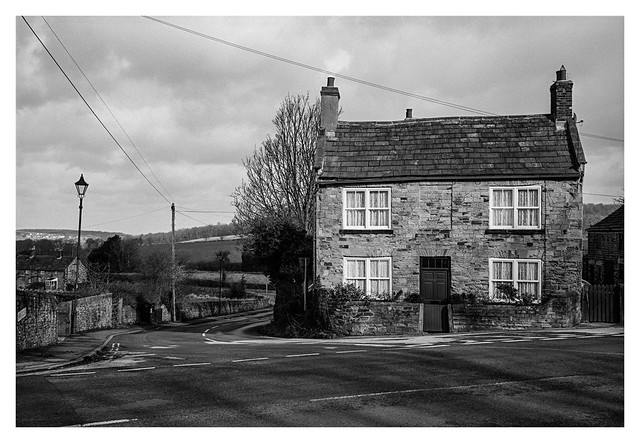
I took quite a while to get the composition how I liked it for this photo. Not a long time, but longer than my usual “there’s a photo! click” method. I saw there was a picture to be had but there were distractions / potential interest points at either side of the frame, so I spent a few minutes moving left, right, backwards, and forwards to get just what I wanted into frame – all the while being conscious that I was stood in a road and that cars might be approaching from my rear.
The right of the frame had a parked car which I wanted to avoid in the shot, but the left had some interesting street furniture that might have added to the photo, plus it showed the curve of the road at the side of the house to better effect. Unfortunately, positioning myself to get the stuff at the left in frame also meant that other unwanted things crept into view as well, so in the end I went for this version.
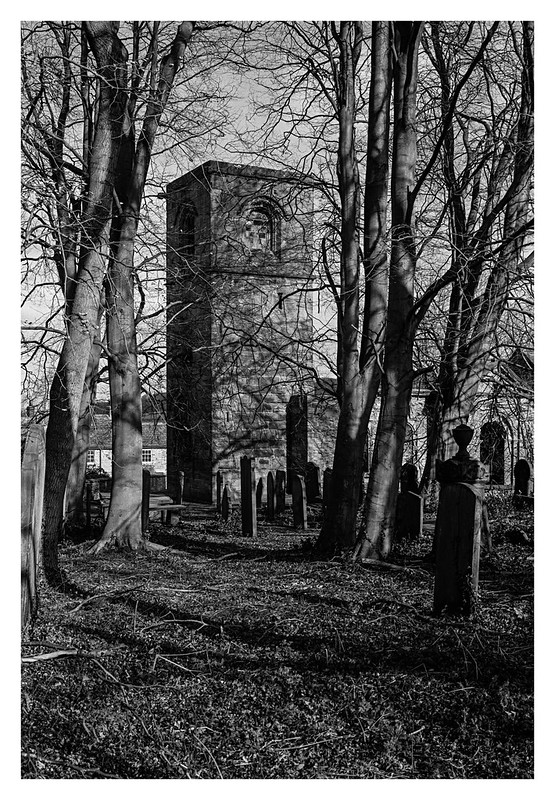
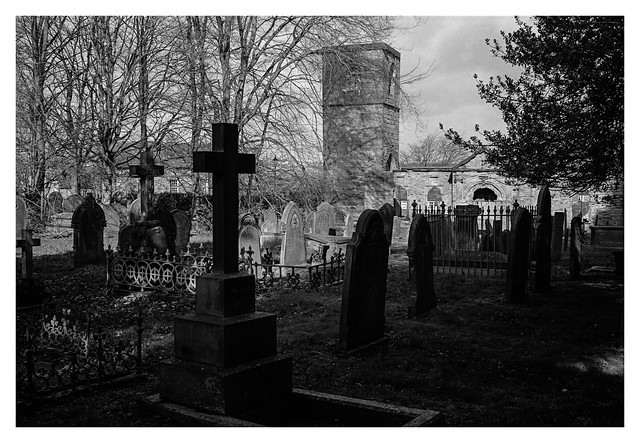
As a direct follow on from yesterday’s post, which showed the new Holy Trinity church – that’s if something nearing one-hundread-and-fifty years old can be considered new I suppose – today’s post shows the old church that preceded it.
The old church tower predates the new one by four or five hundred years, with the rest of the structure having been rebuilt in 1684. The construction is of sandstone and the centuries have taken their toll with the masonry being quite worn by erosion in places, particularly the decorative stonemasonry elements such as carved figures.