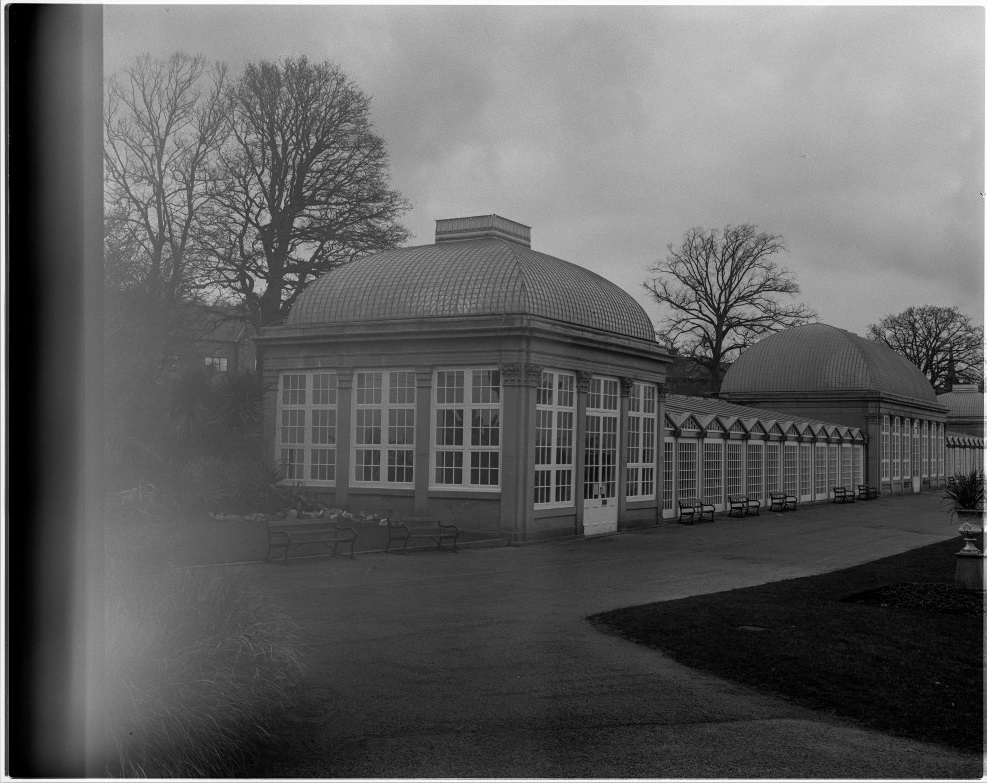
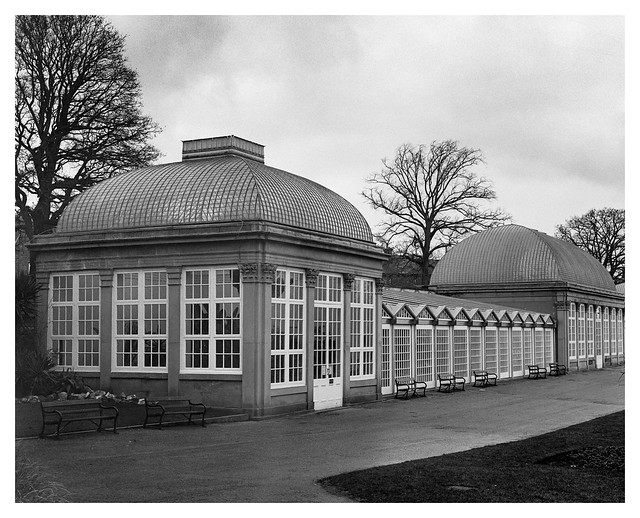
One of the two photographs I took of the Botanical Gardens was a bit of a bust. The shot was alright but I got a big light leak on it. I suspect the leaks I sometimes get when shooting large format are caused by my taking insufficient care when removing the dark slide, perhaps pulling the film holder away from the camera slightly and letting light in.
Given the time and effort it takes to shoot large format (and the cost per sheet!) I decided to attempt to rescue the picture in Lightroom. I had to crop it by a not insignificant amount and then had to apply quite a lot of dehaze and spot editing to try and remove the worst effects of the light-leak. In the end though, I managed to salvage a reasonably useable image from the original. It’s not perfect – the contrast is a bit crunchy, resulting in some crushed blacks, and quite a lot of noise has been introduced, but better than no image at all.
It can’t be too bad – it managed to get into Flickr’s Explore pages somehow!
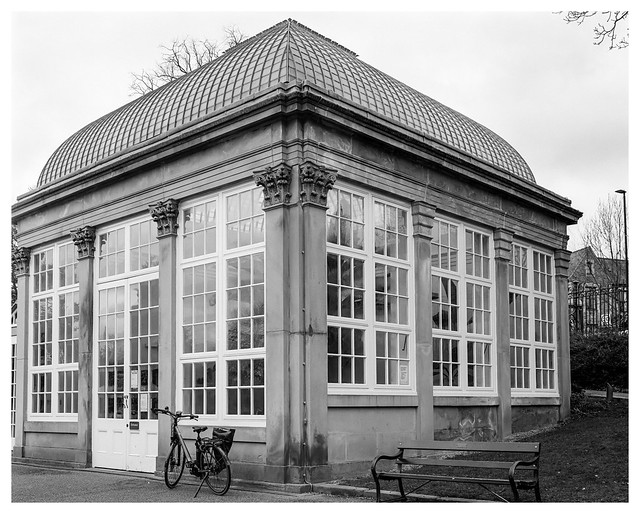
Continuing a theme from yesterday’s post, here’s another shot where my composition is out. In this shot I needed more of the foreground to avoid cropping the bench, and also more of the left hand side to avoid the edge of this part of the greenhouse being cropped. I should have moved further back, which would have solved both isssues.
Someone did point out that the loss of the left hand side of the frame could have been caused when inserting the film-holder, which could have accidentally caused the tripod head to rotate slightly if it wasn’t locked tight. It could easily have been my fault for not checking my edges carefully though.
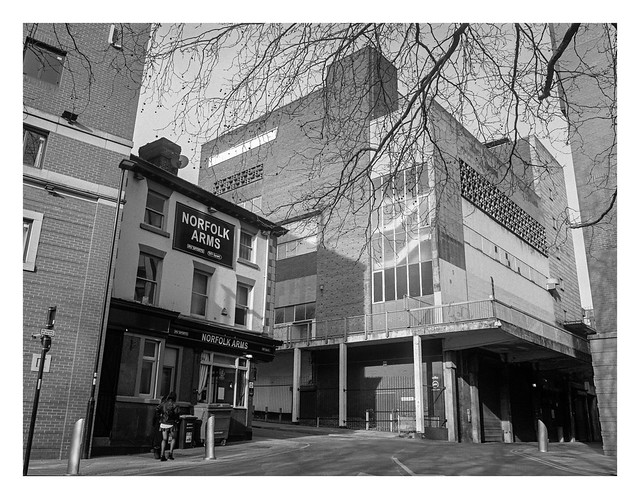
Today’s picture is another that would have fit well in my post about converging verticals that I published a couple of days back. It’s another image where the converging lines work well to produce a sense of scale in the composition, the buildings towering over the viewer (and the people in the scene) even though they are relatively low-rise structures.
Bronica ETRSi & Zenzanon 50mm f/2.8 MC & Ilford HP5+. Ilfotec DD-X 1+4 9 mins @ 20°
A chap I know who shoots exclusively in large format claimed that I’d damaged his eyes with the converging verticals in the shot below. He suggested I take the picture again with my 4×5 camera. He was joking, of course, but it did make me think about the opposition to this geometrical distortion when it occurs in photographs.
Converging verticals seem to cause quite some consternation when they appear in photographs – the photography club I used to be a member of had photo competitions where, should your vertical lines not be perfectly perpendicular, you would lose points and receive a judgemental comment from the, well, judge. It was this sort of arbitrary nonsense that, in combination with covid shutting everything down for some time, led to me stopping attending, even though the other club members were all very nice people (and I should emphasize, the judges were not members of the club).
Converging verticals are how things appear to the eye though, so attempts to “correct” them is inheritantly false unless the photograph was made from a location where they do not occur, such as ensuring the camera is aligned with the ground, or you are so far away that the effect becomes minimised by distance. Stand at the foot of a tall structure though, especially one with regular features such a an office building with regularly spaced windows, and look up and you will see converging verticals. It’s just perspective. In exactly the same way that a long straight road will appear to narrow to a point in the distance, so looking up at a tall building will show the same effect. And I never hear anyone complain that photographs of roads should have the perspective corrected.
I do think that some shots can work well if the verticals are all perpendicular, especially where the angle of convergence is only slight but, as a counterpoint, convergence can add a sense of scale. The photo published here today does this, even though the buildings are not tall. Combined with the steep street the buildings appear to loom over the viewer.
I am kinda interested in seeing what the same scene would look like “corrected” by the movements on my large format camera though. 🙂
Bronica ETRSi & Zenzanon 50mm f/2.8 MC & Ilford HP5+. Ilfotec DD-X 1+4 9 mins @ 20°
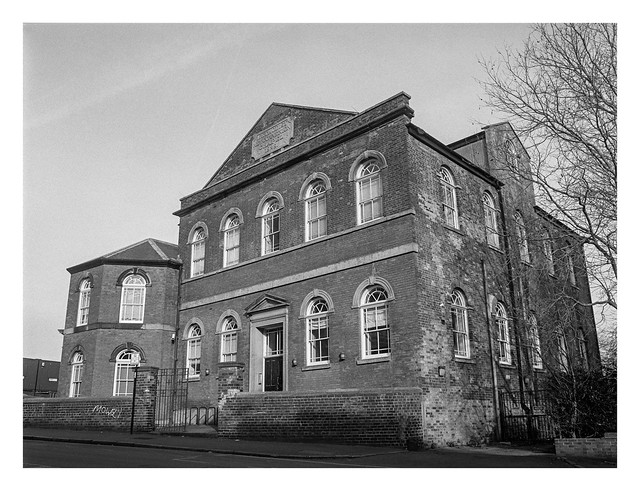
This is the Methodist New Connexion Chapel in Sheffield. I’ve photographed the building before and the area – another part of sheffield where new construction is booming – is rapidly changing to something new. Many of the buildings that were present last time I walked past have now vanished to be replaced by blocks of apartments. But this chapel remains.
The building dates back to 1828, built three decades on from the founding of the church by Sheffield man Alexander Kilham after seceding from the Wesleyan Methodists. Early in the 20th century the church would become part of the United Methodist Church.
Bronica ETRSi & Zenzanon 50mm f/2.8 MC & Ilford HP5+. Ilfotec DD-X 1+4 9 mins @ 20°
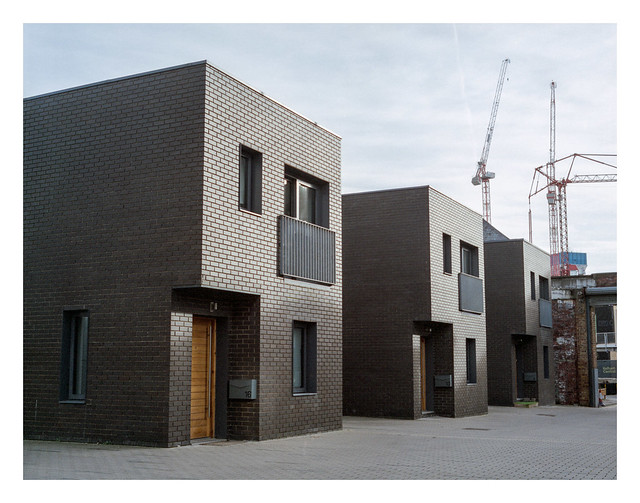
I’ve wandered around Kelham Island in Sheffield to take photos on many occasions and I still manage to find things I’ve not photographed before. This view east through Little Kelham is one such composition. The skyline will no doubt look different again before long once the cranes in the distance finish their work.
Bronica ETRSi, Zenzanon 75mm f/2.8 PE & Fujifilm Pro 400H. Lab developed. Home scanned and and converted using Negative Lab Pro.
Behind the fence and trees flows the River Don. Across the river stands New Testament Church of God (formerly Holy Trinity Church). The chimney and large brick building to the left of the frame is Aizlewood’s Mill, which I wrote about the other day.
Bronica ETRSi, Zenzanon 75mm f/2.8 PE & Fujifilm Pro 400H. Lab developed. Home scanned and and converted using Negative Lab Pro.
There’s a definite appeal to these block-like houses. It’s like someone has taken a cube of fresh clay, imprinted a brickwork pattern, and then cut perfectly angular upenings into the material. Despite the very up-and-coming nature of this part of town, I’m not sure I’d want to live in a home that people can walk so close in front of, and I’m unsure if they have any sort of green space such as a garden (although it could be atop the flat roofs for all I know). Photographically though, I find them very attractive.
Bronica ETRSi, Zenzanon 75mm f/2.8 PE & Fujifilm Pro 400H. Lab developed. Home scanned and and converted using Negative Lab Pro.
This building is Aizlewood’s Mill, now a business centre, but originally used to mill grain harvested in Lincolnshire to the east. The building was directly adjacent to Sheffield’s first railway station, making offloading of the grain a case of carrying it across a bridge from the goods yard and straight into the mill.
The building was constructed in 1861 and remained in industrial use until the 1960s. The building was sold to Sheffield Co-operative Development Group Ltd for £1 in 1985, leading to it being re-developed for current use as a business centre.
Bronica ETRSi, Zenzanon 75mm f/2.8 PE & Fujifilm Pro 400H. Lab developed. Home scanned and and converted using Negative Lab Pro.