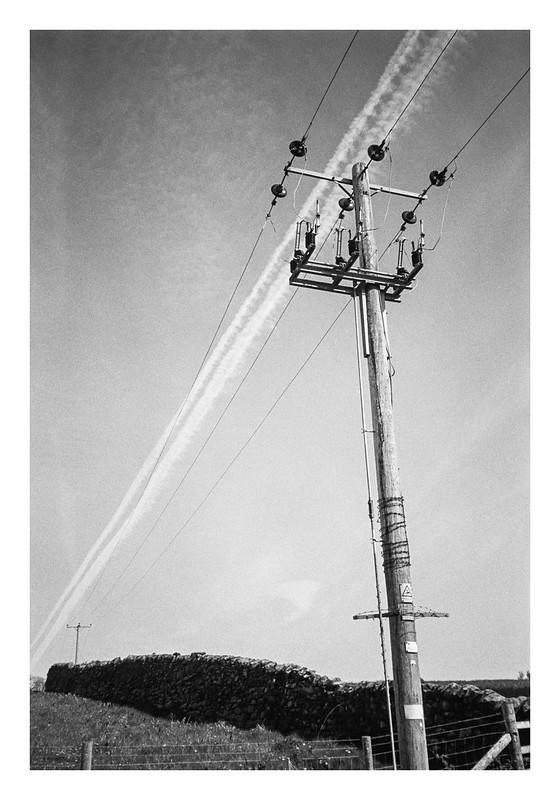
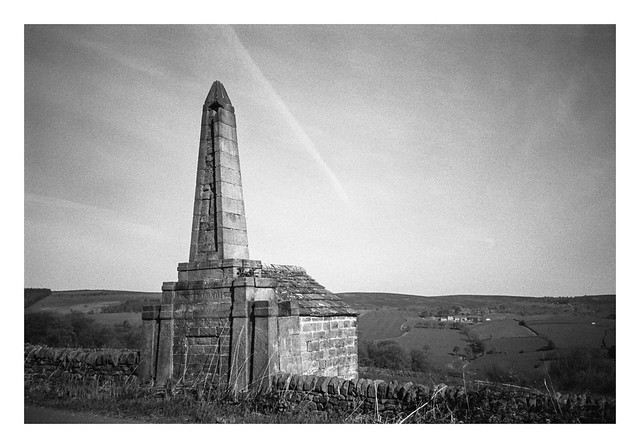
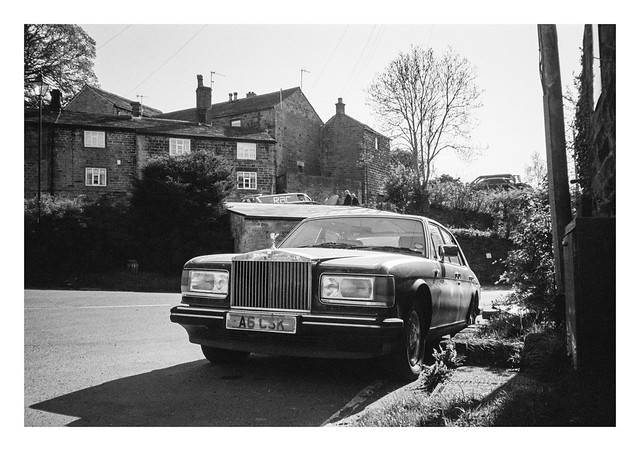
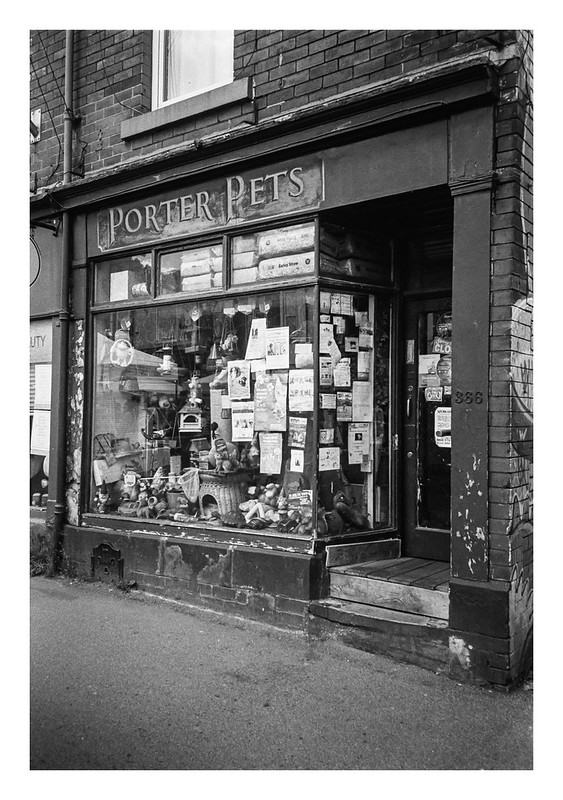
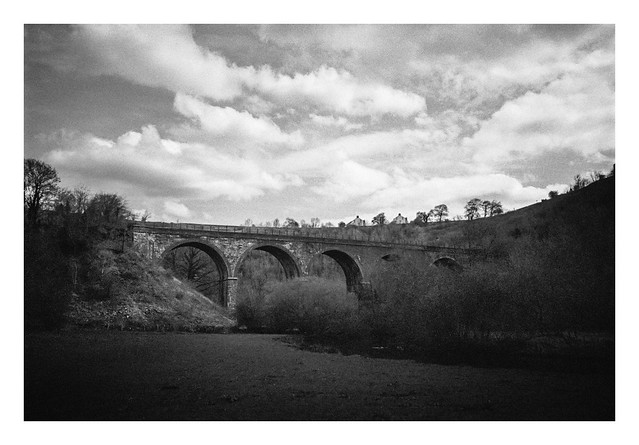
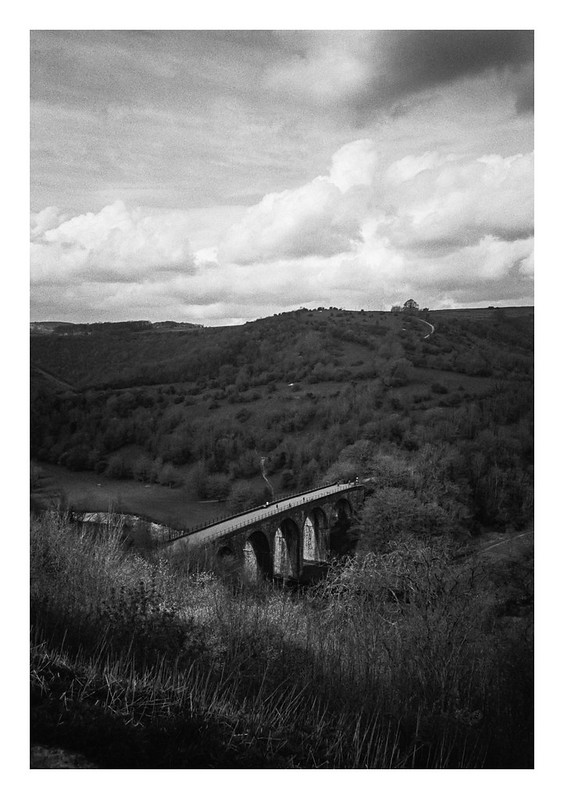
I think that today’s three photos will be the last of the batch from my trip to Monsal Dale (and Asford-in-the-Water). I have a few more images but none that really stand out as worth posting here. For some reason a number of frames from this roll came out a little underexposed – I’m not sure if it was the way the XA3 metered the scenes, or (more likely) that I under-developed them or something. Nonetheless, I’ve managed to get them looking pretty nice (if a bit grainy), I think.
My wife and I have been on a coach trip today – something we haven’t done for quite some time, a few decades at least! We normally drive when we have a day out, or rather I drive, and my wife takes the passenger seat, so the idea of someone else doing the work while I got the chance to look out the window and enjoy the scenery without fear of taking the car off the road was an appealing novelty.
We visited Skipton and Harrogate, both towns in North Yorkshire and the day was enjoyable. It’s been a very long day though and I haven’t had chance to upload any new photos or think of much to talk abou , so today’s picture is one from a previous set.
I didn’t take a huge number of photos on today’s trip, but the ones I did will show up here at some point assuming they’re any good.
Today’s picture is of Conisbrough Castle with a war memorial in the foreground. I’ve had to tidy the image up somewhat as it had some noticable scratching (as did most of the roll of film) caused by the squeegee. I think I’ve managed to successfully remove most of the marks on this frame, although some of the other shots are something of a lost cause. I shan’t be using the squeegee again I don’t think.
Tucked away from the glasshouse in Sheffield Botanical Gardens sits the Grade II listed bear pit. The pit was constructed in 1836 to house a black bear and, later, two brown bears. Local legend has it the a child fell into the pit and was killed in 1870. It is said to be one of the finest surviving bear pits in the country thanks to it being preserved by it’s later use as a gigantic compost pit!
There is still a bear in the pit, although this one is made of rusty steel, its colour perhaps not dissimilar to a real bear’s fur.
I took a trip to Manchester today to visit the Photo North exhibition. It’s been quite a tiring day.
The exhibition was good, but my planning was not, and it would have been much better had I booked earlier / later trains for the outbound and return journeys as, as it stood, I felt somewhat rushed, especially when the train in the morning was delayed by a half hour! Oh well, I still visited and I managed to attend the screening of a documentary on Picture Post magazine, which was interesting and enjoyable.
I shot about half a roll of film while out – using my Olympus 35RC, a great little camera, but one I’ve not used for a while – but when I came out of the exhibition the weather had changed from bright contrasty sunshine to flat grey conditions, so I held off shooting more. I have another trip to Manchester planned in a month or two’s time, so hope to make more photos then.
In the meantime, and completely unrelated to the rest of the post, here are four photos of Sheffield Botanical Gardens that I scanned this week.
On a wall beside the canal towpath, not far from Victoria Quays, is painted this piece of artwork. I though it would make a good photograph, but didn’t know what it represented.
Googling the words revealed them to be part of a folk song about a highwayman named Spence Broughton. In February 1791 Broughton, and his accomplice John Oxley, robbed the Sheffield to Rotherham mail coach as it travelled across Attercliffe Common. Suposedly the only item of value they were able to get away with was a French bill of exchange with a value of £123, which they had difficulty in attempting to fence. Oxley was later arrested for his part in another robbery and, fearing for his freedom, in October of that year Broughton sought help from another criminal, Thomas Shaw, in London. Unfortunately for Broughton, he was recognised and arrested by the police and Oxley and Shaw both gave testimony against him, although Oxley was later able to break loose and make his escape.
Spence Broughton was found guilty in York assizes and sentenced to be hanged. The following April, after the execution, the body of Broughton was transported back to the scene of the crime on Attercliffe Common and placed in a gibbet. This attracted large crowds – supposedly 40,000 people – and the landlord of the nearby Arrow pub claimed that he was able to make a fortune from the passing trade. Broughton’s boy was to ramain in the gibbet for the next 36 years!
Nearby Broughton Lane is alleged to be named after the criminal, although this is disputed by historians.
It’s fascinating what a walk along the canal can reveal.
I thought I’d lump these two photos together in today’s post. There are two reasons for this.
Firstly, both shots were made while I walked along the towpath beside the Sheffield and Tinsley Canal, heading back towards Victoria Quays, so there is a connection there.
Secondly, there is (to my eye at least) a visual connection in the shape of the piece of sky in the railway bridge picture, and the chimney in the second shot. It almost feels like, if you were to overlay them that they might somehow intersect and fit together. Obviously it wouldn’t be a perfect fit, but compositions definitely have a synchronicity about them, a kind of positive / negative relationship.
I’ve been tasked with going out to fetch ice-creams, so I don’t have much time to type a post today. I’ve been scanning more negatives which has also taken up time, although they will at least bear some fruit for the blog at some point (there are some nice ones, I think).
Springflower is the name of this decaying boat, pulled high up the bank above North Landing beach. Decaying boats are not something I see often, living in a land-locked city as I do, so I like to make pictures of them when I get the chance.
I think that this marks the end of the photos from my day-trip to Flamborough. On to something else tomorrow…
The view from North Landing near Flamborough. Although on the east coast of England, because it is on a promontory, this view is actually looking to the north. Setting off on a straight line from here would take you right over the top of the world without hitting land until you reached Wrangel Island, off the northern coast of the Russian mainland to the west of Alaska. It would be a long and arduous voyage for one of the small boats seen in this scene.