Rother Valley Country Park lies within walking distance of my home. It can be quite photogenic but familiarity has bred, if not contempt, then a certain boredom towards it’s possibilities. Like most man made lakes and reservoirs (the lake used to be an open cast coal mine) there’s a certain artificial feel to the place. I guess that over time this will lessen and the place will feel more an more part of a natural landscape (although it’s now been over forty years since the park first opened).
Despite my lack of inspiration, it’s still a great place to go if the conditions are good, especially mist or ice, as it gives it a distinct atmosphere and look that isn’t present at other times.
The two shots published here were taken on a frosty morning in late November last year just as the sun was rising, and I stood stepping between feet to keep warm while I waited for the sun to rise and start to cast light on the scenery. It was worth my time though, I think.
The second shot has been cropped. The top of the frame featured the lines of the cable-powered waterski circuit that occupies this end of the lake.
Canon Sure Shot Z135 & Kodak Gold. Lab developed. Home scanned and converted using Negative Lab Pro.
I wasn’t going to include these pictures as part of this sequence of autumn walk posts but, given they were shot on the same outing and also depict autumnal conditions, it seemed a bit silly not to.
These were among the first pictures from a roll of Kodak Portra 160 and were shot in Padley Gorge, which is right next to the Longshaw Estate where the earlier photos were taken.
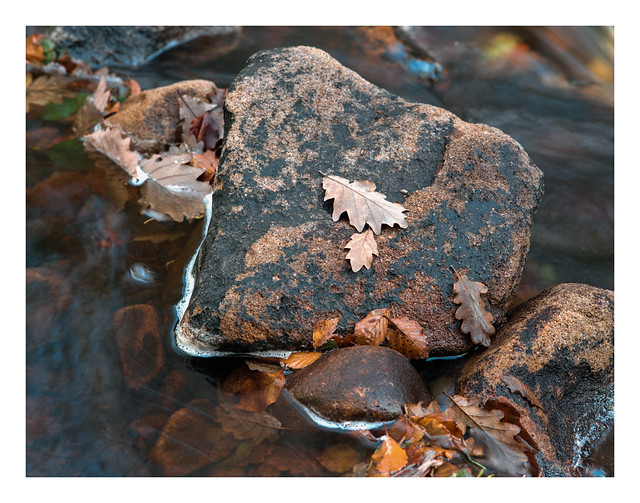
They’re not the best pictures I’ve made at this location, but they’re not horrible either, and I do like the one with the leaf on the boulder quite a lot.
Getting down to the side of Burbage Brook which runs through the gorge can be tricky. The sides are steep and laced with slippery roots, unstable topsoil, and a large volume of rocks – some slippery with moss, some unstable underfoot. Without care, it would be quite easy to gain an injury, potentially a serious one. Beside the brook is where the best photos are to be had though.
Still, I managed my descent safely – something made simpler when I spotted another photographer taking a much easier route. Even better, I was able to escape again afterwards!
Bronica ETRSi, Zenzanon 75mm f/2.8 PE / Zenzanon 150mm f/3.5 MC & Kodak Portra 160. Lab developed, home scanned & converted with Negative Lab Pro.
Blessed with fine weather and on a day where I could take advantage of it, I headed out to the area around Padley Gorge and the Longshaw Estate one Saturday morning in early November with the hopes of catching some autumnal scenes.
The pictures posted today are ones I shot on a roll of Lomography Color Negative 400 with my Bronica ETRSi. Tomorrow I’ll post another, smaller set, that I shot on Fujifilm Pro 160NS.
Bronica ETRSi, Zenzanon 75mm f/2.8 PE / Zenzanon 150mm f/3.5 MC & Lomography Color Negative 400. Lab developed, home scanned & converted with Negative Lab Pro.
When this is published, I will be on my way home from a day-trip to London to see an Evelyn Hofer exhibition at The Photographer’s Gallery (and, if I’ve had time, a nosey around The National Portrait Gallery).
At the time I’m writing this (Friday evening) I must confess that the 32°C temperature that has been forecast for London on the day is not filling me with glee!
Anyway, apropos of nothing, here’s a random picture from back in 2016 that I took with the first Medium Format camera I owned – a Lubitel 166 Universal TLR. It wasn’t the best camera to use, but it could produce nice pictures nontheless.
As promised yesterday, here are the two large format photographs of Mother Cap, a gristone outcrop on the moorland above Hathersage. Looking at them closely, both have focusing issues, and I’ll leave the yellow filter off the lens until after the shot is composed and focused in future as it did make it more difficult to view the scene, but they both look fine if you don’t investigate them too closely.
I had a day off work yesterday and decided that I would take my Chamonix 045N-1 for a second outing. After my initial test a couple of weeks or so back, I felt confident enough to take a slightly longer trip out into the Peak District. By some miracle, the weather was actually good too – warm, with plenty of sunshine and cloud. There was a risk of rain predicted but not until later in the day.
My initial plan had been to visit a few locations but, in the end, I only went to a single spot as I soon discovered that, despite everything else, there was still sand in the gears (not literally!).
I drove out to Surprise View car park in order to photograph Mother Cap, a large gritstone outcrop, and then to photograph the birch woodland in the same area. Although Mother Cap isnt too far from the car park, it is quite a bit higher and the footpath requires some scrambling over rocks – nothing too challenging, but still enough to work up a sweat when you’re carrying a big tripod and a heavy backpack.
The first two shots went well, I thought, although I found focusing a little difficult because I had fitted a yellow filter to the lens (note to self, focus before fitting the filter enxt time). As it turned out, I managed to get some camera shake on the first shot, probably because the tripod was stood on springy heather covered ground and wasn’t stable enough.
The next shot was taken on firmer ground but the issues with the filter meant that there are a few minor focusing problems where I hadn’t set the camera movements as well as I might. It was at this point that my cable release also broke, the threading on the end somehow coming undone slightly, so the next shot had to be taken using the shutter release on the lens without the benefit of the cable. It was at 1/60sec though, so it came out ok. I’ll post these two pictures tomorrow.
The final shot I took was of the birch woodland. This time the camera was placed in a stable spot, and I managed to finagle the cable release enough that it functioned properly again (although I’ll be using a different one in future AND taking a spare). Despite this, a new problem came to bear…
Because it was a warm day with hot sunshine, and because I was quite hot from hiking around with my gear, I now found that beiing under the darkcloth for more than about ten seconds resulted in my spectacles completely steaming up, rendering any attempt to focus of check the scene nigh on impossible (and made even more difficult by the yellow filter).
I did my best with it, but it wasn’t good enough, and the resultant image has a number of problems with soft focus in various parts of te scene. Thankfully it’s not terrible, but it’s not what I wanted. I do like the resulting picture though and it might be worth another visit to try and get a technically better result.
Here it is. It probably looks fine on a small screen, but it loses a lot of sharpness when viewed large.
Another of the four sheets of film I shot with the Chamonix at the weekend. It’s a location that I’ve featured on the blog a number of times, and seemed a reasonable place to fire off a sheet while testing out the camera.
I’d love to get closer to the old building, but it sits in the middle of crops and the footpath just skirts the edge of the field. I could risk it, I suppose, but I’d not feel comfortable trying to explain that in any way that wouldn’t look self-serving in the event I got found out. I’m h ppy the footpath is there though.
One thing I was particularly pleased about with this roll of snowy scenes was that I managed to expose the majority of them well. Snow can often blow out or be rendered an unattractive grey if not given the correct exposure and recommended guidance if to use exposure compensation to over-expose if you’re using a reflective meter, such as the one built into many cameras.
My Bronica doen’t have a meter though (even the one in my metered prism seems to have carked it!), so I rely on a handheld meter instead, and my preferred technique is to use incident readings – the light falling onto the subject, rather than the light reflecting off it. This has a benefit of giving an accurate reading in these sorts of scenes (well, most of the time anyway). I think a couple of my shots were not metered as well as the others, but even those were retrievable in post processing.
The two below look pretty good though.
Bronica ETRSi & Zenzanon 75mm f/2.8 PE & Ilford HP5+. Ilfotec DD-X 1+4 9 mins 30 secs @ 20°
Another of my converted Kodak Gold shots. I almost left this one as colour, but I think the black and white version is better. The colours were pretty muted in any case.
Today was the thing at work that I mentioned a couple of days back – the thing that was causing me stress even though I suspected I was worrying for nothing. And I was right. Everything went absolutely fine. So I’ve spent a few days spending way too much time being concerned about something I needn’t have. Now I need to catch up on the other stuff I didn’t do because I was focused on this. Oh to be me…
Fujica GW690& Kodak Gold (converted to B&W in Lightroom).
Eagle-eyed viewers might recognise this scene (and tree) as the same one that I attempted to photograph on large format film. Recognising that there would be a chance that my 4×5 picture might not work out, I took the opportunity to photograph it with the Olympus Trip 35 I also had with me. In fact, while my large format camera took up the bulk of the gear I was carrying, it was finishing the roll of HP5+ in the Trip that was my primary goal.