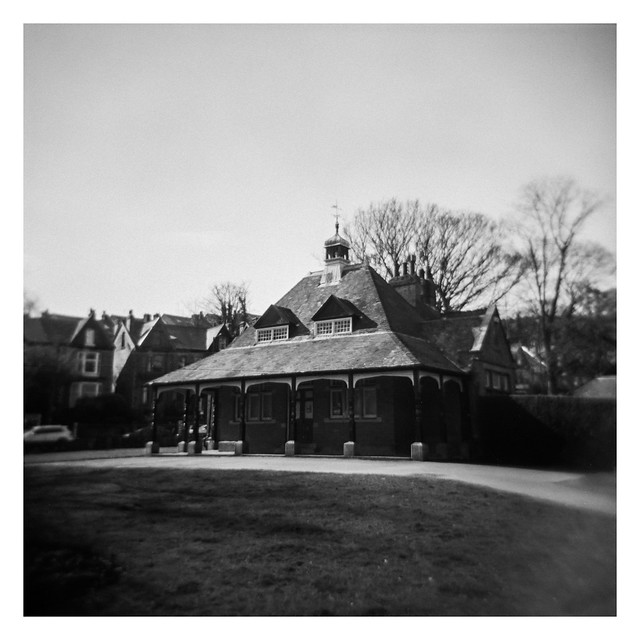
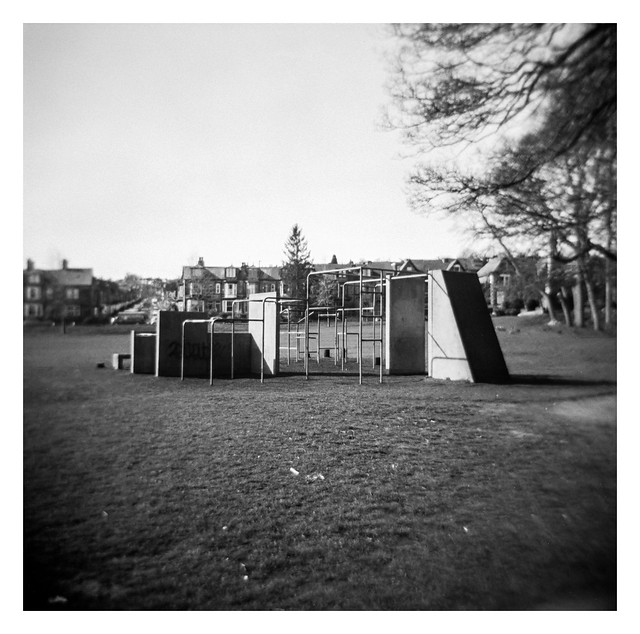
Another set of Holga 120N pictures to follow on from yesterday’s blog post. They include two views of the pavillion in Endcliffe Park, the Trinity United Reform Church (a brutalist design just across the road from the park), and a climbing frame in the middle of the park.
On the day I tried out my first roll of the new Kodak Gold 120 variant, shot with my Yashicamat, I also took the Holga with me. I still had a couple of rolls of the “bad batch” Fomapan 100 (the one that liberally sprinkles little white specks on the resulting pictures), and it seems a good fit to shoot it with the Holga as, while I don’t want to use faulty film with the camera, it is great at covering up such defects due to its uniquely rendered images. I also have quite a stash of film at present and aim to try and get through some of it this year.
This was the first time I’d used the Holga in over a year – the last time was for some snowy shots back in January 2021 – and it’s easy to forget how much I like the pictures it produces. While this roll didn’t produce twelve bangers, I still got several I was happy with, and so I’ll post them here today and tomorrow.
I developed the roll in some of my remaining trial bottle of Adox Adonal (Rodinal in all but name) and used a 1+24 dilution which gave a pleasingly short 4 minute developing time. I’m pretty happy with the way they’ve turned out.
Almost a year ago now, I had the idea to try and double-expose an entire roll of film. The idea was to load it in the camera, tighten the roll, and then draw a line on the film where it emerged from the cannister. Then I would close the back, wind the film on until the counter read “1” and commence shooting. After finishing the roll I would then repeat the process, reloading the film so the mark was aligned as before and then shooting all the frames again, hopefully aligned correctly. As this was something of a fun experiment, I decided to use a roll of expired film – some Agfacolor 200 – that I’d acquired with a camera I’d bought. I had no idea how the film had been stored and only a rough guess as to it’s age (which I placed at around 2005 for the original expiry), so it seemed a good choice for this potentially sacrificial mission. On my first outing I shot around six frames, taking care to frame and expose subjects in such a way as to be suitable for double exposures.
Then another set of restrictions hit, followed by another national lockdown.
The camera sat on the shelf, the roll of expired film gradually getting older, and every chance I did have for photography was utilised for stuff I really wanted to do, rather than this potentially fruitless bit of fun. Nontheless, it didn’t slip my mind completely and I always intended to continue when I had more time. So, last weekend, I decided to go shoot the remainder of the roll – ignoring the double-exposure idea for the remaining frames, but with the intent of re-winding the film and double-exposing just the initial six frames I shot last year.
Sadly, in the interim period, my Olympus OM-1n has redeveloped a fault it had before, and which I though was fixed. The problem consists of the shutter locking after making a shot. Normally, the shutter is pressed and the frame advanced, resetting the shutter. Now though, on most frames, it would fire the shutter, but after advancing the film the shutter button would remain locked. The film advance would still work however, allowing another frame to be advanced but also (don’t ask me how) firing off a shot at the same time. It would them be good for another proper exposure. The unintended shots are almost always afflicted by heavy camera shake due to the way they are made when the lever is being advanced and it pretty much means that 50% of the roll gets wasted (although the fault is slightly intermittent and the camera would sometimes work properly for a few frames in a row).
The end result of this is that I had a roll of film (24 +3 exposures) that definitely had a lot of garbage frames and also, possibly, might look like crap anyway becuase of the unknown quality of the expired film itself. As I don’t have the ability to develop C41 film at home – or at least don’t have the chemicals required – I was left with two options if I wanted to see if there were any half-decent pictures on the roll: take it to a lab and pay for processing; or develop it at home using the black and white chemicals I already have. Being a skinflint, I decided on the second option…
A bit of research led me to a number of different develoing methods, many of them involving stand-development, but also some regular development too. I knew that I would be using some Adox Adonal (Rodinal by any other name), so was able to narrow my results somewhat until I found a YouTube video that had some promising looking instructions.
So, following the guidance, I developed my roll of colour C41 film for 15 minutes at 20° in the B&W chems, agitating with gentle inversions for the first minure, and then four inversion at the start of each subsequent full minute. I wasn’t expecting the best results, and was partly expecting the entire roll to be beyond use, but after fixing and washing the negatives I was pleased to see some images, albeit on a very muddy orange looking film base. I dried them for a few hours and then attempted to make some scans.
I wondered if I might have to scan them as colour in order to remove the colour mask, but found that one of the monochrome settings in Silverfast gave me an acceptable, if somewhat flat, result. Importing them into Lightroom I was able to zap them with a bunch of contrast and other tweaks to get much better looking pictures although there was a heavy ammount of grain present – almost like a 3200asa film.
The pictures in this post are the best of the set. While I wouldn’t go out of my way to repeat this process, it’s good to see that it produced salvageable results – results which I’m actually quite happy with.
Oh, and all the double-eposures were complete rubbish and I didn’t even bother to scan them. 😀
Expiry unknown Just what is a man to do? Cross-process of course!
A couple more frames made with the Lipca Rollop II. These are most likley the last photographs from this particular camera that I will publish here now that I no longer own it. It’s a nice camera should you ever come across one in good working order.
Lipca Rollop II & Fomapan 100. Adox Adonal 1+50 9mins @ 21°.
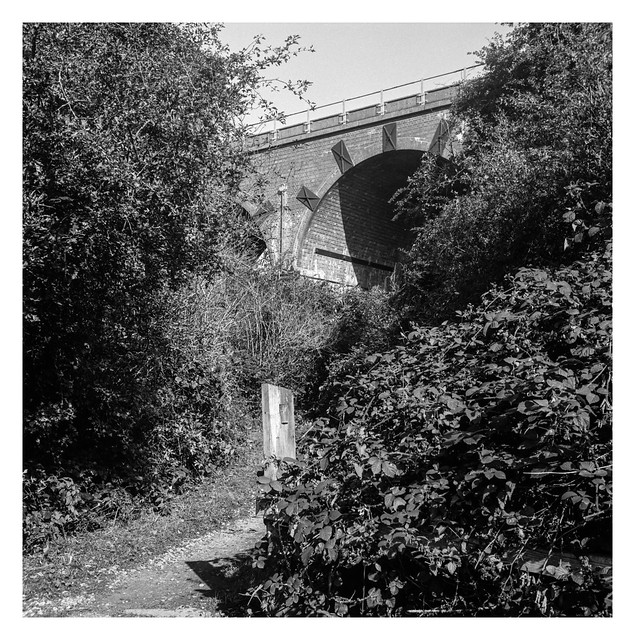
To the south-east of Sheffield, one of the main routes into and out of the city centre is the A57 road. For a long time, the route took it through a number of suburbs. As car ownership increased, so did conjestion, and eventually the route was altered to create a bypass. As the road gets closer to the edge of the city it needs to cross the Rother Valley. This requires it to span not only the River Rother itself, but also two railway lines and the marshy floodplain itself. To do this a viaduct was constructed.
The viaduct stands around a mile from where I live and the floodplain to the east of the river is accessible to walkers (and also a herd of cows that graze there). Both these shots were taken early one morning as I tested the makeshift repair I’d to the Lipca Rollop II TLR (more about that here and here). Spoiler alert – the repair was a bust and I still ended up with the same light leak on some frames (it’s feintly visible in the middle of the shot above). I’ve now moved the camera on to someone else who may hopefully be able to either repair the problem properly, or just live with the fault – it still makes very nice photographs if you work around the issue.
These photos were made on one of my remaining rolls of bad-batch Fomapan 100. As I was testing the camera I wasn’t too concerened about the spotting issues on the film and there are way too many of them for me to bother to attempt to remove in Lightroom or Photoshop. They’re only apparent when the images are viewed large in any case. I think I’m down to a couple of rolls of this batch of film now, so I’ll likely save them for other camera tests or maybe the Holga – that one will eat up defective film for breakfast! 🙂
This also marked my first foray into a different developer. I’ve used Ilfotec DD-X since I started home-developing B&W film when the Covid-19 lockdown began in the spring. DD-X is very nice (if a little expensive) and I will continue to use it. I dod want a cackup though, so I bought a small 100ml bottle of Adox Adonal (Rodinal in all but name). This roll was my first time using it. I think the results are pretty nice. I think I prefer the DD-X, but the Adonal still looks great, is much cheaper, and will be usefull should I attempt stand developing at some point. It should also last forever without going bad.
Lipca Rollop II & Fomapan 100. Adox Adonal 1+50 9mins @ 21°.








 Steel City Snapper photography