Blessed with fine weather and on a day where I could take advantage of it, I headed out to the area around Padley Gorge and the Longshaw Estate one Saturday morning in early November with the hopes of catching some autumnal scenes.
The pictures posted today are ones I shot on a roll of Lomography Color Negative 400 with my Bronica ETRSi. Tomorrow I’ll post another, smaller set, that I shot on Fujifilm Pro 160NS.
Bronica ETRSi, Zenzanon 75mm f/2.8 PE / Zenzanon 150mm f/3.5 MC & Lomography Color Negative 400. Lab developed, home scanned & converted with Negative Lab Pro.
I’ve posted a picture of this ice cream truck before, that picture shot with my large format camera on the same day I took this photo, but the carriage in the second shot was only photographed with my Bronica ETRSi.
I don’t have a clue which type of carriage it is – I did look online, but backed out of the rabbit-hole of potential sunk time before I lost hours to detective work. It’s difficult to know just how old it might be. It could date back to when such things were a primary mode of transport, or it could also be a more recent vehicle, used for displays or special occasions or something, which has been left to decay. Whatever the case, it was interesting to see it there, albeit behind a metal fence that adds little to the picture.
Bronica ETRSi, Zenzanon 75mm f/2.8 PE or Zenzanon 150mm f/3.5 MC, and Ilford HP5+. Ilfotec DD-X 1+4 9mins @ 20°.
Back at the end of July I took a daytrip to the seaside, visiting the Lincolnshire coast resorts of Ingoldmells and Skegness. The two places are just a few miles apart, with Ingoldmells just north of Skegness.
It was the popularity of Skegness – a town that took on the somewhat telling catchphrase “It’s bracing!” – that led to the creation of Ingoldmells (pronounced Ingamells) as a resort, although the settlement had been there for centuries, with the parish church dating to the 12th century. In 1936, Billy Butlin opened his first Butlin’s holiday camp in the village, although it would soon close temporarily due to World War II when it became a shore establishment of the Royal Navy, given the designation HMS Royal Arthur.
Post war, the area developed further into a holiday location. East Lindsey District Council estimates there being nearly thirty-five thousand caravans across the East Lindsey Coasy, incorporating Skegness, Ingoldmells, and the towns further north such as Mablethorpe, with an economic value of over half-a-billion pounds!
It seemed slightly grim that some of the caravan parks were surrounded by barbed-wire topped fencing and, at one point when I ventured into an area to get a picture of caravans with the roller-coasters in the background, I was quickly approached by a member of staff enquiring what I was doing, so I guess some people must get up to no good sometimes.
Ingoldmells is dominated by caravan parks with the focal point being the seafront area and the Fantasy Island theme park which has a variety of rollercoasters and other rides for thrill-seekers young and old. Fantasy Island also has an open air market, with a variety of vendors, all dwarfed by the park’s two big coasters.
The seafront and nearby streets are home to a varety of arcades, food outlets, and seaside bucket-and-spade shops.
I didn’t get the best weather on my visit, it being overcast for the most part (although it did brighten up a little in the afternoon when I moved on to Skegness) and even a little rainy, which is not my favourite scenario for shooting colour film.
At some point while I was there I sheltered from the drizzle and I must’ve disturbed a spider’s nest as, for the next hour, I would occasionally feeling something crawling on me, each time it being a small money spider. Being concered about the extent of this “infestation” I even put my phone into selfie mode so I could check that I didn’t have a swarm of the things crawling unnoticed on me. That might have been embarrassing / horrifying, depending on your feelings about arachnids!
Bronica ETRSi, Zenzanon 75mm f/2.8 PE and 50mm f/2.8 MC lenses, and Kodak Gold. Lab developed. Home scanned and converted with Negative Lab Pro
I found this window to be a curious feature, and interesting enough to make a photograph. Because of the location of the house it probably gives a clear view of the road that curves past the rsidence – approaching from the right of frame and then going behind the point of view. Whether there was a practical reason for this beyond giving a nice view, I don’t know.
Bronica ETRSi & Zenzanon 75mm f/2.8 PE & Ilford Delta 100. Ilfotec DD-X 1+4 10 mins 30 secs @ 20°
No photography stuff for me today. I have a roll of film to develop but I couldn’t be bothered with faffing around with that (or rather, all the getting stuff out, and then having to wash it all and put it away again afterwards). The weather has been overcast, although with some definition in the cloud cover, but after walking around Leeds taking pictures yesterday I didn’t feel the need to go out agin today. Yesterday’s trip left me with a full roll of HP5+ (the one I have to develop) and also some Provia 100 to be sent off to the lab (fingers crossed as it’s an expired roll).
So instead, after my dad came over to visit, I spent the day watching TV and YouTube. Sometimes it maked me feel a bit guilty that I didn’t use my free time more productively, but at the same time sometimes a day vegging on the sofa is a productive use of time in terms of re-charging your batteries.
A friend of mine once said the following: “When I say I’m doing nothing, that doesn’t mean I’m free. It means I’m busy doing nothing.“. Sometimes doing nothing is what you need.
Here’s a random photo of a house. Not mine, and not the one I’ve been vegging out in.
Bronica ETRSi & Zenzanon 50mm f/2.8 MC & Ilford HP5+. Ilfotec DD-X 1+4 9 mins @ 20°
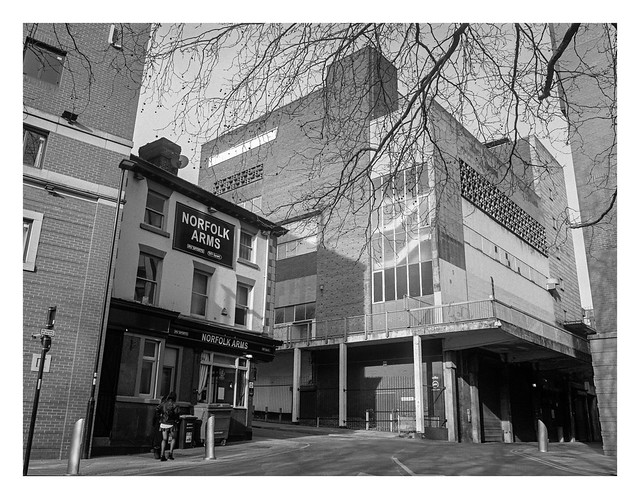
Today’s picture is another that would have fit well in my post about converging verticals that I published a couple of days back. It’s another image where the converging lines work well to produce a sense of scale in the composition, the buildings towering over the viewer (and the people in the scene) even though they are relatively low-rise structures.
Bronica ETRSi & Zenzanon 50mm f/2.8 MC & Ilford HP5+. Ilfotec DD-X 1+4 9 mins @ 20°
A chap I know who shoots exclusively in large format claimed that I’d damaged his eyes with the converging verticals in the shot below. He suggested I take the picture again with my 4×5 camera. He was joking, of course, but it did make me think about the opposition to this geometrical distortion when it occurs in photographs.
Converging verticals seem to cause quite some consternation when they appear in photographs – the photography club I used to be a member of had photo competitions where, should your vertical lines not be perfectly perpendicular, you would lose points and receive a judgemental comment from the, well, judge. It was this sort of arbitrary nonsense that, in combination with covid shutting everything down for some time, led to me stopping attending, even though the other club members were all very nice people (and I should emphasize, the judges were not members of the club).
Converging verticals are how things appear to the eye though, so attempts to “correct” them is inheritantly false unless the photograph was made from a location where they do not occur, such as ensuring the camera is aligned with the ground, or you are so far away that the effect becomes minimised by distance. Stand at the foot of a tall structure though, especially one with regular features such a an office building with regularly spaced windows, and look up and you will see converging verticals. It’s just perspective. In exactly the same way that a long straight road will appear to narrow to a point in the distance, so looking up at a tall building will show the same effect. And I never hear anyone complain that photographs of roads should have the perspective corrected.
I do think that some shots can work well if the verticals are all perpendicular, especially where the angle of convergence is only slight but, as a counterpoint, convergence can add a sense of scale. The photo published here today does this, even though the buildings are not tall. Combined with the steep street the buildings appear to loom over the viewer.
I am kinda interested in seeing what the same scene would look like “corrected” by the movements on my large format camera though. 🙂
Bronica ETRSi & Zenzanon 50mm f/2.8 MC & Ilford HP5+. Ilfotec DD-X 1+4 9 mins @ 20°
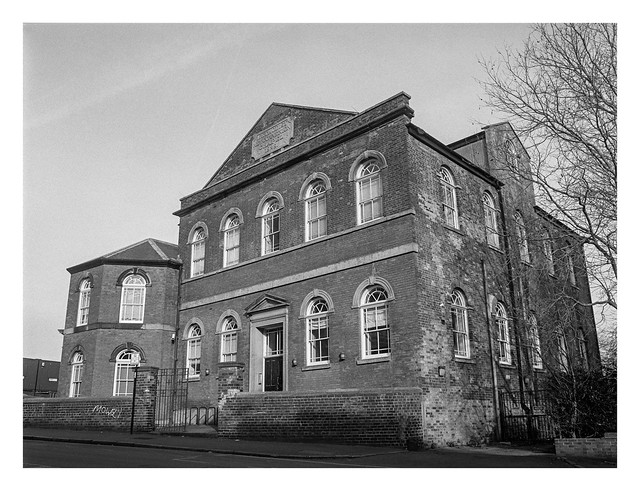
This is the Methodist New Connexion Chapel in Sheffield. I’ve photographed the building before and the area – another part of sheffield where new construction is booming – is rapidly changing to something new. Many of the buildings that were present last time I walked past have now vanished to be replaced by blocks of apartments. But this chapel remains.
The building dates back to 1828, built three decades on from the founding of the church by Sheffield man Alexander Kilham after seceding from the Wesleyan Methodists. Early in the 20th century the church would become part of the United Methodist Church.
Bronica ETRSi & Zenzanon 50mm f/2.8 MC & Ilford HP5+. Ilfotec DD-X 1+4 9 mins @ 20°






 Steel City Snapper photography