The last of Lomography Color Negative 800 images that I converted to black and white (the one’s I’m going to post, at least).
Bronica ETRSi, Zenzanon 150mm f/3.5 MC / Zenzanon 150mm f/3.5 MC & Lomography Color Negative 800. Lab developed, home scanned & converted with Negative Lab Pro. Converted to B&W in Lightroom.
Gainsborough Old Hall began as a 15th‑century manor built by Sir Thomas Burgh II before later passing to the Hickman family, who modernised. Over the following centuries it fragmented into workshops, tenements, civic spaces and even a theatre, before falling into decline. Restoration efforts in the mid‑20th century ultimately saved it, and it now survives as one of England’s best‑preserved medieval manor houses, owned by English Heritage.
I’ve been inside on a previous visit, back when I had a one year English Heritage membership, but this time I just took a few pictures of the exterior.
Again, these are Lomography Color Negative 800 images that I’ve converted to black and white.
Bronica ETRSi, Zenzanon 150mm f/3.5 MC / Zenzanon 150mm f/3.5 MC & Lomography Color Negative 800. Lab developed, home scanned & converted with Negative Lab Pro. Converted to B&W in Lightroom.
Standing beside the river Trent on its east bank, this statue is named The Pilgrim Woman.
On 10 May 1608, a group of Separatists, mostly women and children, escaped Gainsborough to find religious freedom. They left town along the River Trent on a small barge called The Francis, heading for Stallingborough near Immingham. Their plan was to meet a bigger ship there that would take them to Amsterdam in Holland where they would be able to worship freely. A few years later in 1620, they traveled on to America aboard the Mayflower.
Although not visible in my picture, the plinth upon which the statue stands is engraved: “Steering our Future Informed by Our Past“.
Bronica ETRSi, Zenzanon 150mm f/3.5 MC / Zenzanon 150mm f/3.5 MC & Lomography Color Negative 800. Lab developed, home scanned & converted with Negative Lab Pro. Converted to B&W in Lightroom.
Another food production factory in Gainsborough, this time the AB Mauri (former Rank Hovis McDougall) works.
Beyond lie rows of terraced houses, and the spire of the Trinity Arts Centre (which resides in a Grade II listed former church , hence the spire).
Bronica ETRSi, Zenzanon 150mm f/3.5 MC / Zenzanon 150mm f/3.5 MC & Lomography Color Negative 800. Lab developed, home scanned & converted with Negative Lab Pro. Converted to B&W in Lightroom.
This is the view south where the River Trent flows through the town of Gainsborough, looking onto the Kerry food manufacturing plant and then, a few miles further upstream, West Burton power station.
While I wasn’t satisfied with the colours I achieved with the Lomography Color Negative 800, the film has quite a fine grain structure – at least in this 120 format – and it’s produced some quite nice B7W conversions.
This frame is not only converted to black and white, but also cropped.
Bronica ETRSi, Zenzanon 150mm f/3.5 MC / Zenzanon 150mm f/3.5 MC & Lomography Color Negative 800. Lab developed, home scanned & converted with Negative Lab Pro. Converted to B&W in Lightroom.
Back to a run of photos I took in Gainsborough towards the end of last year. These were shot on a roll of Lomography Color Negative 800 – the first time I’ve shot this stock.
Unfortunately, I wasn’t all that pleased with the results. Part of this is down to me, or rather to my light meter, which I had inadvertently switched to it’s cine mode somehow, resulting in poorly exposed photographs. But I’m also not that happy with the colours I got.
Again, this might be down to the exposures in some cases,but I don’t think all frames were affected. It’s also hands down the worst film I’ve ever had to scan. The base is quite thin and it had a very pronounced curve to it that made it extremely frustrating to scan with my flatbed. This fact, more than any of the others, has put me off shooting it again (and I still have a couple of rolls in the freezer!).
The picture below is the only that I’ve left as a colour scan – I like the warm morning light on this closed up shop window. All the rest of usable frames I’ve converted to black and white, and I’ll post some of those in the next few days.
Bronica ETRSi, Zenzanon 150mm f/3.5 MC / Zenzanon 150mm f/3.5 MC & Lomography Color Negative 800. Lab developed, home scanned & converted with Negative Lab Pro.
I was going to say that this post features the last of this year’s crop of autumnal pictures, but I have a few more on a roll of 35mm Kodak Gold still to be uploaded, so there will still be a few more to share (although I expect it will be after Christmas before that happens, unless I move them up the schedule).
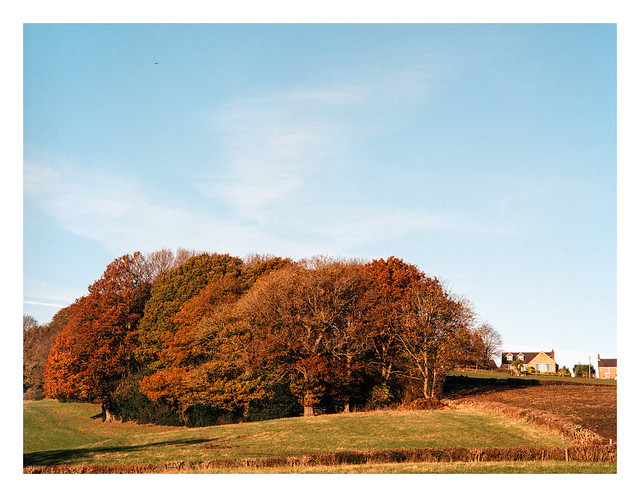
The two pictures here were taken near the village of Barlow in Derbyshire, not too far from Chesterfield. I’ve driven past the lone tree pm a few occasions and noticed that it has a handy public footpath running through the field beside it. Whit it was the main reason I got out of the car with my camera, I think I prefer the first shot of the woodland, which has a nice selection of autumnal tones against the slightly hazy blue sky. The lone tree is ok, but I think there is a better photograph to be had.
I’ve managed to shoot (almost) a couple of rolls of 120 Ilford HP5+ this weekend during an overnight trip to York with my wife to visit the Christmas market. I’m not sure how they will turn out – I rarely make my best pictures when I’m out with someone else, and always feel like I’m rushing or missing things. I’ll hopefully get a chance to develop them soon though, so we shall see…
Bronica ETRSi, Zenzanon 150mm f/3.5 MC / Zenzanon 75mm f/2.8 PE & Kodak Portra 160. Lab developed, home scanned & converted with Negative Lab Pro.
This pair of residential towers are a Sheffield landmark. Not particularly because of the way they look, but their location at the top of the Herdings district means they are widely visible from across the city and can be seen from many miles away, particularly from the east.
They were built in 1959 and there were originally three towers named Leighton, Morland and Raeburn and were referred to as The Three Sisters, but Raeburn was demolished in 1996 when it was deemed unsafe following the discovery of a fault in the ground where it stood. The remaining two towers were renamed as Queen Anne Court and Queen Elizabeth Court and are now sometimes known as the Herdings Twin Towers.
I’ve driven past them at sunrise before and always thought they would make for a nice picture, so a few weeks back I decided to go and make one. The light was nice on the day, but I’d have preferred a bit of cloud to break up the blue sky. The image is also vey slightly soft despite me using a tripod. An excuse to re-visit the location at some point, I think.
Bronica ETRSi, Zenzanon 150mm f/3.5 MC & Kodak Portra 160. Lab developed, home scanned & converted with Negative Lab Pro.
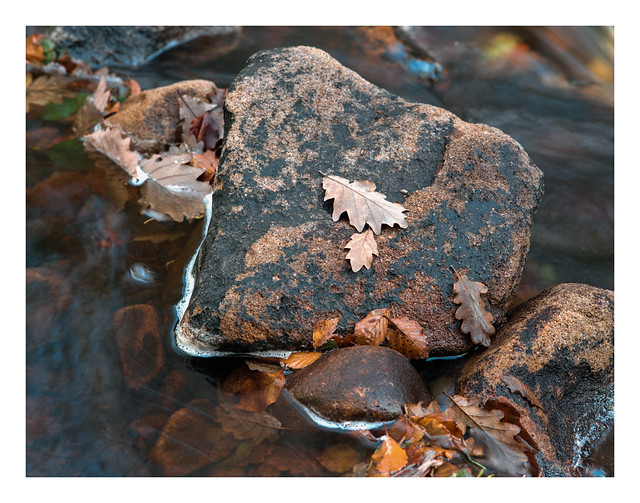
I wasn’t going to include these pictures as part of this sequence of autumn walk posts but, given they were shot on the same outing and also depict autumnal conditions, it seemed a bit silly not to.
These were among the first pictures from a roll of Kodak Portra 160 and were shot in Padley Gorge, which is right next to the Longshaw Estate where the earlier photos were taken.
They’re not the best pictures I’ve made at this location, but they’re not horrible either, and I do like the one with the leaf on the boulder quite a lot.
Getting down to the side of Burbage Brook which runs through the gorge can be tricky. The sides are steep and laced with slippery roots, unstable topsoil, and a large volume of rocks – some slippery with moss, some unstable underfoot. Without care, it would be quite easy to gain an injury, potentially a serious one. Beside the brook is where the best photos are to be had though.
Still, I managed my descent safely – something made simpler when I spotted another photographer taking a much easier route. Even better, I was able to escape again afterwards!
Bronica ETRSi, Zenzanon 75mm f/2.8 PE / Zenzanon 150mm f/3.5 MC & Kodak Portra 160. Lab developed, home scanned & converted with Negative Lab Pro.