Film photography · Medium Format · Photography

Woodland road (and dealing with some spotty Fomapan 100)

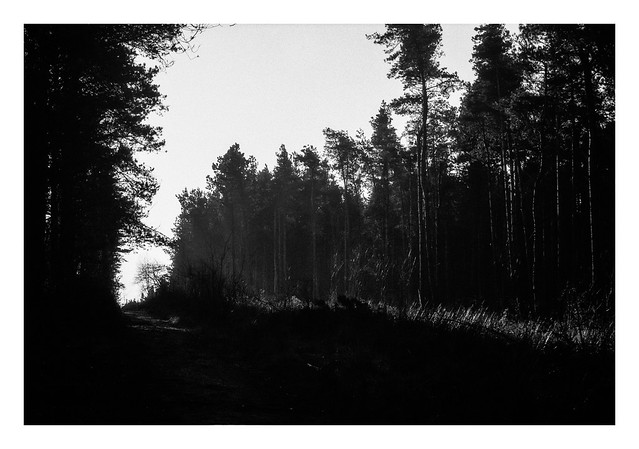
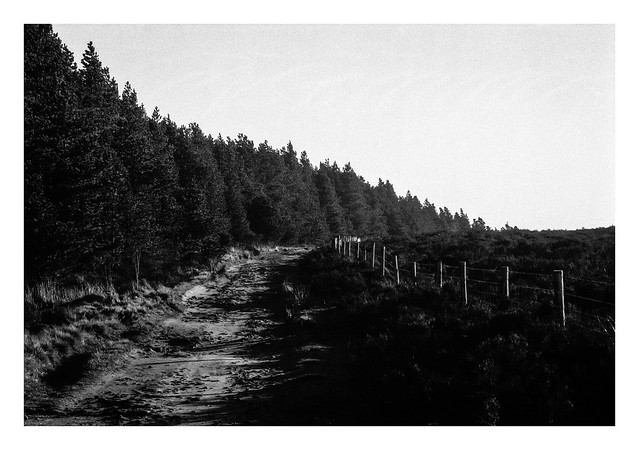
A photograph of a woodland road today, taken on one of the rolls of Fomapan 100 that I’ve been having problems with. As I’ve mentioned in previous posts (such as this one) I’ve been having issues with white speckles of debris when using this film. I ruled out my development process and chemicals – both worked fine when developing other film stocks. I also tried omitting a chemical stop-bath, replacing it with water, and also adding a pre-wash of the film before developing. Nothing seemed to work and the speckles still stubbornly appeared when I developed each roll of Fomapan 100.

Then, a month or so back, I came across a post on the Photrio forum which seemed to detail someone having the same problem. It turned out that other people suffering the same difficulties all had film form the same production batch. One person in a linked post had contacted Foma themselves and been advised that the cause was a harder than usual anti-halation layer on that run of film and that a specific development process might help. I tried the process myself, but still ended up with the smae spots on the negatives, albeit possibly slightly less pronounced than before.

I decided to contact Foma myself and they replied with some similar instructions, although this time I noticed an additional stage that involved a wash of the developed film in an ethanol / water mixture before the final wetting agent stage. I’ve not tried this process as yet and, I suspect, probably won’t – mostly because ethanol seems quite hard to come by, at least at a price that isn’t prohibitively high. It would likely be cheaper to buy some fresh, unproblematic film, than attempt the ethanol rinse process.

I’m grateful for Foma’s response though, plus they sent me a few rolls of film as a goodwill gesture – two rolls of Fomapan 400, plus a roll of Retropan 320. I’ve never shot Retropan 320 before, so I’m quite looking forward to giving that one a go.

Should anyone else be suffering a similar issue when developing Fomapan 100, the instructions provided to me by Foma are as follows:

In case of your already exposed & processed negatives we recommend to you the following procedure to remove the residues of remaining anti-halo layer:

1) Prepare working solution in minimum with 40% of ethanol (optimally 70%).
2) Put carefully the films into spiral´s developing tank or a spiral with the film into similar transparent container with enough ethanol solution, with emulsion layer inside of the cylinder tank/container.
3) Keep the negatives in this solution approximately 45 minutes and make moderate movement each 4-5 minutes.
4) Wash sheets of the negatives in running water from tap for 2-3 minutes.
5) Make standard drying including wetting agent (FOTONAL).

If you may decide to use also other films from the same emulsion number, we advise you to follow this procedure of processing:

1) Exposed films put inside of the spiral´s developing tank.
2) Pour distilled water or water without minerals into this developing tank and keep the films in this solution for 20-30 minutes. Occasional inversion is convenient. This solution, ca. 600 ml, is possible to use in maximum for 2 rolls.
3) Immediately after pouring the water out you can fill the tank by developing working solution keeping standard conditions of developing, best using more alkaline developer, e.g. FOMADON R09.
4) After developing we recommend to stop process just by water bath, best running filtered water, in minimum for the time of 30 seconds in water´s temperature 12-18° C. Using acidic stop bath like FOMACITRO and others is not convenient in this case, because there are needed alkaline baths to help with dissolving the hardened anti-halo layer.
5) Standard fixing.
6) Wash the strips of the negatives in running water for 20-30 minutes (according to higher or lower temperature).
7) Use ethanol solution and other steps (1-5) as described in previous paragraph.

Forest road
There’s a set of power-lines tucked away in here if you look for them…

Bronica ETRSi, Zenzanon 75mm f/2.8 & Fomapan 100. Ilfotec DD-X 1+4 8mins @ 20°

Taken on 23 August 2020
35mm · Film photography · Photography

Kodak Gold woodland

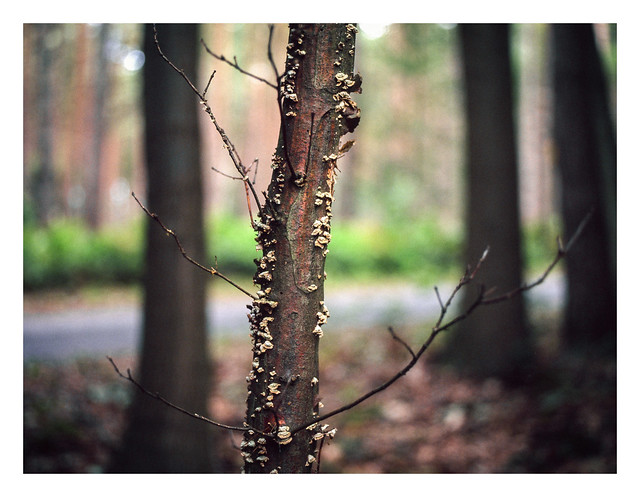
A couple of photos taken in woodland beside the Chesterfield Canal, the smell of wild garlic heady in the morning air. Although I’d started my walk quite early, because of the time of year the sun had already risen quite high by the time I made these photos.

Wild garlic woodland

This sort of scene, with sunlight dappling the woodland floor is beautiful to look at but often makes for disappointing photographs due to the difference in dynamic range between the sunlit highlights and the much darker shadows. While the eye deals with such things without issue, film and digital sensors tend to fare poorly. Still, I took a couple of shots because I thought I might get away with it in this instance as there was more shade than sunlight. I think they turned out quite well for a consumer grade film.

Natural reclamation

Nikon F80, Nikkor 50mm f/1.8 AF-D & Kodak Gold 200.

Taken on 31 May 2020

35mm · Film photography · Photography

Springtime churchyard

Following on from yesterday’s photograph of the barred church entrance, here are a couple of photos of the churchyard itself.

Churchyard blossom

The light was very nice on the day these were taken and the blossom on the trees glowed in the sunshine. It was an occasion where I really wished I had a roll of nice colour film in the camera. I had Ilford Delta 400 though, so the colours will have to remain in your minds eye.

Churchyard

Canon Sure Shot Telemax & Ilford Delta 400. Ilfotec DD-X 1+4 8 mins @ 20°.

Taken on 14 April 2020

35mm · Film photography · Photography

Through sunlit trees

Today’s picture is another photograph making use of glorious low sunlight. I like the way that the building – Chesterfield Town Hall – is obscured behind the trees. It gives it a bit of an air of mystery, I think.

In other news, it seems that both #FP4Party and Expired Film Day have crept around again, so I best get myself sorted for those – although, in the case of the former, I already have, and scanned some Holga-shot FP4+ negatives today.

For the latter, I have three rolls of expired film defrosting – one relatively fresh roll of Ektachrome 100 that’s dated 2008, a roll of Kodacolor Gold 200 from 1989, and oldest of all, some TriFCA from 1975 (which I’m not even sure the local lab will process – I shall ask them before I shoot it!). Shooting days are this weekend (13-15 March).

Through the trees

Minolta SRT 101b, Rokkor 50mm f/1.7 & Ilford HP5+.

Taken on 27 February 2020

35mm · Film photography · Photography

Lone figure

I like the sense of scale in this photo. I’ve never really considered how tall these trees are before, but the figure in the distance gives some sense of their size. There is, to be fair, a little bit of perspective to take into play – the person in the shot is beyond the leftmost bit of the trees, but not by too far.

FILM - Figure

Nikon F80, Nikkor 28-80mm f/3.5-5.6 & Ilford HP5+.

Taken on 22 January 2020

35mm · Film photography · Photography

Tangled

A maze of beautiful twisted oaks just below Wellington’s Monument on Baslow Edge. I don’t think I’ve got the best composition here – I’m not sure about the grassy area at lower left – but it’s a location not too far away, so plenty of chance for me to get a better shot in future.

FILM - At the edge of the tangle

Olympus OM-1, F.Zuiko 50mm f/1.8 & Ilford Delta 400.

Taken on 4 January 2020

35mm · Film photography · Photography

Shooting a roll of Polypan F

A few months ago, a friend on the photography forum I’m a member of offered some rolls of bulk-loaded Polypan F to other members. Apart from generosity, he was interested to see what sort of results a variety of other people would be able to achieve with the film. Several people volunteered to take part and a box full of film was circulated (each person taking a roll and then posting the remainder to the next person, and so on).

I received the box back at the start of November, but didn’t shoot my roll untill the end of December. The main reason for the delay is the nature of the film. Polypan F is a motion picture copy film. It has very little anti-halation and so can make bright light sources bloom and glow in the right conditions. As November in the UK is not known for it’s bright conditions, I decided to wait for a sunny day. The 30th of December wasn’t the first sunny day to come around, but as I work full time, it was the first one where I was off work and could get out and shoot the film.

There was a loose theme attached to the film – the subject matter should be related to the letter “P”. Based on this, I decided to shoot my roll in a plantation of pine trees in the Peak District national park.

Polypan F has a native speed of 50asa so, even given the bright conditions, I would probably need to shoot accordingly. As a result I took along my tripod and a shutter-release cable. Alas though, even these measures were not to be sufficient.

Shooting in relatively well lit areas of the woodland didn’t pose much of a problem, especially with the 50mm lens, but the 75-150mm was another matter. I was using mid-range apertures to try and maximise my depth of field while shooting at focal lengths over 100mm. When in shaded conditions, this was dropping my shutter speed right down to little over 1sec in many instances. While the camera was firmly held on the tripod, and I was using the cable-release, I still ended up with a lot of shots displaying noticeable camera shake. I believe that the long lens, coupled with the slow shutter speed, was subject to vibrations from the cameras mirror when I took the shots. This was a shame as I lost a number of photos that I think were otherwise pretty nice, Still, I’ll take it on the chin and chalk it up to experience. I’ve never used the OM-1’s mirror lock-up before, but am now fully conversant with how it operates!

Here are some of the better shots from the day.

1 – This is the southerly path I took when entering the plantation (Lady Canning’s Plantation, to the south-west of Sheffield at Ringinglow). The plantation is commercially operated but has public access, including a number of mountain bike trails that were in heavy use on the day of my visit. The light blooming is quite apparent in this shot, particularly where the sun is peeking through the trees.

FILM - Through Lady Canning's Plantation

2 – I ventured off the main footpath to take the next two photos. This was perhaps a mistake as the ground was very uneven (from the wheels of heavy plantation machinery that must have worked there some time in the past) and with a notable quantity of prickly, clothes-snagging, skin-scratching brambles to fight through. Even though I was only 20 or 30 metres from the path, I did wonder if anyone would ever notice me where I to collapse or something. Me and my cheerful thoughts, eh?

FILM - Battles with brambles

FILM - Glade

3 – This wide avenue bisects the plantation and is the route of an underground pipeline, hence the lack of tree cover.

FILM - Pipeline passage

4 – The southern boundary of the plantation opens onto Burbage Moor.

FILM - Southern boundary

5 – A couple of hundred metres or so from the southern edge of the plantation stand the Ox Stones, a gritstone tor. Also nearby is a triangulation (trig) point.

FILM - Ox Stones

FILM - Trig point

6 – And finally, here’s a detail shot of one of the Ox Stones.

FILM - Strata

It was interesting to use the Polypan F. I’m not sure it’s a film I’ll rush to use again, but I wouldn’t say no if some more came my way. I wish I’d not had the issues with camera shake though as I might have had more images to share.

All photographs taken with my Olympus OM-1, F.Zuiko 50mm f/1.8 / Zuiko 75-150mm f/4 lenses & Polypan F.

Taken on 30 December 2019

Film photography · Medium Format · Photography

A bridge over the River Moss

Muchos grain in today’s photos, both Holga shots on expired Tri-X which resulted in pretty thin negatives. As a result I increased the exposure in Lightroom which has increased the noise in the images by a considerable amount.

Both images depict a wooden footbridge across the River Moss, where I took a walk last weekend.

FILM - Bridge over the Moss

FILM - Crossing point

Holga 120N & Kodak Tri-X (expired 2012).

Taken on 27 December 2019