A few weeks ago I posted a couple of photos of pillar boxes (or post boxes if you prefer) that I shot on some Fuji Velvia 100 and which exhibited vividly saturated reds. Today I have a photo of a different pillar box, this one dating from the reign of Queen Victoria – hence the VR insignia on the front. A quick bit of Google research points to this being a VR Penfold model.
Once again, the slide film has delivered vivid reds. While I’ve tweaked the contrast a little which might account for some of the rich colour, I’ve not touched the saturation of vibrancy controls at all. It looks pretty much like this on the original transparency too.
Olympus OM-2n, Zuiko Auto-S 50mm f/1.8 & Kodak Ektachrome 100 EPP (expired at some unknown date).
One of two theatres adjacent to one another in Sheffield city centre, the Crucible is the younger of the pair, dating from 1971 (the other, The Lyceum, dates back to the late 19th century). It’s probably most famous for being the host venue for the World Snooker Championship since 1977.
As I write this today, Sheffield (and the rest of South Yorkshire) has been put on notice that we will be moving to the Tier 3 “Very High” level for Covid-19 restrictions at the weekend. While, for the most part, these won’t make much of a difference to what I do (it’s nothing like as restrictive as the full lockdown we had earlier in the year), it does place a restriction on mixing with people outside your immediate family or support-bubble, so it’ll mean I can’t see my dad for the next few weeks (assuming it’s lifted by then).
It also means that I’m not supposed to travel from the Tier 3 area to areas at a lower level of alert. This is disappointing as I have a week’s leave coming up and had planned to make a visit or two to the Peak District National Park. While I can still access part of the park (some of it falls within Sheffield, and South Yorkshire’s borders), it’s a relatively limited area and doesn’t include the places I’d hoped to go to. As I would be travelling in a private vehicle and not interacting with anyone, I’m not sure that there’s a problem or that I would be risking any sort of trouble, but I guess I’ll see what happens before making a decision one way or the other. If not, there are plenty of other places within South Yorkshire that I can visit, and not just the bits within the Peak District. I have a project that I came up with the idea for over a year ago, so maybe I can make a start on making the pictures for that.
Olympus OM-2n, Zuiko Auto-S 50mm f/1.8 & Kodak Ektachrome 100 EPP (expired at some unknown date).
This wonderful sculpture was sat outside Midland Station in Sheffield when I walked past a few weeks ago. The day was bright with autumn sunshine and the metal body of the fish caught the light nicely on its scales. The OM-2n metered the scene with aplomb, the Zuiko glass resolved sharp images, and the expired Ektachrome gave a gorgeous look (although I have removed a purple cast that was lurking in the shadows).
Olympus OM-2n, Zuiko Auto-S 50mm f/1.8 & Kodak Ektachrome 100 EPP (expired at some unknown date).
Back in July I bought several rolls of expired slide film from someone on a forum I frequent. They consisted of Kodak Ektachrome 100 EPP, and Kodak Elite Chrome in 100asa and 200asa variants. The seller was unsure of the age of the film and stated it had just been kept in a box in the house, so no refrigeration. Despite this, having had some results from expired E6 film that I’d been happy with, I went ahead and bought some.
About a month ago I shot one of the rolls of Ektachrome 100 EPP from the batch. I have no idea how old it is as it wasn’t boxed, just stored in it’s plastic container (with a Kodak label on the top). The Elite Chrome is boxed and (IIRC) expired around 2010, but I’ve not idea if the Ektachrome is similarly dated.
Anyway, I decided to shoot the first roll at box speed as a bit of a test – still aiming to make appealing photographs, but just shooting at easy to visit locations. This way I’d have an idea of how the film has stood the test of time and also whether I need to overexpose it or not on future rolls. The results are, on the whole, very nice. There was a bit of a purple / magenta cast to the results, but I’ve been able to remove that using Photoshop. In terms of exposure, I think it needs a little more light – the shadows are a little dark on some frames, especially some that were shot on an overcast day – so I think I’ll shoot the next roll at 80asa to see if that works better.
There’s something very special about E6 colour film though – the bright, vivid look of the colours isn’t something that tends to be matched by negative film. It’s just a pity it’s such a harsh mistress (and so expensive!)…
The three frames posted here today are just the ones I’ve uploaded to Flickr so far, so there will be a bunch more in the coming days.
A short post today, just another picture from the roll of expired Ektachrome 100 EPN I shot recently.
There were going to be three images shown, but WordPress has decided that, no matter what I do, it will only show one of them as a link rather than a picture. There’s probably a solution – like using the old editor or something – but I don’t have the time this evening.
Yashica Mat 124G & Kodak Ektachrome 100 EPN (expired 2008).
I recently shot a roll of expired Ektachrome 100 EPN that I’ve had sat in the freezer for quite a while now – since last Christmas in fact when they were kindly gifted me by my Emulsive Secret Santa. I like the thrill of shooting expired film, there’s a certain frisson of tension around how the shots might turn out. On the other hand though, I never use it for outings where I want my shots to count – holidays, day trips, special events and so forth that I might not get the chance to visit or photograph again. I still aim to get shots I like though – the last thing I’d want is for it to be wasted – and so I shot this roll on a very nice sunny day last month.
The subject matter is just a bunch of things that I thought might look nice (to me at least). I’m not sure what genre this sort of thing falls under – I’m tempted to say it’s inspired by the New Topographics movement, but I’m not sure it that’s the case or not. A sort of halfway house between street and architecture I guess. Who needs labels anyway?
The film was shot at box speed and turned out pretty nicely I think. There’s a bit of colour shift towards magenta but nothing major, and it has a subtle, overexposed Portra look about it that’s nice.
Yashica Mat 124G & Kodak Ektachrome 100 EPN (expired 2008).
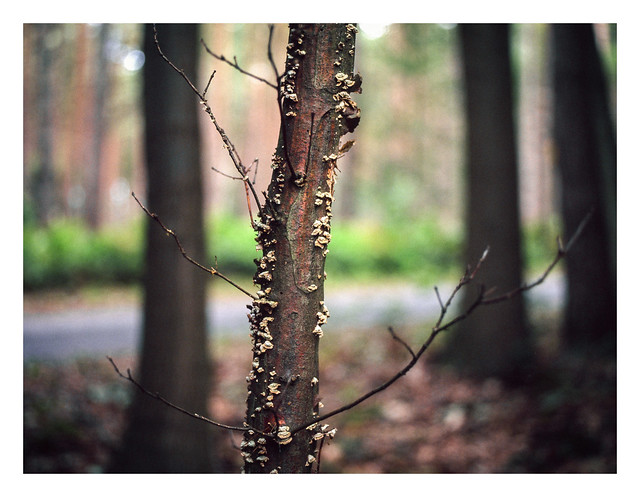
A quick post today with another shot from the Bronica on the roll of expired Provia 400. Maybe not the healthiest tree, but the one that attracted my attention.
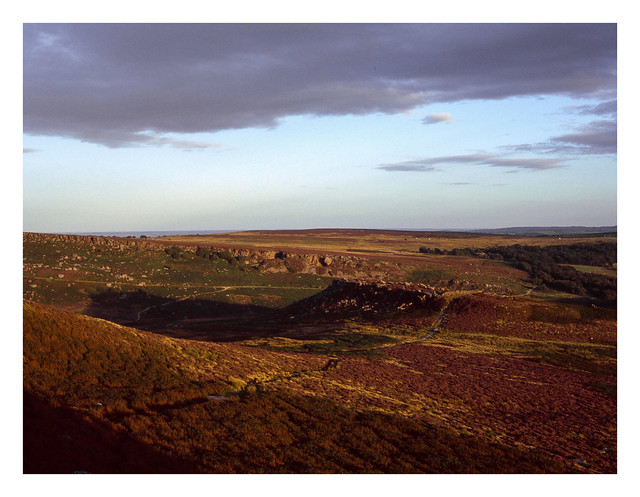
A couple of weeks ago I took an impromtu trip out to the Peak District National Park one evening after work. August is the month when the heather flowers, blanketing the landscape in a cover of purple. For the last couple of years I’ve managed to miss it altogether for one reason or another, or have only caught the end of the season when it’s past its best. So, given the weather looked nice, I decided to take to opportunity. There might even be a sunset!
I took my Bronica ETRSi loaded with a roll of slightly expired Provia 400. I’ve not shot the 400 variant before, but was quite hopeful given the decent results I’d had a few weeks earlier with some 2003 vintage Ektachrome. As I got closer to my destination it became apparent that I wasn’t the only person taking advantage of the pleasant eventing and there were a considerable number of other people and cars about. I managed to find a place to park without too much trouble though and climbed atop Higger Tor to make some photos.
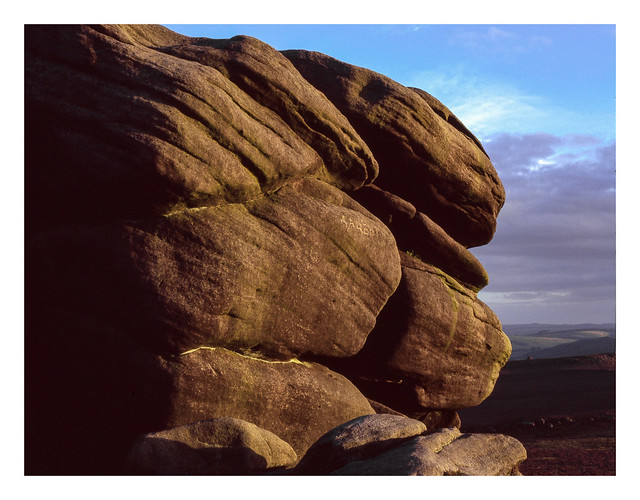
Heather amongst the gritstone
I soon noticed a curious issue with my light meter, which was giving slightly odd-looking shutter speeds like 1/128. I wasn’t sure what the problem might be, but the speeds were all close enough to regular shutter settings to not give me undue concern. After a few shots it became moot anyway when the meter’s battery died – even though it had been on two bars the last time I checked – and I had to resort to my light-meter app on my phone. It was only when I got home and fitted a new battery to the light meter and looked at the manual that I realised I’d managed to set it into cine mode! Given reversal film’s intolerance of poor exposure, I resigned myself to a roll of mostly ruined shots. One receipt on my transparencies a few days later however, it seemed that most of them were not too bad at all – somewhat ironically the worst shots were the ones where I’d used the light meter app!
Anyway, I roamed around atop the plateau making a number of photos although, if I’m honest, my enthusiasm wasn’t high – I felt somewhat rushed due to the last-minute nature of the trip, plus people kept wandering into my compositions. There was no sunset either…
Looking down from Higger Tor towards the ancient hillfort of Carl Wark
After a pretty successful session scanning my roll of 135 Velvia 100 previously, I jumped headlong into scanning the Provia 400 when I received the transparencies from the lab. And promptly had the confidence knocked out of me. The settings that had worked so well for me in Vuescan for that earlier roll now served to deliver only disappointment. I know that it’s a different film, and I was also scanning it on my Epson V550 – not the Plustek – as that will scan medium format negatives, but I had hoped that my previous settings would at least serve as a good starting point.
The results were awful. Using the Adobe RGB output setting, that works so well on other scans in Vuescan, here served to produce ugly and blocky purple highligts on some parts of the image. Switching to a different output setting resoleved this, but now the images lost some colour and also seemed to vary in quality by a large degree from frame to frame.
In the end, I resorted to using Epsonscan – an application that has given me less than pleasing results when scanning slides in the past. This time though, it beat the Vuescan files – although it took some considerable faffing in Lightroom & Photoshop before I got something I was mostly happy with and which seemed to reflect what I could actually see on the transparencies.
Given Fuji Velvia’s penchant for rich saturated colours, I couldn’t help photographing a couple of red pillar boxes with it.
Scanning this Velvia 100 took a bit of trial and error to get the colours and tones correct. My initial attempts resulted in slightly flat looking images, lacking in that brightness that you see when viewing a transparency in natuaral light, so I had to create a Lightroom preset to make the necessary adjustments required. Even then, however, the scans still had a very warm cast to them. A little research revealed that scanned Velvia 100 is sometimes nicknamed Redvia due to the red tones in the shadows. It might be possible to remove this in Lightroom, but I found it easier to set up an action in Photoshop to use a curves layer to drop the shadows in the red channel. They look much closer to the original transparencies now, but retain those saturated tones that the film is known for.
I’ve been really pleased with the results from this roll (and the fact that the OM-2n’s meter has proven itself to be dependable even when metering for something as finicky as slide film). I hope the other four rolls I have will be just as satisfying.






 Steel City Snapper photography