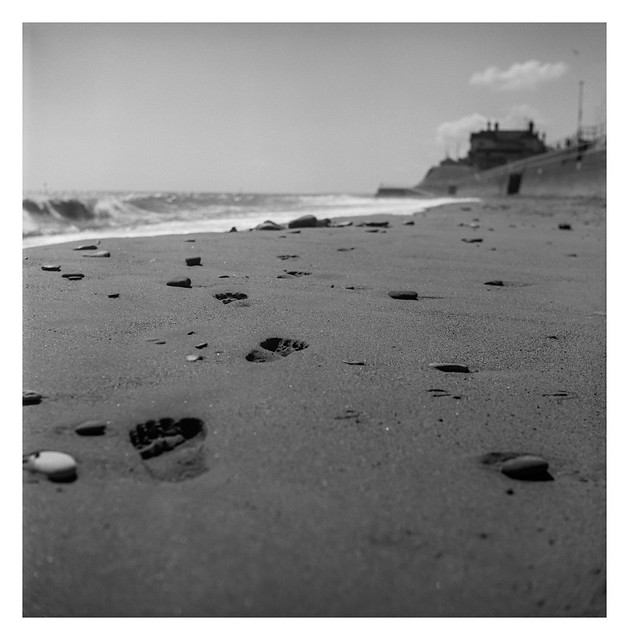
If you look very carefully at this picture (you may need to click on it to see it larger on Flickr), you can just make out some of the footprints in the sand that featured in the picture on my blog a few weeks ago. I can’t remember if I took that picture before, or after the one shown here, but they were taken within fairly quick succession either way.
The building you can see is a pub called The Marine. I took a couple of pictures of the pub but neither one was particularly interesting in retrospect, so I didn’t upload them anywhere.
Olympus 35 RC & Kodak Gold 200. Lab developed. Home scanned and converted with Negative Lab Pro.
A few weeks back I mentioned in this post that I’d found, and photographed a large “pebble” made of housebricks. I’d not yet finished the roll of film containing the picture at that time, but I have now, so here’s a picture of the somewhat unlikley looking product of erosion.
It actually looks quite interesting, and I’ve idly wondered how it would look if polished to a smooth finish and used as the top for a small table or something. It would certainly be a talking point.
I also wonder where it came from? Someone’s house, a clifftop wall? And how long has it been subjected to the forces of nature to reach this state?
Olympus 35 RC & Kodak Gold 200. Lab developed. Home scanned and converted with Negative Lab Pro.
I’ve posted many photos taken along the Tranbs Penine Way on this blog, mostly because a section of it – the southern spur that leads to Chesterfield – is only half a kilometer from my home. The photo today shows the very first time I saw the starting point (or, I guess, the finish if you travel the other way) for the main east / west route. This post marks the easternmost point at Hornsea on the Yorkshire coast beside the North Sea. The far end of the trail lies in Southport in Lancashire on the edge of the Irish Sea.
I’ve never been to Southport before, but perhaps a trip will be in order someday – I do like seaside resorts after all, and it would allow me to pair up both ends of the trail.
I wonder what this wooden groyne looked like when brand new? And when it actually was brand new? It would be interesting to know how many years of being pounded by waves, pebbles, and sand it took to reduce it to this somewhat broken-toothed appearance.
I like this photo. It has a clean, minimal feel to it. The sky is clear of cloud (bar a couple of barely discenible whisps) and the lines of the horizon, fence, and bench add an element of structure. The man sits slightly off-centre, adding a small sense of discord to the picture.
I wonder what the man was thinking about as he sat there, looking out across the North Sea? When I see picture that I have taken such as this, I sometime wonder if I should have spent more time taking in the view myself, rather than trying to photograph it. I sometimes feel that I’m spending too much time trying to capture a moment to be enjoyed later when the reality is right there in front of me. But the camera, it draws me…
At Hornsea, where the wooden groynes meet the sea wall, concrete steps have been placed to allow people to bypass the wooden structures. The sun was bright and contrasty by the time I made these pictures and, as I had a roll of Fuji Acros in the camera at this point, I thought that these steps might make for decent subjects.
While I’m sure that this little boat once served some actual water-borne purpose, it now looks to serve as decoration for this building which houses a shop, a cafe, and I believe, the inshore rescue service.
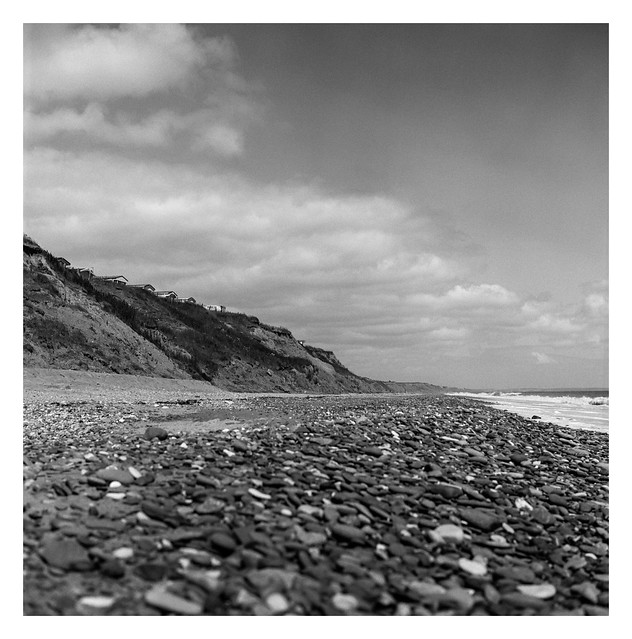
I spoke a little about the erosion that is taking place on the shoreline of Yorkshire’s east coast the other day. These two pictures show how close to the edge some of these caravans are sat. While they no doubt have wonderful views out over the North Sea, I think I’d be tempted to move to a new pitch if I was the owner.
This video gives a good view of just how parlous the situation is for structures placed close to the cliff tops in this region.
Someone had been walking barefoot across the beach at Hornsea on the day I visited. Whoever they were, they had moved out of sight before I came across their tracks.
I like this picture but can’t help but think that there was a better one to be had. I wanted to keep the building in frame at the upper right, and I wanted a crashing wave as well, both of which I’m happy with, but the placement of the footprints isn’t quite how I’d like it.
Scenes like this require care. walk into the scene and, to quote Joel Meyerovitz, it becomes bruised – in this case the risk that the smooth sand becomes tarnished with my own footprints as well as the unknown walker’s. Maybe I should have sought out more patience but, as usual when I visit somewhere that’s not as easy to get to, I like to try and maximise my value from the day and see as much as I can, which means I tend not to hang around a sinmgle location of photo opportunity for too long. Perhaps I would improve my photography if I did.
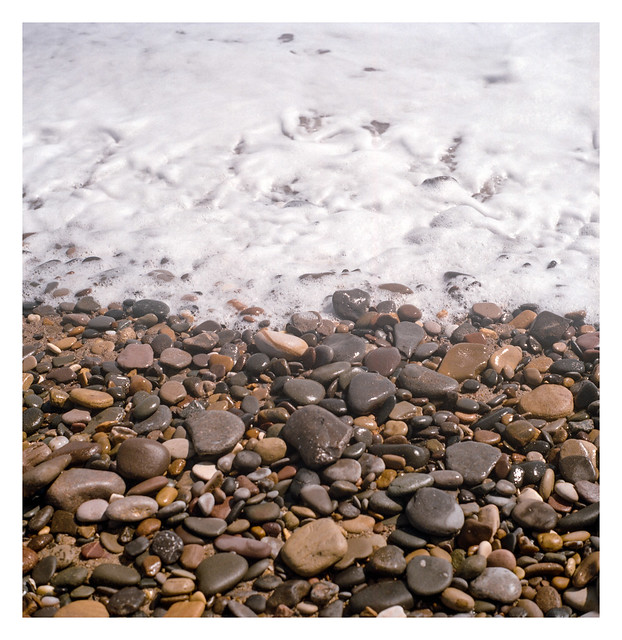
The beach at Hornsea has a lot of pebbles, no doubt in part because of the coastal erosion that is taking place in the region. Pebbles are interesting to look at, with an endless array of shapes, sizes, colours and textures. The colours are multiplied further when the pebbles become wet, their tones becoming more saturated, fragments of minerals sparkling in the sunlight, and some taking on a crystaline, semi-translucent appearance.
I wondered as I stood there, how long the process of taking a rough chunk of rock and smoothing it to an organically sleek pebble would take. “How long is a piece of string?” might be a suitable retort as, given the range of different types of rock and mineral, plus the fact that the process never ends, each individual piece being constantly weathered until it becomes sand, but it’s still something that I expect will take a considerable duration.
So I was quite surprised to see a large pebble formed out of a section of brickwork, complete with mortar holding the components together. While I’ve no idea when this chunk of masonry began it’s transformation, I expect it’s far more recent than I might have expected. I took a phot of the brick-pebble but it’s on a roll of film I’ve yet to develop. Hopefully, if it has worked out ok, I’ll post it on the blog.
Yashicamat 124G & Kodak Gold 200. Lab developed. Home scanned and converted with Negative Lab Pro.





 Steel City Snapper photography