35mm · Film photography · Photography

The size of a tree

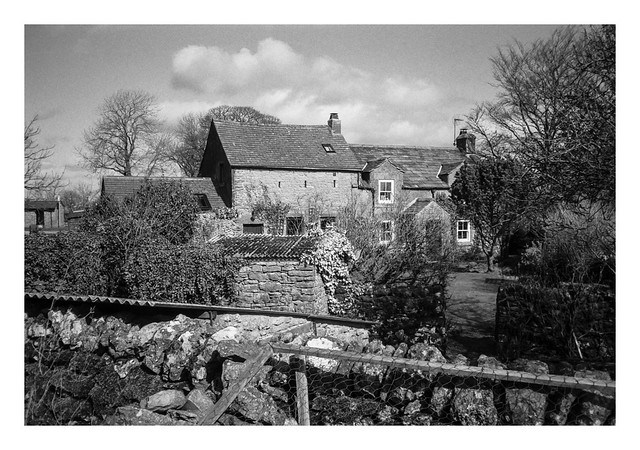
I took these two photographs on my way back to the car after visiting Magpie Mine back in March. The light in the village here was lovely and I finished the roll of Delta 400 that was in my (somewhat tempremental – it sometimes decides that it’s won’t fire, until suddenly springing back into life a few minutes later) Sure Shot Supreme making photographs of some of the scenes.

I didn’t really pay heed at the time, but on seeing the scan of this first image it really brought home to me just how big trees can grow in comparison with their surroundings. This one towers above the house it stands beside and I wonder which of the two came first?

Giving trees a sense of scale

It’s not really a tall tree in the scheme of things either, there are much larger ones to be found – including true titans such as the giant sequoia’s that grow in the western US. I think that this one is a sycamore (judging by the texture of the bark at least), but it’s very possible that I’m wrong. There was a time when I was younger that, in true boy-scout fashion, I could readily identify a whole range of trees from their shapes, leaves, fruit, bark etc., but it’s a skill that has faded over time. I still know the obvious ones – oaks, chestnuts, maples – and I would recognise sycamores from their leaves and seeds – but I’m not sure I’d know an ash from a birch these days without looking it up. I have a book of British flora and fauna, so maybe I’ll see if I can refresh my knowledge.

Scenes that catch your eye

Canon Sure Shot Supreme & Ilford Delta 400.

Taken on 16 March 2020

35mm · Film photography · Photography

Developing, scanning and remembering a trip in the countryside

I’ve remained mostly housebound today, with the exception of a quick trip to the local shops for some food and other essentials – and as my wife was with me, that was in the car rather than walking it there as I usually do these days. I was amused to see that the car parked beside ours had been converted into an “RV”. I’ve seen plenty of vans that have been converted, but this was a family estate car that had a cooker, cupboard and fridge, along with electrical sockets fitted in the rear. It looked like a fairly professional job had been done, but I can only image the amount of back-twisting maneouvering that would be required to carry out tasks in a space maybe three feet wide by three feet high!

I spent the rest of the day doing some other film-related tasks.

Firstly, developing a roll of Delta 400 that I finished shooting about a week ago. The process went smoothly and the negatives look good (although I haven’t scanned them yet). Some of them do look like they have noticeable dust on them though, which hasn’t happened before, so I might have issues when I do get around to scanning them.

I also scanned a roll of Fomapan 100 that I shot during my trip to Magpie Mine a little while before the country entered lockdown. The shots on that roll look quite nice, and I will post some here later in the week. The camera I used for the roll, my Yashica Mat 124G, has developed some haze on the taking lens and is currently away for a service, but the shots on this roll aren’t, for the most part, showing any signs that they’ve been affected.

Today’s photo was taken on the same day as visiting the mine as I walked back to where I’d parked my car.

A place in the country

Canon Sure Shot Supreme & Ilford Delta 400.

Taken on 16 March 2020

Film photography · Medium Format · Photography

Expired Film Day 2020 – Magpie Mine

The weekend just gone was Expired Film Day 2020 – actually three days, as shooting was allowed on the 13-15 March – four days for me as I didn’t shoot most of my roll until the 16th, possibly voiding my ability to be nominated for a prize. Oh well, I wasn’t expecting to win, and didn’t take part for that reason anyway. 🙂

I shortlisted three rolls as potential candidates this year:

  • Kodak Ektachrome 100 – expired 2008
  • Kodacolor Gold 200 – expired 1989
  • TriFCA35 – expired 1975

After a bit of research, I decided against using the TriFCA35 – it’s apparently a C22 process film, but it’s likely my local lab would have only processed it as B&W. The feedback by others on the film wasn’t particularly encouraging either, with some saying that, even when fresh, it wasn’t especially great, so I decided to not chance it – as cool as it would be to get images back from a 45 year old roll, I wanted to make sure I did get some images given the limited opportunities I had to take photographs during the timeframe, so decided on the Kodacolor Gold 200 instead.

Given its age, I decided that overexposing the Kodacolor by a stop for each decade of expiry would be a good plan, meaning that I’d be metering for 25asa. Not a problem if I used a tripod and shutter release though.

My original intention was to go out on the 13th and get some shots during a day’s leave I’d taken, but I had an appointment in the morning (when, as you might have guessed, the light was great). By the time I was able to go out, the sky was developing a layer of cloud cover that probably wouldn’t be condusive for good results from expired colour film (or even fresh colour film, for that matter). Nonetheless, I didn’t want to waste the opportunity, so went out anyway, rushing to try and catch the last of the light.

Rushing. That’s rarely a good idea with photography is it? And this case was no exception. I had planned to go to Lady Canning’s Plantation at the edge of the Peak District and take some woodland and rock formation photos but, given the thickening cloud, instead went to Ford, a small hamlet much closer to home. This was a wise decision as, upon setting up for my first shot, I discovered that I’d grabbed the wrong quick-release plate in my haste to leave the house, and the one I had was too big to fit the Arca-Swiss head on the tripod I’d brought. I managed to take a couple of shots anyway, with the too-large plate fitted precariously, but then decided that the day wouldn’t be improved by my camera falling onto the floor, so gave it up and went back home (in a somewhat less than positive mood).

The following day was a pre-planned trip to Wakefield, where I took plenty of photos, but none on the expired film – which would have been far too slow to be of any use in the place I visited. Then Sunday was a washout due to the weather. Monday, despite being outside the stated shooting days for Expired Film Day, was also a day I had taken as leave, and was blessed with good weather to boot, so I (carefully this time!) packed my stuff, and headed out into the Peak District to Magpie Mine. I’ve seen pictures of this location before, but this was my first visit, and it’s a very nice place to visit – especially on a nice day without too many other visitors to get in the way of your photographs.

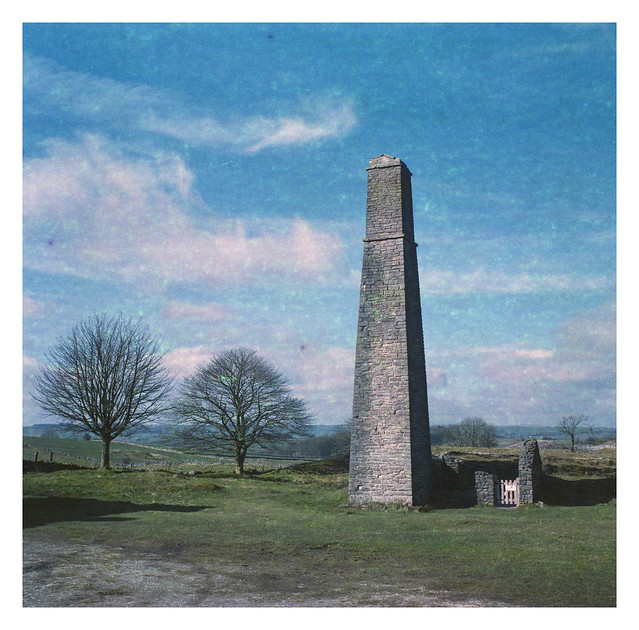
The location is one of the best surviving examples of a 19th century lead mine in the UK, and features the remains of various chimneys, engine houses, winding gear, and mine shafts (all covered by grilles, so you can’t fall down – although phones, wallets, light meters and the like might be easy prey!). It’s apparently possible to stand on the grille atop the main shaft and see water over 500 feet below (the shaft is flooded a further 150 feet below the surface of the water).

Given the lovely light, there were all manner of compositions to be found and I shot all ten remaining frames on the roll of expired Kodacolor, as well as ten frames of Fomapan 400 that I had in my YashicaMat 124G. I even shot a few frames of 35mm using the Sureshot that Ihad in my coat pocket.

The following images are the ones I’ve chosen to submit to this year’s Expired Film Day, and are, I think, the most pleasing images from the roll – although there were a few close runners up too.

For a thirty-one year expired roll of consumer-grade colour film, I’m pretty happy with the results. There are obvious signs of degradation, and the colours are a bit off-whack, but it’s given me some pleasing images nonetheless I think.

Expired Film Day 2020 #1

Expired Film Day 2020 #2

Expired Film Day 2020 #3

Zeiss Mess-Ikonta 524/16 & Kodacolor Gold 200 (expired in Feb 1989).

Taken on 16 March 2020

Film photography · Medium Format · Photography

Cascades at Hell Bank Plantation

One of the ways I like to find potential locations for photography is by browsing Ordnance Survey maps. Usually I look for public footpaths and rights of way and plan a walk in the hope that there might be something interesting to photograph along the route – usually there is. I’ve loved to look at Ordnance Survey maps ever since I first came across them as a child – specifically the 1:25,000 scale Landranger maps. They’re a treasure trove of detail with their beautiful design and iconography, and just skimming across them will turn up evocative little identifiers for things like trig points, towers, tumuli, wells and all manner of other intriguing things. And so it was on this occasion, where my browsing alighted upon the intriguingly named Hell Bank Plantation which also had a little marking stating “Waterfalls“.

So last Saturday, after my walk along the River Derwent at Calver, I decided to head home via a route that would take me to Hell Bank Plantation so I could see what it was like as a location.

After a wrong turn that would have gotten me where I needed to go – if I was on foot(!) – I finally took the right route and managed to get a parking space at the top of the plantation (where a decent number of other vehicles were already parked). The entrance into the plantation was via a stile a few yards from where I’d parked and the trail led down into the pine woodland. After a short distance the main footpath had a fork with the narrower branch heading down towards where I assumed the stream and waterfalls would be.

FILM - Gnarly

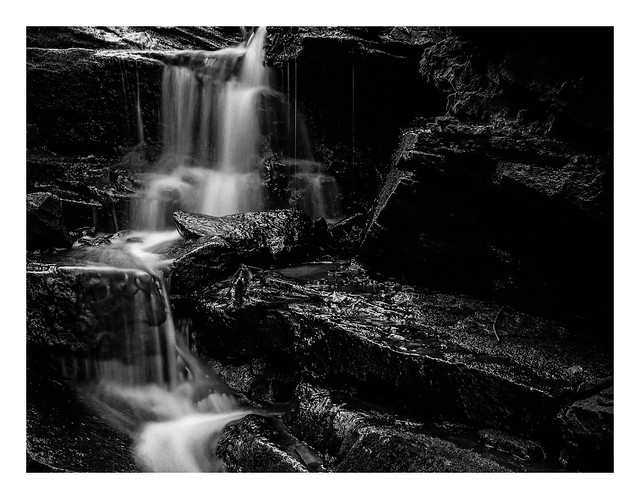
The path led me across the stream and then took a left turn so that it descended into the valley with the stream on my left, now at the bottom of a steep-sided gorge. I could see a number of cascades of water down there – nothing spectacular (although I guess it will be much more exciting after some heavy rain) but attractive nontheless. After walking down the valley a couple of hundred yards, it became apparent that there was no easy way to get to the stream from this path down here so I back-tracked. Back near the top I found a place where, with care, I might get down to the water. So, using my tripod as a walking pole, I eased myself down the steep bank to the bottom.

FILM - Hell Bank cascade

Near the bottom was the remains of a stone bridge about ten feet wide, broken in the middle and covered in moss. Thankfully, it also looked like there might be an easier way back up the opposite bank when I finished with my photography. I made my way upstream a little to get in position for some photos – while the stream wasn’t a torrent, there were still some pools that were plenty deep enough to submerge my walking boots fully, so careful progress was required. When I found a good spot I took an incident meter reading and also a couple of spot readings of shadows and highlights to see what they would show (the average wasn’t too far off the incident reading, so I went with that). As I wanted to try and get everything in focus, I metered for f/22 which gave an exposure of around 2 seconds.

FILM - In a narrow gorge

After taking a number of shots I retreated to the broken bridge and, as I’d hoped, was able to climb the eastern bank with relative ease and from there walked back uphill to the car and the journey home.

FILM - Cascade

The processed negatives were a little on the thin side, although not unduly so, and I’ve ended up with contrasty images that I like – at least where the stream and cascades of water are concerned. Some of the other shots (including the bridge) are somewhat busy and I think, if I return to the location, it deserves colour to properly seperate the vegetation, rocks, water and wood textures in the pictures.

There is also another waterfall further down the valley according to Ordnance Survey. 🙂

Bronica ETRSi, Zenzanon 75mm f/2.8 & Kodak Tmax 400.

Taken on 25 January 2020

Film photography · Medium Format · Photography

River-side house

Continuing the theme from the past couple of days, here’s a shot of the scene just downstream from the previous locations. As is so often the case when I pre-arrange a day out with the camera, the weather was dull with featureless grey stratus clouds, making for somewhat less than interesting skies. Still, we make do with what we get and, while the conditions might have been better, it was still a very nice walk along the river.

FILM - Oblique

Bronica ETRSi, Zenzanon 75mm f/2.8 & Ilford Pan F Plus.

Taken on 25 January 2020

Film photography · Medium Format · Photography

Through the pines

This was taken on the footpath beside the River Derwent a little further upstream from the bridge I posted a photo of yesterday. I’ve taken a picture at this location before, last year, using my Yashica Mat 124G. Unfortunately something went wrong with that version – I think the camera strap, or possibly the cable release, had gotten in the way of the taking lens without me noticing and the resulting image had a blurry streak across part of the frame. This one worked much better (although prior to this I managed to waste three frames by somehow shooting them with the dark slide in the camera – something I didn’t even think was possible with the ETRSi).

FILM - Can't see the wood for the trees

Bronica ETRSi, Zenzanon 75mm f/2.8 & Ilford Pan F Plus.

Taken on 25 January 2020

Film photography · Medium Format · Photography

Crossing calm waters

This is the road bridge that crosses the River Derwent just above Calver Weir. It carries the A625 and I believe is called New Bridge, although I have no information byond that unfortunately. It makes for nice photographs whether viewed from up or downstream though – the nearby weir means that the water here is deep and slow flowing, producing lots of opportunities for reflections.

This shot is my entry for the 2020 film photography contest I’m taking part in – the theme for January is “Openings”.

FILM - Opening

Bronica ETRSi, Zenzanon 75mm f/2.8 & Ilford Pan F Plus.

Taken on 25 January 2020

35mm · Film photography · Photography

Wellington’s Monument

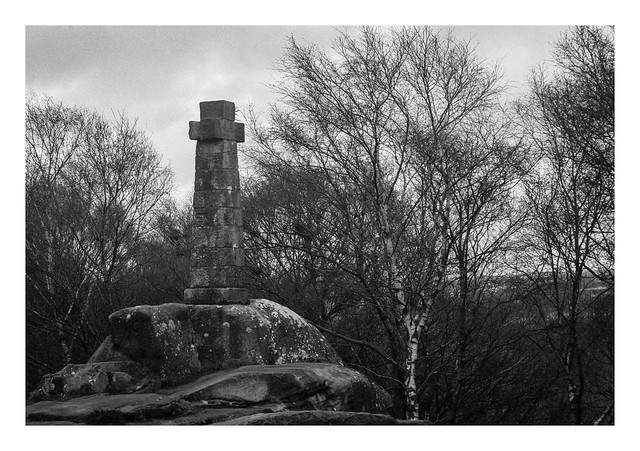
Stood right beside the twisty oak woodland that I featured yesterday stands Wellington’s Monument. This stone cross features the dedication: “Wellington, Born 1769, Died 1852. Erected 1866 by E.M. Wrench, late 34th Reg’ment” and commemorates Wellington’s victory at the Battle of Waterloo. The cross is visible atop the hillside from the A621 Sheffield Road which passes to the east at the bottom of the valley. Across the valley on Birchen Edge stands another monument, this one dedicated to Admiral Lord Nelson.

FILM - Wellington's Monument

FILM - Wellington's Monument

Olympus OM-1, F.Zuiko 50mm f/1.8 | Zuiko 28mm f/3.g & Ilford Delta 400.

Taken on 4 January 2020