This, I believe, a Heinkel Kabine “bubble car” from the late 1950s. I’m fairly certain the clockwork winding key is not an original feature! 🙂

Nikon F80, Nikkor 28-80mm f/3.5-5.6 & Eastman Double-X.
Taken on 17 August 2019

Steel City Snapper photography
35mm, medium format and large format film photography (with the odd bit of digital every now and then…)
This, I believe, a Heinkel Kabine “bubble car” from the late 1950s. I’m fairly certain the clockwork winding key is not an original feature! 🙂
Nikon F80, Nikkor 28-80mm f/3.5-5.6 & Eastman Double-X.
Taken on 17 August 2019
Amongst the various vintage and classic vehicles at the Lincoln steam rally were a couple of Invacars, which immediately caused a pang of nostalgia because I haven’t seen one for a long time. The Invacar was a fairly commonplace sight when I was a child back in the 70s and 80s with it’s distinctive 3-wheeler shape and uniform colour (they were all the same shade of ice-blue), but they haven’t been seen on the roads in any great numbers for a long time now. They tended (in my experience) to be referred to as Invalid Carriages, rather than Invacars, or (in the politically incorrect schoolyards that existed 1970s and 80s) by somewhat harsher and more unfavourable terms that I’ll not repeat here.

The background of this distinctive little vehicle begins shortly after WWII when a fellow named Bert Greeves built a vehicle around a motorcycle converted for full manual control for use by a paralysed cousin. As there were many people living with disability following injuries sustained during the recent conflict, a commecial opportunity was spotted and government help was sought. The result was Invacar Ltd. and the cars were distributed to disabled drivers by the Ministry of Pensions up until the late 1970s when the contract ended.
The single-seater cars originally had a small engine, but a later upgrade resulted in far more power and it is reported that this gave a top speed of over 80mph. Despite the rakish angle of the passenger compartment, I doubt that this was the best idea and was likely akin to strapping a rocket engine to a paper airplane. I can only imagine the thrill (terror!) that would be induced in experiencing this speed in such a tiny, fibreglass-bodied Invacar. I believe they also had a tendency to catch fire on occasion too!

Over time, as motability schemes were introduced that allowed people with disabilities to adapt regular vehicles for their use, so the need for these small cars fell away. In 2003, all the remaining Invacars still owned by the government were recalled and scrapped as they could no longer meet road safety regulations, although vehicles still in private ownership are still allowed to be used on the road apparently.
I had a roll of B&W film in the camera when I came across the car (actually there were two, but this “well loved” model was better placed and more interesting of the two for photographs) so I can’t show the distinctive shade of blue on here, but there will be many other photos around online should you choose to go looking.

Nikon F80, Nikkor 28-80mm f/3.5-5.6 & Eastman Double-X.
Taken on 17 August 2019
While I can’t honestly say that I have much more than a passing interest in cars – whether they be classic or contemporary – as a photographer I nontheless recognise their appeal. I know when I photograph an interesting car that it’s something that’s going to look pretty cool as a picture. So here are three more car pictures (or fragments of cars, at least) captured on beautiful Eastman Double-X.
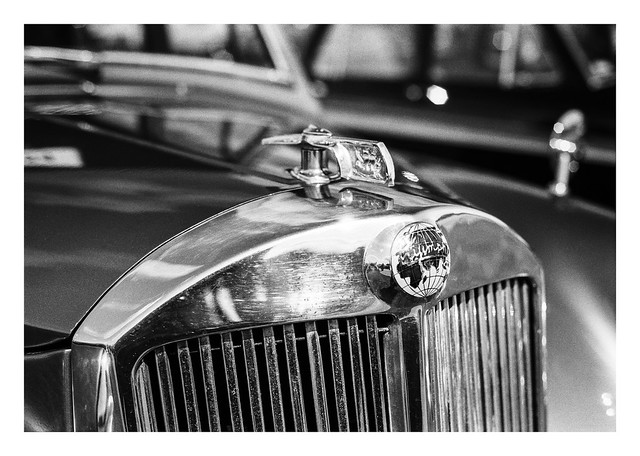
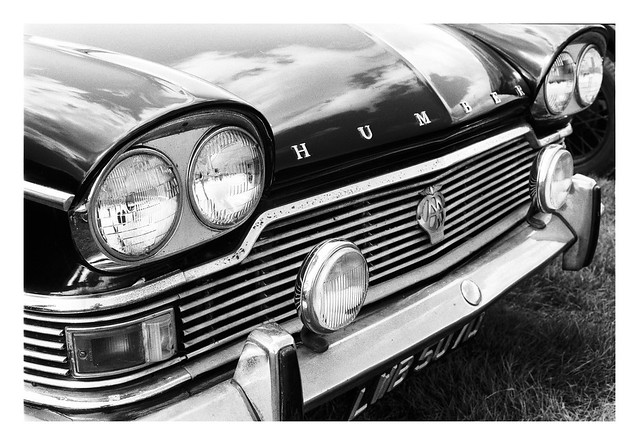
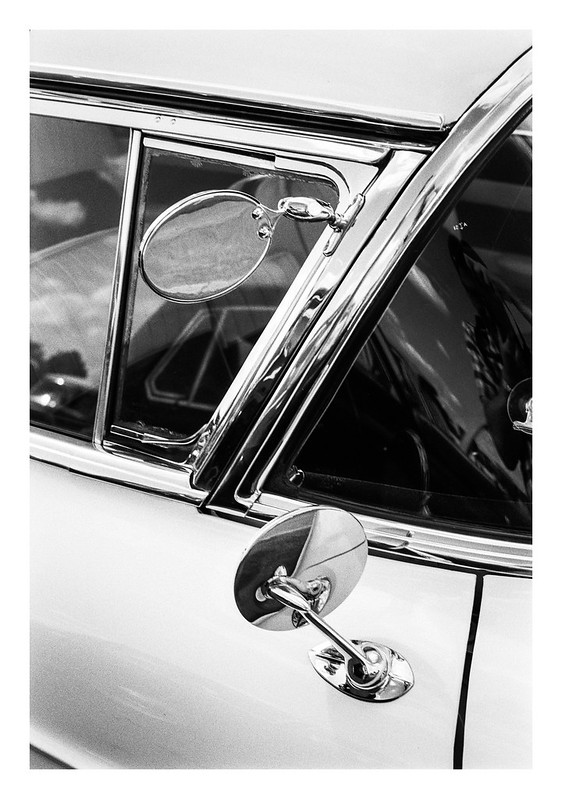
Nikon F80, Nikkor 28-80mm f/3.5-5.6 & Eastman Double-X.
Taken on 17 August 2019
I was very lucky last Christmas to receive a generous gift from my Emulsive Secret Santa. Included in the box were a number of rolls of film, a camera strap, and a pin badge. Also in the box was a lovely Kodak Retinette IIa camera along with a very nice letter from my kind benefactor.
The film included two rolls of Eastman Double-X and I was very happy about that. Unfortunately, I think my happiness at receiving it also made me very cautious about shooting it. I felt that I didn’t want to waste the film on everyday snaps and that I should use it at a worthy location or occasion.
I’ve come to realise that this is probably not the best thing to do. I was given some great film and instead of getting out and taking some great pictures I was instead hoarding it away like Gollum with the One Ring. Last weekend I visited the steam and vintage rally at Lincoln and as I was packing my bag, grabbed a couple of rolls of HP5+ – my go-to black and white film – before I realised that I should shoot some of the Double-X. After all, the rally would have a load of vintage vehicles and that a classic black-and-white cinema film might make them look really great, so I grabbed a roll and popped it in the bag.
I shot a couple of rolls of 135 colour film first (I shot a LOT of film on the day – for me at least – 2 rolls of 120 and 3-and-a-half of 135. It has been quite expensive getting it all processed!). Then I dropped in the Eastman Double-X and got to work with that, getting through the whole 24 exposures.
After getting the film processed, the negatives looked vey contrasty and I initially feared that I might get almost two-tone images with blown highlights and crushed blacks, but upon seeing the scans emerge, there was actually plenty of detail across the whole range. They were still very contrasty but, hey, if anyone likes contrasty photos, it’s me! It’s certainly a classy looking film, and the way the the higlights show halos (due to the anti-halation layer being removed from the film I presume) is nice too.
Anyway, I’ve not uploaded all of them to Flickr yet, but here are three from the roll…
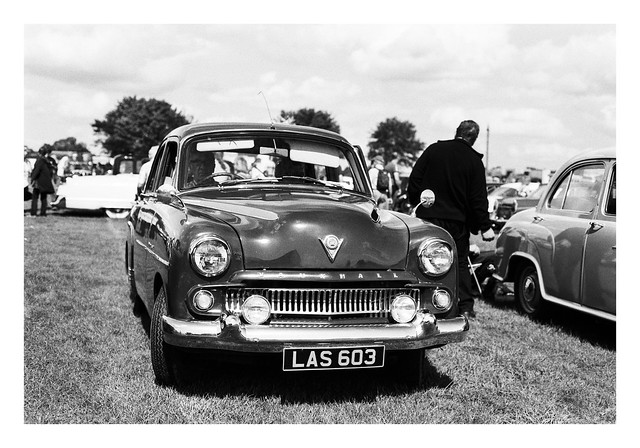

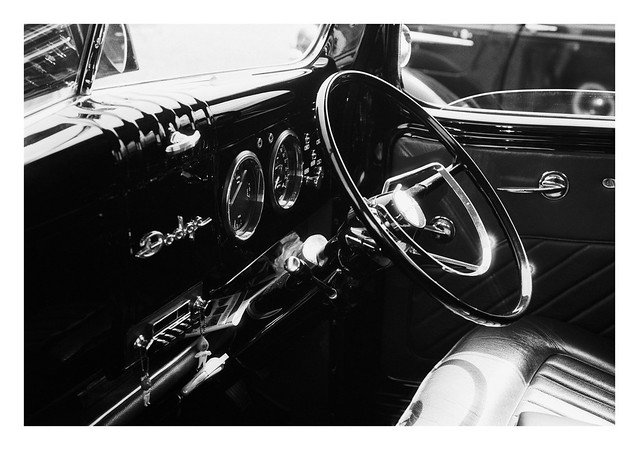
Nikon F80, Nikkor 28-80mm f/3.5-5.6 & Eastman Double-X.
Taken on 17 August 2019
Another cropped shot, this time for artistic reasons rather than a glaring light-leak!
The vintage fire-engine in the foreground has a wooden ladder, similiar to those seen in the background, but I’ve annoyingly managed to chop some of it out when framing the shot. I think it was because, as I was composing the image people were wandering between of the fire-engines, and I wanted to get the shot before one of them walked into the frame. This probably caused me to rush a little and thus mis-compose the picture. As a result I’ve cropped it to a 6×7 ratio. The bell is a little tight in the top-right corner (and if you look really closely there is a tiny sliver of the wooden ladder still in frame), but the bell is intact and I still think it works ok.
Ektar certainly gets on well with the reds!

Zeiss Mess-Ikonta 524/16 & Kodak Ektar.
Taken on 17 August 2019
For a 65 year old camera (or for any age camera for that matter), my pocketable Zeiss Mess-Ikonta is a great little medium-format machine. It produces lovely sharp photographs. The uncoupled rangefinder serves to slow you down a little – spur of the moment shooting is not the forte of this camera (unless you’re shooting in steady light and at a set focal distance / aperture that removes the need to change settings) – but I really don’t care when it allows me to make pictures like this.

Zeiss Mess-Ikonta 524/16 & Kodak Ektar.
Taken on 17 August 2019
This is another frame from the roll of Provia 100F that was badly affected by light-leaks. I’ve had to crop this one quite a lot to avoid the effect. It’s now in a 6×4.5 ratio and probably less than half the size of the original image. It’s a shame that I’ve had to crop out some of the long line of red tractors, but better than losing the entire image, I suppose.

Zeiss Mess-Ikonta 524/16 & Fuji Provia 100F.
Taken on 17 August 2019
Yesterday I made a comment about providing an explanation for cropping my 6×6 photo to a 6×7 ratio. The reason for this was a series of highly noticeable light leaks across the whole set of images, and I think I know the reason why this occurred…
After shooting the roll of Provia, I wound the fill all the way onto the take-up spool as I normally do. Then, however, rather than removing the film and sealing it ready for processing, I instead left it inside the camera. My reason for this was that it was a bright, sunny day and, as I wasn’t planning on shooting any more medium format during the day, I’d leave it in the camera rather than risk it in the daylight. Oh, the irony.
What I think then happened is, as I enjoyed the rest of my day out, the film in the camera – no longer held under tension – was able to loosen itself slightly on the spool. Then, when I got home and removed it, I immediately noticed that the rolled film was protuding over the flanges on the spool slightly. I quickly wrapped it in some tinfoil but, alas, the damage was already done – as evidenced by the light leaks on the top and bottom of most of the frames.
Thankfully, with a little bit of cropping (turning most of the roll into 6×7 or 6×4.5 ratio images, or reducing the area of the 1×1 frame) I’ve been able to rescue most of the photos, including today’s shot of an old Octopus fairground ride.
I’ve not seen one of these rides in a long time (although, to be fair, I don’t tend to visit travelling funfairs all that often anymore now that my kids are older). My last real memory of this particular ride (literally this same model) was back in the early 80s when myself and a friend went on it. It made me feel a little dizzy and I was glad when it was time to get off. Unfortunately, the operator miscounted the riders when letting people off and new people on, and we ended up getting a free ride. Sometimes free stuff really isn’t worth it!

And here’s an example of the light leak (admittedly this is the worst one of the roll):
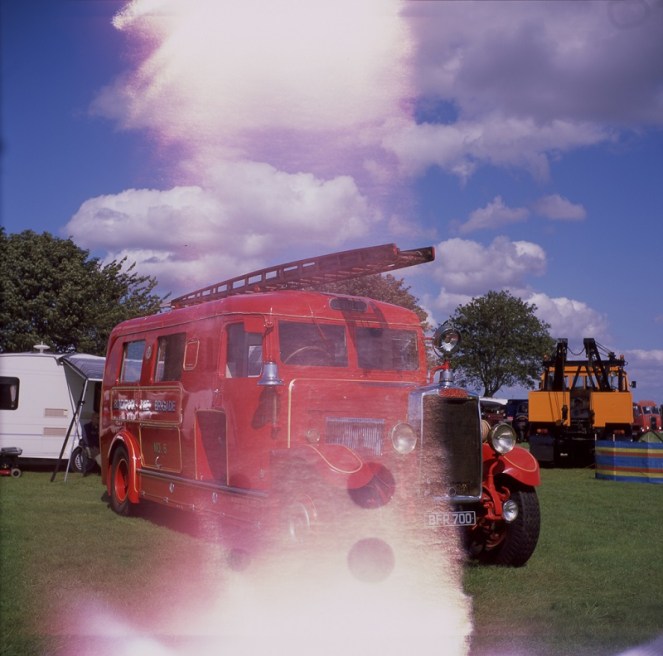
Zeiss Mess-Ikonta 524/16 & Fuji Provia 100F.
Taken on 17 August 2019
I’m in a bit of a rush today, so can’t say a lot, but the eagle-eyed readers of this post might notice that this is a 6×7 format image and the Zeiss Mess-Ikonta 524/16 is a 6×6 camera. Hopefully I’ll have time to explain the reason for my “creative” croppage tomorrow.

Zeiss Mess-Ikonta 524/16 & Fuji Provia 100F.
Taken on 17 August 2019
 Steel City Snapper photography