Trees. Big, solid, tall, impressive things, aren’t they. But what if you were a giant? What if you stood several hundered feet tall? Would a forest become a lawn? Would the people walking beneath their canopies become like bugs?
This is what popped into my head when I was composing this shot.
This ruined structure sits beside the River Moss in Eckington near Sheffield. The main flow of the river runs to the right of the scene in the picture but there’s also a separate stream that runs behind the building which leads me to think it was a water mill of some kind. The building is depicted on Ordnance Survey maps but not named. There are the remains of mineworking in the area, with a pumphouse (named the Seldom Seen Pumphouse) a little further up the valley, so it’s possible that this building may have formed part of those activities.
The Tinsley viaduct has been a feature of Sheffield since 1968, carrying the M1 motorway across the Don Vally to the east of the city. It was unusual at the time for being one of the first two level road bridges of its kind. Until 2008 the viaduct had a fellow landmark in the shape of the two cooling towers of Blackburn Meadows power station. The power station remains, albeit in a new form, but the towers were demolished – to much local consternation from people who didn’t want to lose a landmark that indicated they were almost back home following a journey, and which was felt to be an intrinsic part of the city’s identity. The twin cooling towers can still be found on items of Sheffield memorabilia despite the fact they are no longer in existence.
To the west of the viaduct – towards Sheffield – would have been the site of much heavy industry when it opened but the most noticeable feature now is probably the large Meadowhall shopping mall.
Fujica GW690 & Fujicolor Pro 400H. Lab developed. Home scanned and converted with Negative Lab Pro.
Walking around one of the industrial parks on the outskirts of the city, I really liked the way the side of this Boeing facility was illuminated by the early morning sunlight. There’s probably a better angle to photograph it from (avoiding that slightly annoying lamp post in the middle of the frame), and maybe something that would look good in large format…
Fujica GW690 & Fujicolor Pro 400H. Lab developed. Home scanned and converted with Negative Lab Pro.
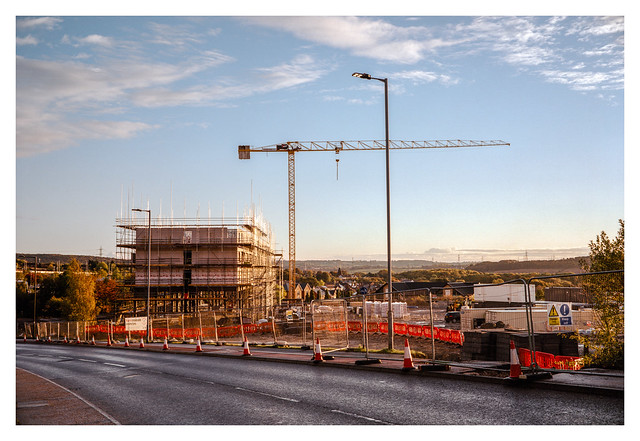
This area has been massively developed in the last decade or so. It sits just to the west of the site of the old Orgreave coking plant – famous for the “Battle of Orgreave” which took place between striking mineworkers and the police back in the early 80s. Pretty much all signs of the previous industry have now disappeared, replaced by a large housing development and a modern industrial park, but construction still continues in the area, with further homes and also new business units being built.
I’m not sure what the structure in today’s photograph will be when completed, although it has the feel of a small hotel, perhaps to accomodate visitors to all the new businesses in the area. Whatever it will be, I felt there was a picture to be made.
Fujica GW690 & Kodak Portra 400. Lab developed. Home scanned and converted with Negative Lab Pro.
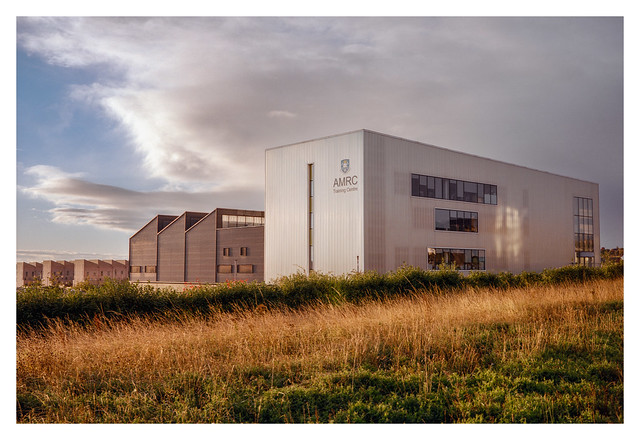
Despite the rain that soon arrived, I think I fell pretty lucky with the weather and light on the morning I took the photos I’ve been publishing the past few days. The incoming cloud added a lot of interest to the skies and, because the sun was in another part of the sky, everything was lit beautifully meaning blocky industrial structures like this training college were transformed.
Fujica GW690 & Kodak Portra 400. Lab developed. Home scanned and converted with Negative Lab Pro.
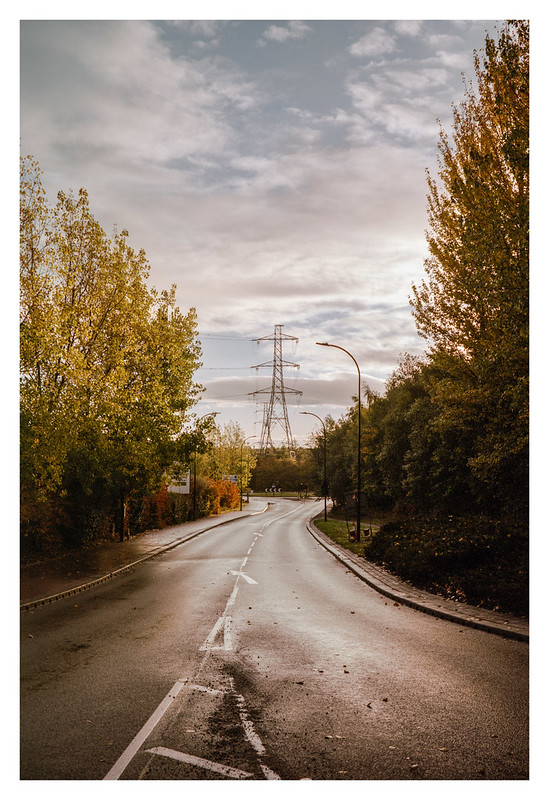
Just a few metres from the picture in yesterday’s post but facing the opposite direction, the morning sun was beginning to be snuffed out by cloud-cover when I took this photo. The trees are not glowing as much as they had been when I’d driven past on mornings with clearer skies. Nontheless, there’s still a hint of autumn in the leaves and I like the damp road and it’s slightly reflective surface. And it has a pylon. 🙂
Fujica GW690 & Kodak Portra 400. Lab developed. Home scanned and converted with Negative Lab Pro.
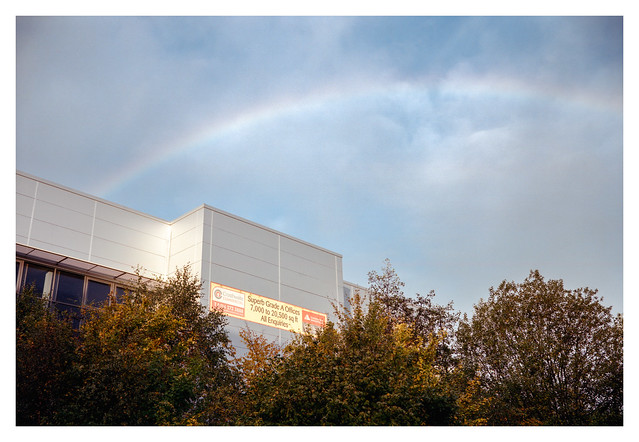
On the morning I took this, I’d hoped for clear skies and an autumnal golden-hour, but this was somewhat scuppered by a fast approaching band of rain. But because the wet weather was approaching from the west, it made for an attractive rainbow, and the front of this otherwise mundane office building was thus transformed.
Fujica GW690 & Kodak Portra 400. Lab developed. Home scanned and converted with Negative Lab Pro.
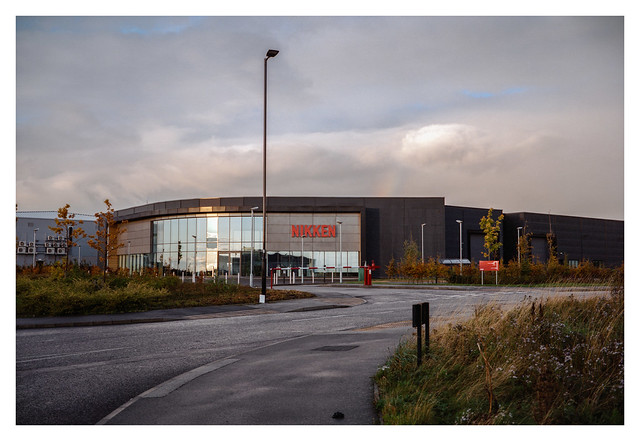
I took a series of pictures around some out-of-town industrial estates a few weeks ago. On the day I took this I arrived around sunrise with a mostly clear sky, but with heavy rainclouds fast approaching. This made for some pretty nicely lit scenes, many featuring a rainbow. You can just see a hint of a rainbow in this picture above and to the right of the Nikken sign. I like the splashes of red in this image, as well as the trees showing a hint of autumn tones.
Fujica GW690 & Kodak Portra 400. Lab developed. Home scanned and converted with Negative Lab Pro.