I’ve not finished off any rolls in the past week, so this post is from a trawl through my archives (which only really go back to last summer, film-wise).
I’ve noticed that I often take photos of doors, doorways, windows etc. I don’t think I’m alone in this, and there are entire Flickr groups dedicated to just this subject, but I thought it might make a decent subject for a blog post. I’ll limit the post to shots taken on film, and just those where the door is the focal point of the image (or at least a significant part of it) and will give a little background (in so far as my memory allows) on where and, perhaps, why I took each photograph. They’re shown in rough chronological order, oldest first.
#1
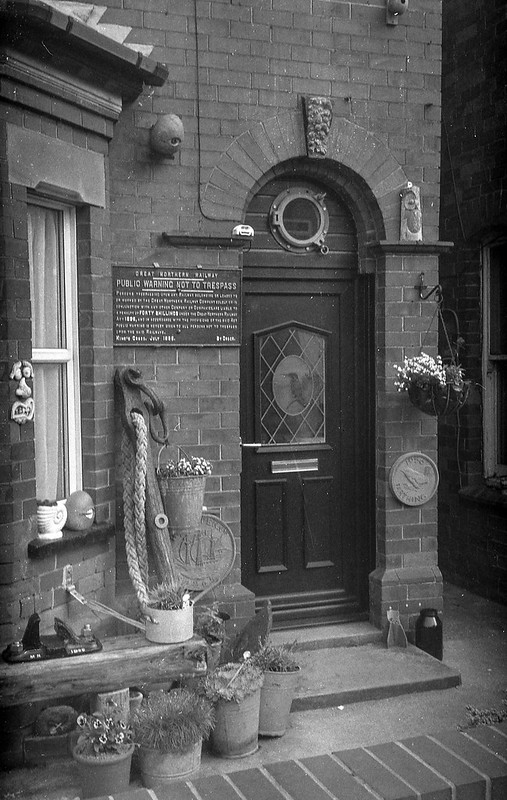
First of all, apologies for the quality of this scan. It has loads of dust and marks on it. Partly, no doubt, due to my not doing a great job when scanning it, but mostly because this entire roll came back from being processed in quite a sorry state. Almost every shot had odd marks, smudges, scratches and horrendous blobs of dust-like artifacts on the negatives themselves. It was as though the roll had been fallen down the dusty back of the processing machine and then been scraped back out from underneath with someone’s shoe. Indeed, I’ve never used this particular place for processing since, and now instead use Peak Imaging, who do a marvellous job.
Anyway, this shot was taken at the Lincolnshire seaside town of Mablethorpe – a regular and frequent holiday destination throughout my childhood and teenage years thanks to my grandparents having a caravan nearby – in September 2016 and this house stood out due to the interesting collection or artifacts surrounding the door. The film used was Agfa Vista Plus 200 (converted to B&W in Lightroom) and it was shot on my Olympus 35 RC.
#2
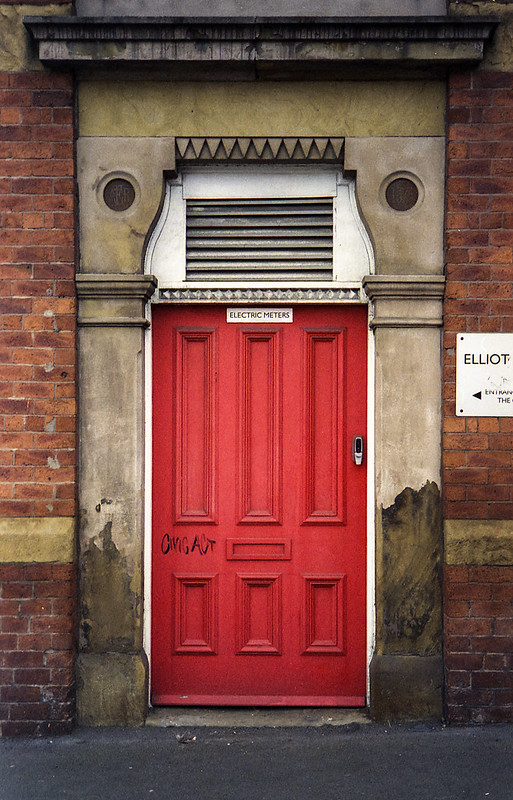
This shot was taken in September 2016, again with my Olympus 35 RC. The film used here was an expired roll of Kodak Ultra 400 (which expired around 2004). The film suffered from some additional grain and I think I ought to have overexposed it a little more to compensate (I think I overexposed it by a single stop), but was otherwise ok. I didn’t notice any significant colour shifts or other faults, although I’m by no means the expert on such matters. I still have a few rolls of this expired film left to shoot.
The door in the picture is in Elliot House on Sylvester Street in Sheffield. The building is now converted to apartments, but used to be part of the Joseph Elliot & Sons cutlery works that was based on the same street (although very little now remains, and the cutlery firm closed in 1990).
#3
Taken in early October 2016, these doors are the main entrance to the central glass house in Sheffield Botanical Gardens. The glass houses are grade II listed structures and were built in 1837-38. They were renovated and re-opened in 2002 which is why the clock above the doors is dated as such. This is another Olympus 35 RC & Agfa Vista Plus 200 photograph.

#4
This was taken on the same day as the shot above. Same camera, same roll of film. It was taken on a road near the botanical gardens and I liked the autumnal look of the leaves piled up on the path and the encroaching holly bush. It’ll not win any prizes but, hey, it fits the theme of todays’ post.

#5
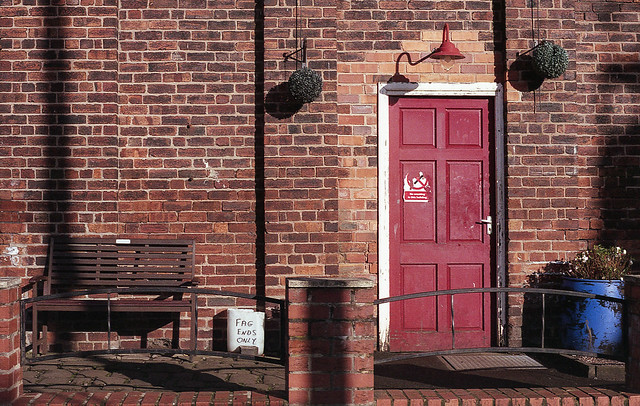
Taken in November 2016 at Barrow Hill Roundhouse, Britain’s last surviving functional roundhouse. The venue is closed at present due to National Lottery funded renovation work that is being carried out. I discovered this to my detriment after driving out for a visit earlier this year without checking the website, only to discover it was closed when I arrived (I ended up going to Bolsover Castle instead). While I’m not particularly a rail enthusiast, I do find that museums such as this offer lots of nice photo opportunities, so are well worth a trip. The shot below is, again, on Agfa Vista Plus 200, but this time shot with my Olympus OM-1, which I’d recently acquired. The lens used was a 50mm F Zuiko f/1.8. I like the way red comes out on colour film (see #2 above), so this was an easy shot, helped by the nice light on the day in question. I particularly like the inclusion of the smoker’s bench and associated “fag-ends” bin, although I’m not sure that dropping cigarette ends into what looks like a plastic container is a good idea. I suppose it might’ve been full of water though – I’m sure these things were carefully considered by the good people who keep the roundhouse going!
#6
Guess the film… Yes! It’s Agfa Vista Plus 200 again! This time shot with my Olympus Trip 35, which is a great little camera with a nice, sharp lens. This is in Paradise Square, Sheffield (if only I’d stepped to right slightly, you’d have seen the full street name for yourselves! Oh well…). This was taken in January on one of my first film-only outings following the (mostly digital) 366 project I did through 2016. The light was great and I went out with my Lubitel 166 U and the Trip and shot a full roll through each.
Paradise Square is a cobbled square surrounded by Georgian houses built through the 1700s. Thankfully it survived the bombing raids that ruined or destroyed much of the city’s historic architecture the Second World War. It now seems to be mostly home to a variety of solicitors and accountancy firms.

#7
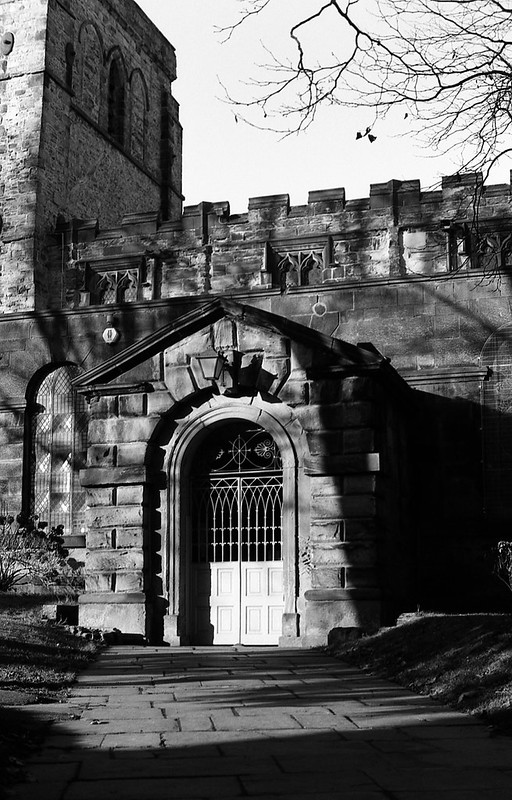
This is the doorway of St. Peter & St. Paul’s church in Eckington, Derbyshire. The church dates back to the 12th century, although has had modifications in the intervening time. I hadn’t gone out to intentionally photograph the church, but I parked my car right outside and the afternoon light was lovely, so I took a couple of shots, one of which you see below. This is the first ‘true’ black & white shot from this set, being shot on Ilford FP4 Plus with my OM-1.
#8
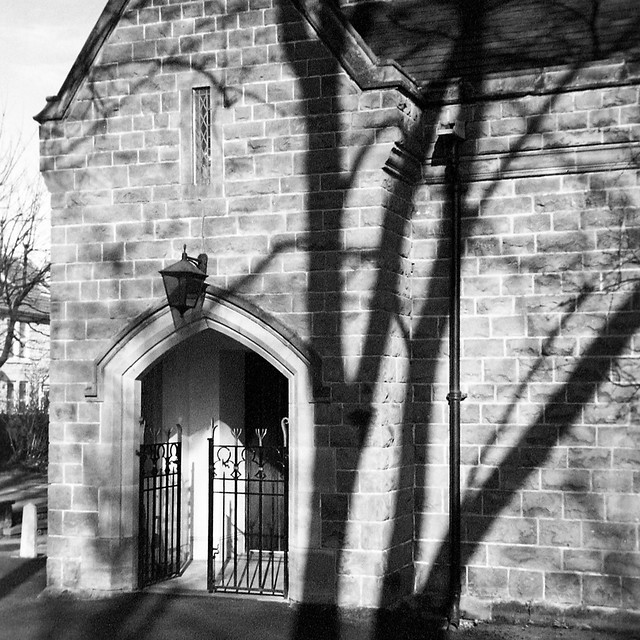
Another church doorway, this time St. Joseph’s Roman Catholic church at Handsworth, Sheffield. My wife had an appointment on our way out on a shopping trip, so I decided to go for a walk rather than sit in the car, and I liked the look of the tree’s shadows cast upon the church wall. The camera I had to hand was an Olympus Superzoom 105 G, which is a point-and-shoot compact that was produced around the turn of the century. I bought it for £2 at a camera fayre and it had a partially used toll of Kodak Gold 400 still inside. This was one of the shots taken to use up the remaining frames. As the camera used doesn’t have any way to change the film speed setting, the expired film was shot at box speed and as a result came out with considerable grain. As a result, I decided that B&W worked best for this (plus a crop to a square). For the curious, the other shots on the part-used film consisted of several photos of the (presumably) previous owners’ cat in a kitchen, plus a series from trip to Scotland (After a bit of larking around on Google Maps, I was able to place the specific location of several of the Scotland pictures, which was nice).
#9
Another shot from the £2 Superzoom 105 G. This one is on Fomapan 100. The doorway in the picture is set in the side of the Manchester Crown Court building, and is a suitably imposing entrance. This was taken in April 2017 while I was attending a training course nearby.

#10
Taken while waiting for the train to Manchester to attend the training course I mentioned above. This entrance to the hidden luxuries of the first-class lounge is on one of the platforms of Sheffield’s Midland Station. Shot on our old chum, Agfa Vista Plus 200, and with a Konica Pop camera (the third of the £2 cheapies I picked up at the camera fayre). The camera still had batteries in when I bought it, but they’d leaked and had corroded the battery terminals enough to prevent the electrics from working. Thankfully, if you like a challenge, you can shoot the camera manually by using Sunny 16 guidelines. Although the lens is fixed focus, and the shutter speed is locked at 1/125 sec, you can alter the aperture between f/4 and f/16 by a combination of the ASA setting switch and whether the flash is in it’s up or down position. I know it all sounds a bit Heath-Robinson, but it works nonetheless!

#11
Olympus OM-1 again and another B&W conversion on Agfa Vista Plus 200. This is the entrance to Chesterfield town hall. The framing is maybe a little tight on this at the bottom, but I think I might’ve just about gotten away with it.

#12
Broad Lane, Sheffield. I liked the weathered, graffiti-scrawled look of this particular door. It was taken with a Pentax P30T on (you guessed it!) Agfa Vista Plus 200. I had to stand in the road to get it in shot using the 50mm Rikenon f/2 lens that was attached to the camera.
#13
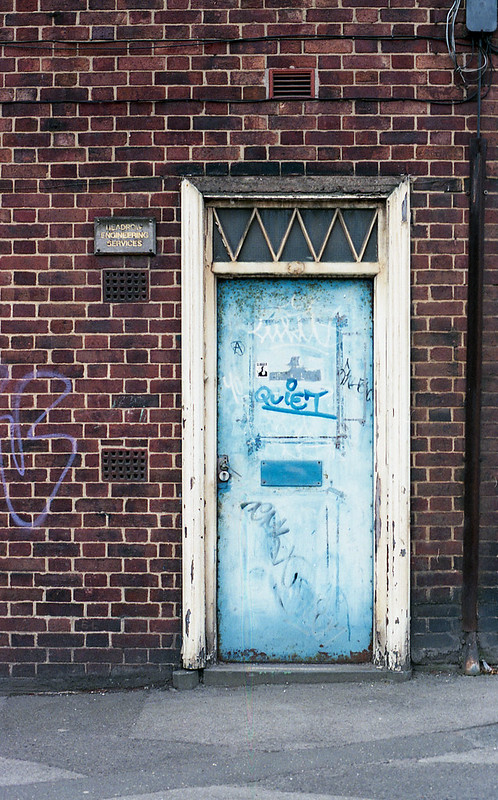
Not far from the door above, is the next one, not a dissimilar shade of blue, on Trippet Lane. They could almost be related! Again, the weathered look drew my eye, and this one has a nice bit of sticker-art affixed. Same camera, same roll of film.

Well, there you go. This turned out to be a longer post than I expected. Thirteen shots in all (I hope no-one is superstitious!). At the rate I photograph scenes like this I ought to have enough for another bakers’ dozen in about a year’s time!