From the footbridge across the railway line, the space outside the scrapyard can look a little like a lunar landscape, or a cratered battlefield. It’s very much an industrial space with a scattering of industrial skips and a gritty, oily surface with a scent of oil and chemicals. Beyond it is a second railway bridge that leads to the northern end of Rother Valley Country Park, and there is a footpath that skirts the edge of the scrapyard and this open area (or, as the figure in the first picture is doing, you can just cut the corner).
It’s not a pretty place, but there are photographs to be had. The skips catch the light and, when the angle is right, can be contrasty subjects with interesting shadows.
The puddles, when it has been raining, also offer opportunities to find reflections of the objects present and the surrounding structures.
I took the following two pictures while walking to Woodhouse Washlands where I shot the photos that I’ve shared here during the past week.
The first bridge crosses the railway line that comes from Sheffield, via Darnall and Woodhouse, towards Chesterfield and onward destinations. A scrapyard sits just at the other side of the bridge, along with footpaths to Rotherham Road, Rother Valley Country Park, plus some other trails through the floodplain.
Just to the right of the the bridge is a somewhat pointless bike gate. That aint stopping anyone!
The second is of the railway bridge which carries the stretch of track running between Rotherham and Chersterfield across the River Rother (from which Rotherham takes its name, translating from the Old English Homestead on the Rother). This line joins the line crossed by the footbridge pictured above a little further south. It’s not obvious from the picture, but the river bank in the foreground was quite slick and muddy!
From here I followed the course of the river downstream through the section of floodplain that lies south of the Mosborough Bypass (which marks the southern edge of Woodhouse Washlands). Before the bypass, I had to cross Ochre Dyke and Rotherham Road. The dyke is spanned by a small bridge. Or it normally is…
On this day I found that the bridge had been removed and the foundations for a replacement were now in evidence. The water looked jumpable, but I thought it might be prudent to walk around. Unfortunately, following a lot of rainfall, the route was blocked by swampy, submerged grass, and I would have had to make a significant backtrack to get around. So I decided to risk the jump after all.
Despite not looking too bad, it was quite a hard landing on the far bank, resulting in a muddy knee, a hand prickled on a bramble, and a pain in the joint just above my knee that has flared up on occasion ever since. I’m no longer young, it seems…
I went to the cinema a few weeks back (to see Dune Part II, I think it was). In one of the car-parks at the shopping mall where the cinema resides, was a circus. The sky was heavy with dark cloud, but the sun was shining through and illuminating things nicely. I’m glad I had the XA3 in my pocket.
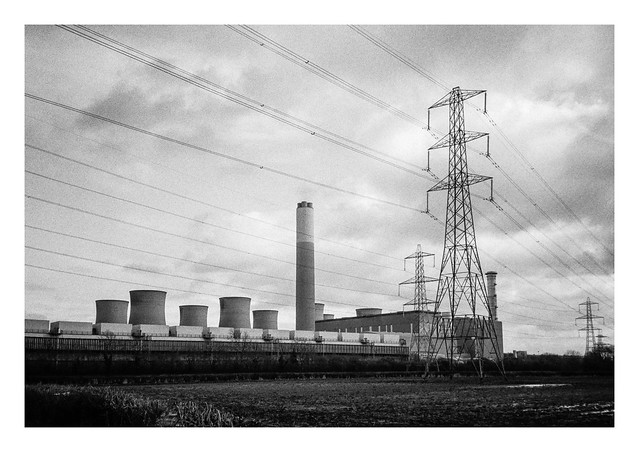
After yesterday’s post about West Burton power station, here’s one about Cottam power station, which also stands beside the Trent a few miles upstream to the south.
Cottam power station went into operation in 1968, generation power for fifty years (20 years longer that it’s original life expectancy). It ceased generation in 2019 and demolition began in 202/ The chimney and cooling towers are due to be demolished by 2025.
Some of the buildings in these pictures were demolished just a few days after I photographed them on the 22 February 2024. I expect the views of, and from, the village of Cottam will look considerably different when the demolition work is complete.
West Burton power station, or rather stations (as there are two on the site – West Burton A and B), sit alongside the River Trent in Nottinghamshire. West Burton A was a coal-fired station, one of only three remaining in the UK in 2022 when it was due to be decommissioned. Due to energy uncertainty caused by the Ukraine War, the station was kept open a further year, before decommissioning took place in 2023.
Demolition of the site has commenced in 2024 and is planned to be complete by 2028.
While I’m glad that we are moving away from environmentally unfriendly coal-fired power stations, I shall be sad to see the structure go. The station can be seen on the horizon from many tens of miles away, including the hills of Sheffield, my home city, and also the Lincolnshire Wolds to the east and it a feature of the landscape that has been present my entire life. It also serves as a visual marker for the River Trent which I always counted as the midway point on trips to my favourite seaside town, Mablethorpe (it’s actually closer to Sheffield than Mablethorpe, but let’s not split hairs… 🙂 ). It will be strange when it has gone.
There have been attempts to preserve the cooling towers as part on the nation’s industrial heritage, but I believe these have been unsuccessful. While West Burton A will go, West Burton B – a gas-fired station – will continue to operate, and the West Burton A site has been announced as the proposed location for the UK’s first nuclear fusion plant.
I hope to visit the site whenever I get the chance to get more photographs before it disappears (or changes) permanently.
I went for another hike today, picking a circular route from the Ordnance Survey app that looked like it could be interesting. The full route was around seven or eight miles. I didn’t make it that far though…
I’ll post more about it in a future post but, suffice to say, it’s not a route to take when it’s been raining. The entire part of the walk I managed was claggy with mud, in some places impassable without wellies, and I ended up with wet feet. On a positive note, the hiking clothing I’ve bought recently held up nicely, even when it rained.
The picture below was from another outing a few weeks ago. The ground was muddy in places then too, but not like today!
I’m claiming this to be a barn, but I really don’t know. I guess, looking at the doors (and also at the taped -electric? – fence) that it could be also be a stable or something?
What it definitely is, is photogenic. Old, weathered, buildings usually are.
Another short post today. I have been out shooting a lot of new photos though! I’ve decided that I’m going to do a lot more hiking this year where the purpose is the walk as much as the photography. I plan on writing about these hikes and illustrating the posts with pictures I made during the outing. I’ve got pictures from three walks in various stages of development, scanning, and publishing, so they will be appearing on here at some point. More about this when I have the first post ready to go!