The clunky coin-operated telescope – a staple of the seaside resort in the UK (and probably all over the world – there were loads of them dotted around when I visited New York for instance, although were fancy binocular variants). They always seem awkward to use. Big heavy lumps of metal and glass on stiff supports with a limited range of movement. The optics are often full of debris, giving a nostalgic, cataract-ridden view of whatever you manage to point them towards. They probably promise more than they tend to deliver, but I’m happy they’re there, especially when they look beautiful against the blue summer sky as this one does.
Say what can you see? Out on the beach and the seas And up in the skies
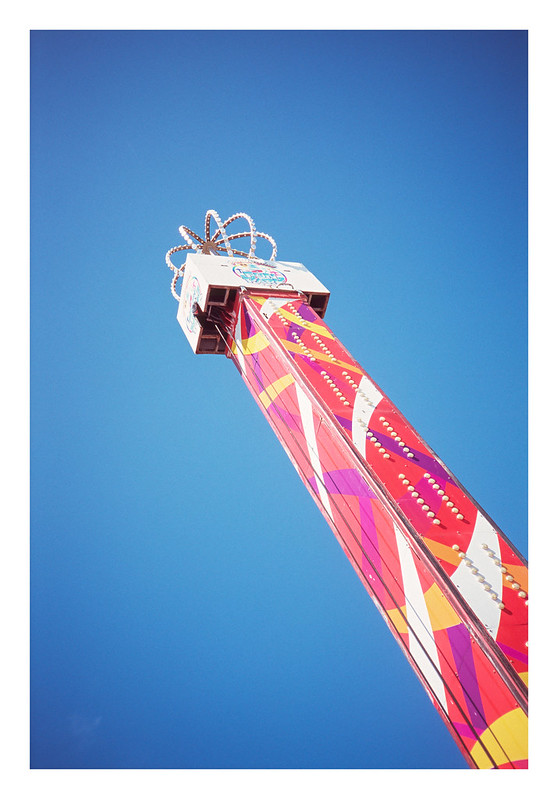
The sign for the Fun Park stands out vividly against the lapis-blue of the summer sky. At least when shot with this roll of expired Fuji Sensia. I don’t think it was quite so vivid in reality, but who cares about that?
In summertime skies A bright glory of colour Welcomes visitors
I tend to find seaside arcades a bit of a letdown nowadays. They mostly seem to contain kiddie rides, prize grab games, slot machines, and coin cascades. These things all have their charm, and when my kids were younger, would be a genuine source of amusement (and a drain on my wallet), but something has been missing for a long time now… Videogames.
It may be a coincidence of my age, but the arcades are largely synonymous with, well, arcade games. Even when I was quite small I remember early games like Pong, Boot Hill, Sea Wolf and Night Driver among others. Then I was around for the real emergence of games: Space Invaders, Asteroids, and a little later, Pac-Man, Donkey Kong, Defender and a whole slew of others. It was heaven.
The arcades would ring with the electonic sounds of the games, flashing attract sequences, and simple 8-bit tunes bleeping, blooping, and crashing as they drew players into this world of light and sound. A single £1 note would, when changed into coins, provide ten games on the machines. Sometimes this would be gone in a fragment of time if you chose difficult games that you were ill-prepared for, but if you knew your stuff you could play for a long time on such meagre funds.
As the years progressed games advanced in graphical and sonic fidelity. Gameplay became more complex. Multi-player experiences appeared (Gauntlet anyone?), and the cabinets gained features. But as the arcades advanced, so did home gaming systems. For a while they trailed their arcade big-brothers, but in the 90s the advent of the Sega Saturn and Sony Playstation finally drew level. Now you could truly have that arcade experience at home (well, except you missed tha cacophony of sound, the atmosphere, the groups of fellow games and all the other joys of being in an arcade).
Sadly, this meant the gradual decline of the video arcade. New machines became ever more specialised with light guns, custom cabinets that the player could sit in to fully experience the action, and all manner of other bells and whistles that were difficult, if not impossible, to recreate in the home. And the pricper play increased. Where once that £1 would have given you ten credits, not you got a single game for the same price, often with no guarantee that it would last any longer. Slowly, the arcade floorspace that had once been given over to rows of individual game cabinets was reclaimed by other attractions.
The heritage of the video arcade still remains, and there are nods to the Space Invaders and Pac-Man games of old, with large attractions that, upon gaining a score, spew tickets that can be exchanged fro prizes and novelties. It’s not the same as getting your name on the top of the score table though.
Please insert a coin To defeat the invaders You puny Earthling
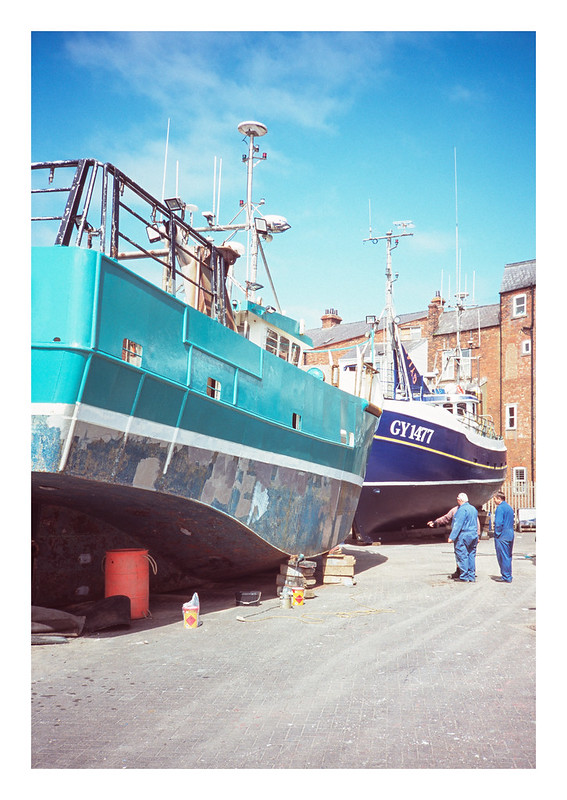
This boatyard in the British seaside town of Bridlington is at the top end on the car-park where we left our car for the day. It was a little difficult to get an angle I was happy with without some of the parked cars encroaching on the scene. I’m not unhappy with this one though and think the three men make the scene work nicely. Once again, lovely colours from expired slide-film too.
Today I’ve been out trying out a new digital camera. As this blog is about my film photography I doubt I’ll post any results from it here, but I might dust off my sister blog (which I haven’t updated in years) for the occasional post. The camera is a Ricoh GR III – a high-end compact camera with a fixed 28mm f/2.8 lens and an APS-C sensor. The camera is tiny (comparable to my Olympus XA3) and so will be easy to take with me on trips, even if I have a film camera with me too. It’ll probably be used mostly for (attempts at!) street photography and other urban architecture type stuff, but who knows? It won’t mark any reduction in my film output, I don’t think.
Blue boats and blue skies Out of their environment Yearning for the seas
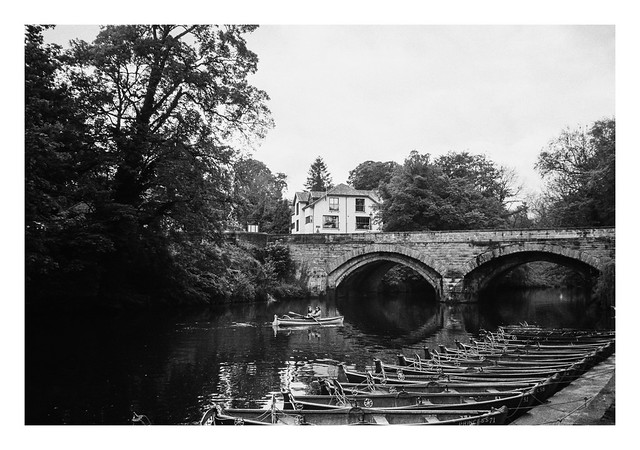
Two girls row their way up the River Nidd at Knaresborough in North Yorkshite. To the left of this scene, behind the large tree, is Mother Shiptons Caves, a local attraction. Mother Shipton herself was a prophet who supposedly foretold various events including the Great Fire of London and the defeat of the Spanish Armada amongst others. She was born in the cave to which the area is now known.
The attraction is well known for its “petrifying well” where visitors over the years have hung objects beneath a flow of mineral-enriched water where they gradually turn to stone. All manner of objects are there, including children’s toys, ice-skates and even Queen Mary’s shoe, each gradually becomeing encrusted in mineral deposits as the years go by.
For a while the attraction was owned by the magician, Paul Daniels, a staple of television entertainment when I was younger. Mr Daniel’s is no longer with us and I’m unsure as to who owns the attraction these days.
Mr Paul Daniels A performer of magic On television
I’ve had a long day full of phonecalls. Almost back-to-back all day long with no more than half-an-hour between each. As a result I feel like I’ve achieved little (even though the calls all served a purpose). To make it worse I’ve had a low-grade headache since I got up and, for a worrying moment, almost felt I was going to drop off to sleep during one of the calls!
But the working day has concluded now and it’s time to think of something to post on my blog which, today, is a small set of photographs of homes on a steep hill in Knaresborough.
Though gentle at first The street soon increased incline Taking us downwards
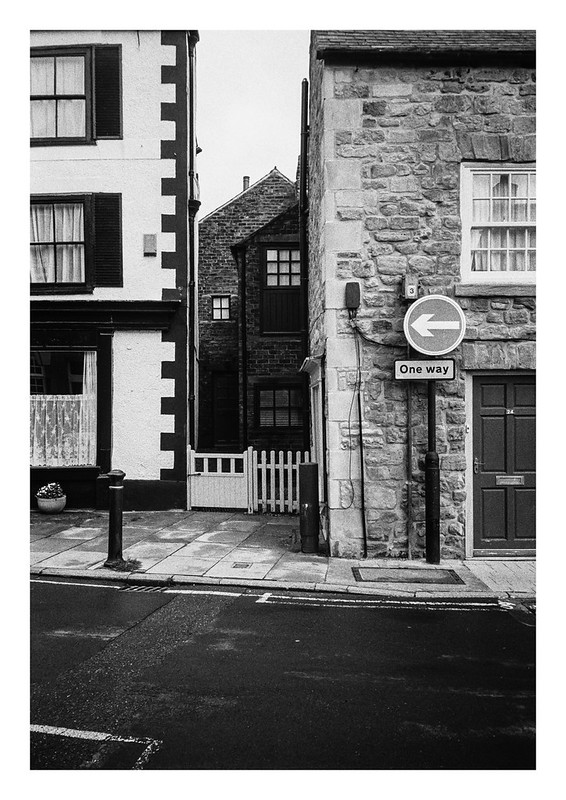
This scene was photographed somewhere in Knaresborough, although I can’t remember precisely where (and my XA3 doesn’t do GPS tagging!). Anyway, I liked the way this house looked squashed between the two other buildings. The road-sign, wiring, and planter add a bit of interest too.
Down the narrow path A house is squashed in between Its foreground neighbours
The railway viaduct at Knaresborough carries the line to Harrogate across the deep valley containing the River Nidd. It opened in 1851 and cost £9,803 (which equates to around £1.4m today – a figure that seems nonetheless quite low. I wonder how much labour and other costs would otherwise inflate a modern day similar construction?). The viaduct had originally been intended to open three years earlier but it collapsed shortly before completion necessitating a complete re-build.
Across the river Carrying passengers to Harrogate and on
A couple more frames of the expired Fuji Sensia, these made during a trip to the Yorkshire market town of Knaresborough. It’s a lovely town to visit, but the weather was less than great on the day we visited, with scatterings of rain and dull overcast skies most of the time we were there, although – wouldn’t you know it – it brightened up as soon as it was time to leave!
Anyway, there wil be quite a few more photos from Knaresborough appearing over the coming days, but most of them are black and white (which better suited the conditions, to be honest).
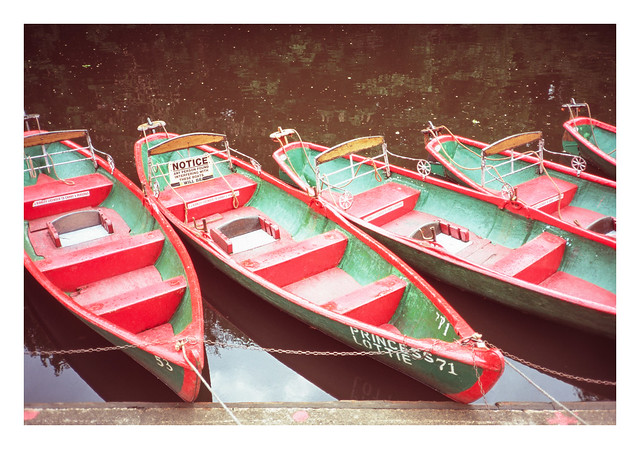
Red and green ladies Lined up on the riverside Waiting for oarsmen