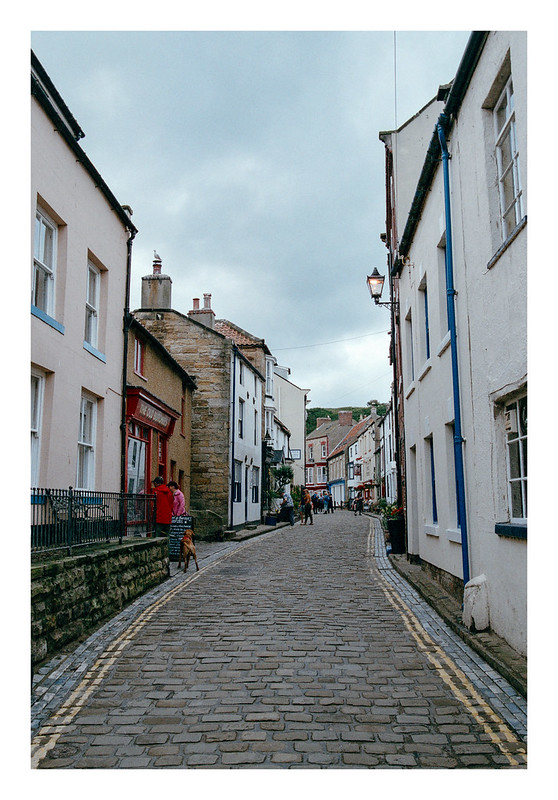
Many of the buildings in this part of gull have a blue plaque affixed, denoting their historic significance, including the Old Dock Offices, and Blaydes Shipyard, You can see a couple reading one of the plaques in the third image. I read the plaques as I passed, but it seems I neglected to take a picture of them with my phone.
Still, the light was nice, producing clean and contrasty photographs on the Tri-X.
Nikon F80 & Tamron 28-300mm F/3.5-6.3 Di VC PZD on Kodak Tri-X. Ilfotec DD-X 1+4 @ 20° 9mins.
I was reading an online post today from someone who suffers from anxiety, and how they used journalling as a means to help deal with it. One of the things they found useful was to list a number of good things that had happened during the day, and to also set some goals for the following day.
I suffer from anxiety sometimes. Mostly it’s focused on a particular issue and goes away when that thing has been resolved, but I do tend to worry about things in general too. This doesn’t tend to give me the same physical and mental symptoms as actual anxiety, but is more of a constant low-level awareness of things that might be (but not necessarily, will be) a problem. Sometimes this can lead to catastrophizing and imagining extreme outcomes from often innocuous things, such as someone’s tone of voice, or something I overhear. I’ve gotten better at recognizing these situations, and I can usually talk myself out of this behaviour, knowing that the thoughts are unrealistic and ungrounded.
Knowing this, I’m going to make an effort to look out for the good things each day, and make a note of them when they happen. I think that setting my weird mind looking out for good things will be a much better use of energy than imagining what might be bad. I’ll try to list some of them here each day.
Something good that happened today…
I took down the Christmas decorations. This is something I don’t enjoy very much and which always makes me feel a little bit sad that Christmas is over for another year, so it might seem weird that I’m using it as “something good”. But the fact is that, despite my sadness that I’ve had to take them down (not that I would leave them up indefinitely or anything), I don’t actually feel too bad about it. I think I was more worried about being sad, than actually sad, and I feel fine now.
I also had our two cats helping me which was kind of annoying, but also nice. A balance between the frustration that they were constantly getting in the way, and the delight at seeing them sitting in every single box they could find (usually just as I was about to put something inside it!), which made me smile and laugh.
Today’s pictures are the last of the batch I took when I visited King’s Lynn back at the start of autumn (I know I say this a lot, but time really is flying by quickly as I get older!). This cottage forms part of the border of the grounds of St. Nicholas’ Chapel, a church dating back to the 11th century.
The Kelham Island area of Sheffield has provided me with pretty good pickings from a photographic point of view and it’s often a place I’ll head to if I’ve got some camera time but no real idea of where to go. The area isn’t huge but there are still parts of it that I’ve not seen. Plus, the ongoing gentrification means that there are always new things popping up down there.
It’s a little sad to see the old industry converted into apartments, but the industry was mostly gone anyway and the other option would probably have been a decline into dereliction. At least this way a lot of the architectural heritage survives with new purpose.
It was a day of changeable weather when I made this photo and five minutes earlier I’d had to rush for shelter (along with a few other people) when the heavens opened. The rain on the floor in the photo is the evidence of the downpour.
My small umbrella Under the onslaught of rain Was insufficient
Sheffield was heavily damaged by bombing during WWII which resulted in the loss of many of it’s historic buildings. As with many towns and cities that were affected similarly, the destroyed buildings were replaced by new structures during post-war re-building. Thoughts on the aesthetic qualities of these replacements – often angular concrete and glass edifices – varies, but in general tends towards the negative in comparison with the older buildings.
It’s quite easy to think that the entire city is full of structures built after the war while missing the multitude of older buildings still present. Similarly, it’s also easy to imagine that the streets of the city are paved in modern materials and that all the history has disappeared, but the truth is that you generally don’t have to walk very far to find evidence of the past. Sometimes this is peeking out from behind the curtain of modernity, but it can also be found largely untouched, such as this cobbled alleyway not far from one of the city’s hospitals. Yes, there are signs of change in the shape of the lamppost and the somewhat ugly patch of tarmac, but mostly this still remains as I imagine it would have looked a considerable time ago.
Beneath the modern A strata of history Still waits to be found
It’s always a joy to wander around an unfamiliar area with a camera, whether it be somewhere far-flung and exotic, or just a part of your own town or city that you’ve not explored before.
During my wander around Hull last weekend I found a number places that just brought a smile to my face. While probably not drawing a second glance from many local eyes, to me they were heavy with possibility – even in the somewhat flat, grey, overcast light in which I viewed them.
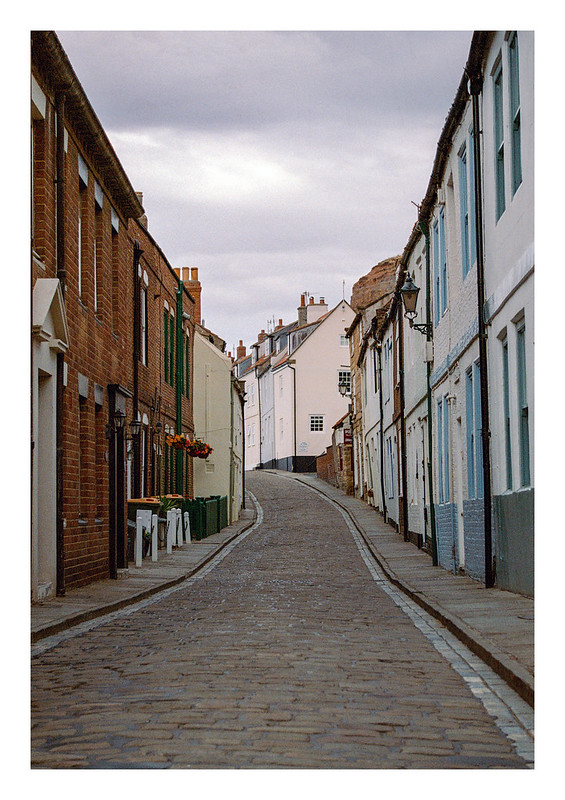
This is one such location – Bishop Lane. I never knew this existed before last Saturday (and why should I? Despite a couple of prior visits to the city, I’ve barely scratched the surface in terms of exploration) but as soon as I saw it I was finding photographs in it’s wonderfully cobbled straightness and shot a few pictures. The first two were of an empty street, but then a couple appeared at the far end of the lane and began to walk in my direction. As they got closer I noticed that the man carried a guitar case and the woman a smaller intrument case – possibly a fiddle – and I knew I had to get them in a photograph of the location.
Before they got too close I checked my focus – the 28mm is fairly forgiving, but I pre-focussed on a spot where I thought the composition would work best as they passed, and then I waited. Looking at the photo it seems evident that one thing I didn’t check was the shutter speed as the couple have some noticable motion blur, so I’m guessing the camera was at 1/125sec (or perhaps even 1/60sec) when I pressed the shutter button. Despite this, I feel the photo works with the blur – it adds a subtle hint of motion in an otherwise motionless scene.





 Steel City Snapper photography