I take a lot of pictures of buildings of all shapes and sizes, but sometimes I find one that grabs my attention because it has a particularly interesting design.
The photo in today’s post illustrates this quite nicely. I have no idea of the history of this structure, but it’s an unusual shape to be sure. The wedge-shaped roof of the far section, to the oddly narrow middle section, then dropping down to a single storey section that has, what looks like, a more recent extension. It looks like an interesting place to live (I’m not sure, but it might be made up of apartments) and, as I walked past it in late December, I could see the Christmas decorations still present within, giving it a very homely feel.
An angler digs for bait at low tide on Cleethorpes beach. The beaches around the uk are a prime habitat for lugworm, which are a popular sea fishing bait. They can be bought from fishing tackle shops, but can also be harvested from the sea shore in areas where it is permitted to do so.
The worms are filter feeders and live in u-shaped burrows with a small dimple at one end and a distinctive squiggly cast at the other meaning they are easy to locate when the tide is low.
Seaside resort during the off-season are a bit of a mixed bag in terms of what is open and what is closed. Some cafes were serving hot drinks to the December tourists, some of the arcades were taking their money in exchange for amusements while others were shuttered, fish and chips were readily available, just not from everywhere, and an ice cream could still be had by the foolhardy (i.e. me).
Unsurprisingly the deckchair hut was closed though.
A couple of photographs of Cleethorpes beach. Although December, it wasn’t especially cold, so there were quite a few people about, albeit no-one making sandcastles or paddling in the sea that I saw.
The fenced-off area at middle-right of the first picture is the site of the new lifeboat station and boathouse – at the right edge of the image you can just make out the concrete supports that will hold the boat ramp when the building is complete.
A return to the blog for Hammy the Haddock, who last featured here a couple of years ago back in March 2022.
For those of you who might have missed that earlier post, Hammy is a plastic bottle recycling “bin” who resides on the promenade at Cleethorpes since being placed there in 2020.
Although Hammy seems like a strange name for a haddock (despite the alliteration), there is a story behind it. A children’s competition was held to find a name for the metal fish and the winner was Lilly-Mai Halligan from nearby Grimsby. The name Hammy came from her late uncle, Bernard ‘Buster’ Hammond, who had been part of the beach safety team for over three decades.
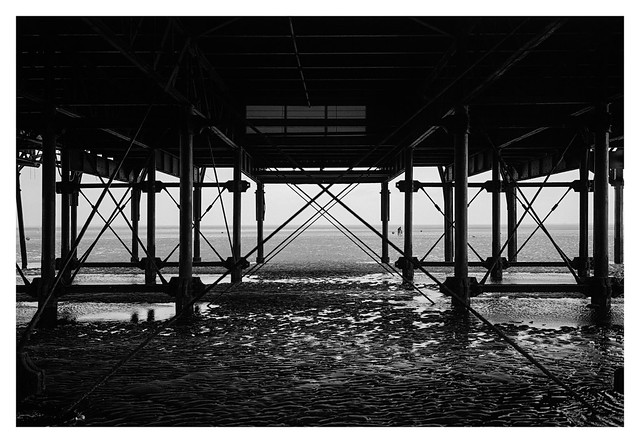
After yesterdays picture of Cleethorpes pier, here’s a picture showing what it looks like underneath.
This is one of the first photos I’ve ever spot metered handheld. I have a Reveni Labs spotmeter that I bought from someone second-hand. I’ve only used it at a basic level so far – looking for a Zone 3 area (dark, but with detail) to take a single reading and place it on middle-grey (Zone 5), and then underexposing a couple of stops from what it tells me (I don’t think I’ve explained that very well…).
It’s worked pretty well on the handful of shots I’ve used it for so far. I’ll likely continue to use an incident meter where possible, but it’s good to have the option to be more precise when I can’t get into the same light as the subject.
The upper part of this picture is pretty dark, but that’s what it was like (and there’s no way I could capture setail there without blowing out the brighter parts of the scene). My intent was to retain detail in the vertical struts, which I’ve managed to do.
It seems that every time I visit Cleethorpes, I photograph Papa’s fish and chip restaurant. Or, rather, I photograph the pier. Papa’s just happens to be the current tenant. It’s a photogenic scene though, so I’m not surprised that it draws my lens.
I think this is the third time I’ve featured the pier and chippy on the blog (here and here, although it might be in some other posts too , just not where I’ve mentioned it by name).
These groynes are both at Cleethorpes, but the ones I remember most vividly are the ones at Mablethorpe, a little further down the coast (although those didn’t have marker posts as far as I remember).
On days at the beach they would provide lots of opportunities to play at receding, or low tide. Most of the groynes would trap pools of water beside them or around their ends, and these were often good places to catch small crabs (I never saw any more than a few inches across their shells). The water in these pools could sometimes be deceptively deep (maybe three or four feet sometimes) and it was quite easy for the waterlogged sand to collapse beneath your feet and lurch you into the depths. I have memories of my sister doing this when she was a toddler – suddenly flipping headfirst into the water fully dressed before she was swiftly grabbed and rescued by my mum.
The outflowing water provided a multitude of engineering projects for my young self, usually in the form of creating dams, or sometimes intricate and meandering canal systems to take the water to holes I’d dig in the sand. Sometimes I would float small pieces of driftwood, upturned shells, or lollipop sticks and watch them make their way out to sea (or, usually, to a place where the sand could no longer hold its structure and the waterway had collapsed).
Unlike Cleethorpes, the groynes at Mablethorpe are no longer present. Or if they are, then they are buried beneath the sand. Mablethorpe undertook a project of offshore dredging to place a thicker layer of sand on the beach. This has not only removed the groynes, but also made some of the sea defences less vertiginous than I remember them being when I was little.





 Steel City Snapper photography