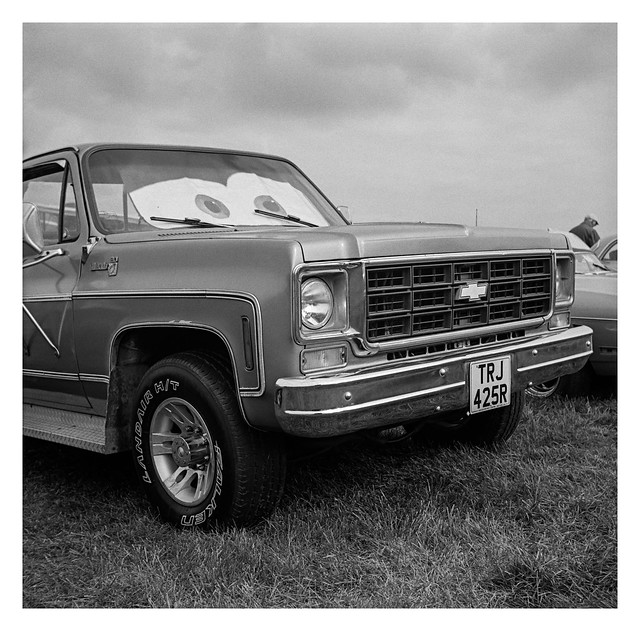
More vintage rally photos, this time a couple of vintage Chevy pickup trucks. I’m no expert on such things (as I’ve pointed out more than once on this blog), and I’m British and these are American trucks to boot, but a bit of Googling has given me the models. At least I think it has. As always any expert opinions correcting my errors are gratefully received.
Anyay, the first is, I believe, A Chevrolet AK, which were produced between 1941 and 1947, placing this particular vehicle near the end of that production run.
The second truck is around three decades younger being (again, I believe) a Chevrolet Blazer. I’m tentatively dating this one to the late 70s – 1977 onwards – due to the 5×3 grid on the radiator grille. Again I could be talking out of my backside though!
Maybe I hould have asked the truck, although it has a slightly worried looking expression… 🙂
American trucks Gas guzzling automation Moving the masses
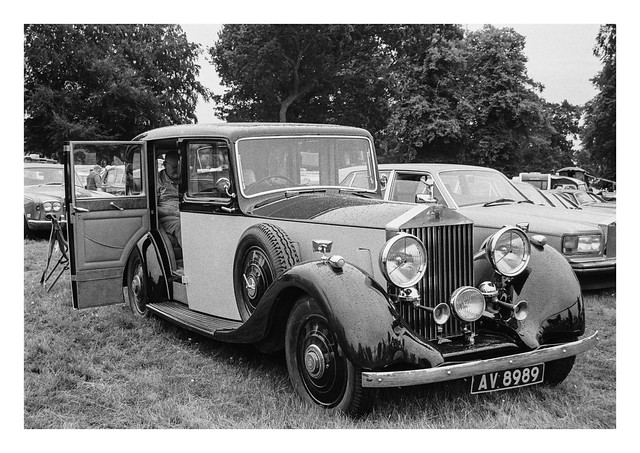
The weather at the Astle Traction Engine Rally the other week was dull and rainy. While this meant there were umbrellas in abundance and raindrops of automotive paintwork – both attractive subjects for a photograph – it also made the act of making photos was far more troublesome, especially without the benefit of a weather-sealed camera.
It also meant that a lot of the exhibitors could be found sat inside their vehicles to escape the damp, as in this Rover 100 and Rolls Royce Wraith.
Sat in your dry car Looking out at passersby Don’t want to get wet
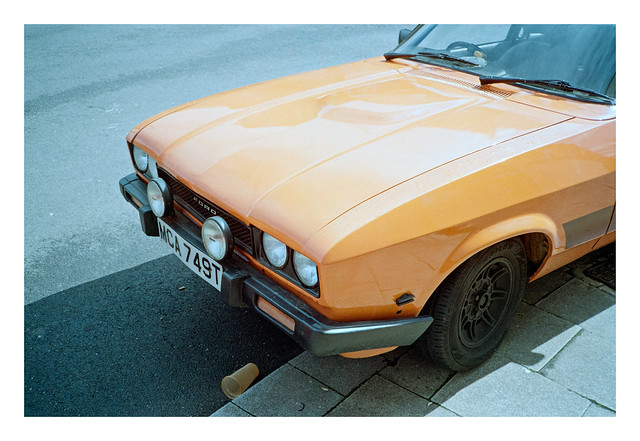
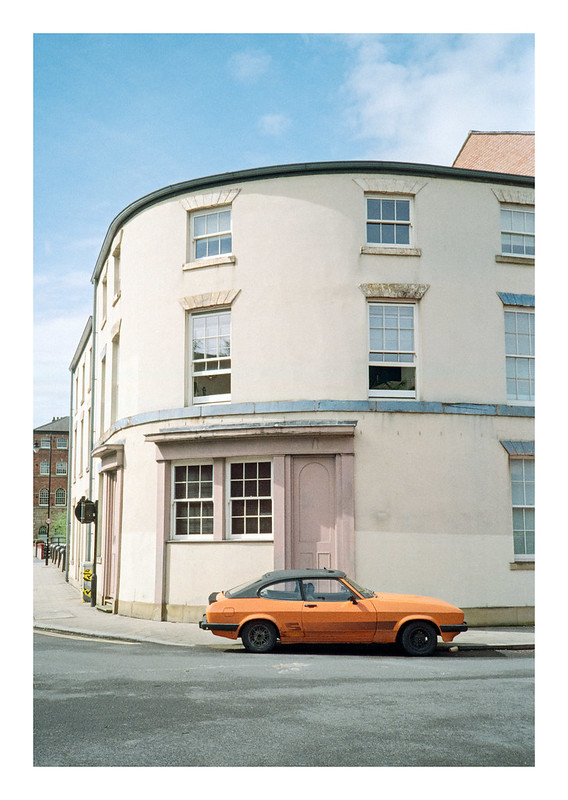
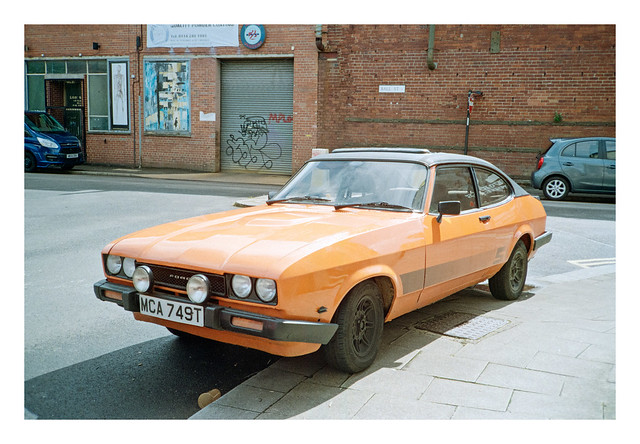
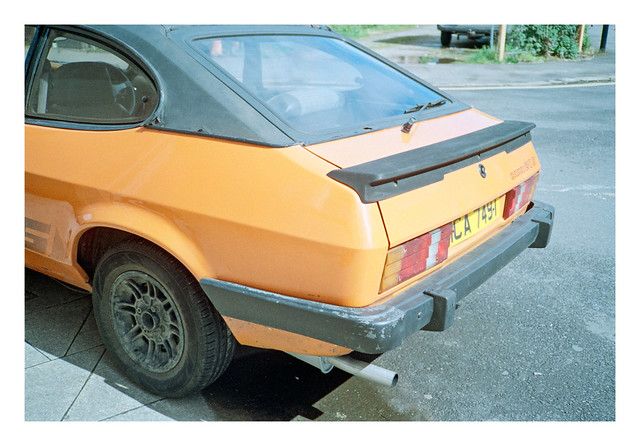
Apologies to anyone hoping to see the beautiful island of Capri in this post. Instead you are going to get an infinitely cooler Ford Capri instead. It may not have the designer stores, millionaire’s residences, or crowded funicular railway, but who wants any of those when you can have a cool old car?
It’s the same car I portrayed back on 28 May, and these were taken at the same time with my Canon Sure Shot on a roll of Kodak Colorplus. I much prefer these colour photographs.
A few weeks ago (well, a month to be accurate) I wend to a local car-boot sale early one Sunday morning on the lookout for old camera bargains. There were none – one stall had an old digital compact, and another had one of those cheap 35mm film panoramic cameras – the ones that use a mask to basically crop a 35mm frame down to a thinner output – but nothing I was interested in spending any money on.
As I’d planned to go somewhere afterwards and shoot some film, I had my OM-2n with me. As I walked through the cars parked on the field beside the boot-sale area I noticed this old Austin rally car, so made a photo.
Today my wife and I visitted Knaresborough, an attractive market town in North Yokshire, about sixty miles or so north from where we live. It’s not a place I’ve visited before but it was a lovely location to wander around, looking in the local shops, having a bite to eat, and making some photographs (which will appear here on theblog in due course). Having just started to scan the first roll I shot through my recently-acquired Olympus XA3, I’m very pleased with the results – no signs of any faults and the photos are lovely and sharp – so I decided to take it with me on the trip. It’s tiny size is a definite boon! I did have another camera in she shape of my Canon Sure Shot Supreme – that one mostly because I have a roll of expired Fuji Sensia loaded that I’m wanting to test (I have a few more rolls of the same film so this is the guinea-pig roll to see how they look shot a box speed). All told, and despite some gloomy, if not unexpected for the UK, rainy weather, we had a nice day out.
In amongst the cars Of people looking to bag A bargain or two
It’s not often that I see classic American cars while out with my camera – outside of car shows and the like at least – so I had to grab a photo of this Chevy when it pulled up beside me. A moment after taking this shot the traffic lights changed and the car pulled forward but had to stop to wait for oncoming traffic. Grabbing the opportunity to photograph it without other cars in the way I composed a quick shot… only for another car to shoot into the frame and ruin the picture. Grrr.
While the car is still obscured in the first frame, it looks much better than the second.
Classic red Chevy Stood in traffic at the lights Waiting for the green
I’ve photographed this same vehicle before, but is seems to have suffered some slight damage to the grille in the intervening period. It’s still a lovely looking truck though.
For the best part of the last two years, whenever I’ve shot colour negative film, I’ve sent it off to be developed and scanned. While I have the means to scan it at home, I was never satisfied with the colours I achieved using Epson Scan. I tried a number of other tools to see if I could improve my results and managed to do better with Silverfast for 35mm when I bought my Plustek scanner, but the images still didn’t look quite right. So I resigned myself to getting lab scans of all my colour negative stuff.
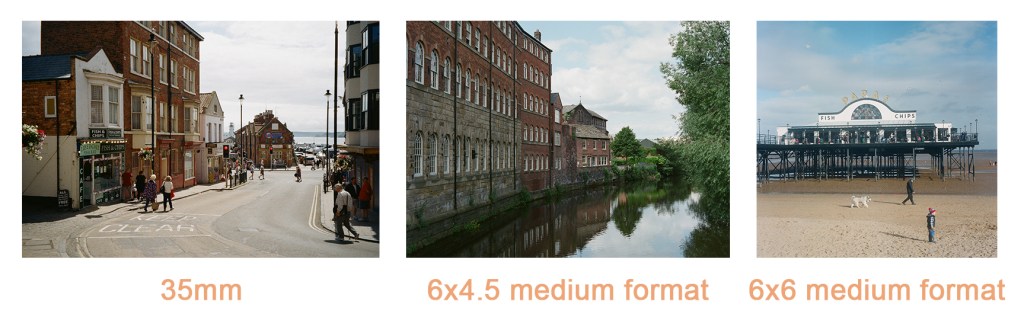
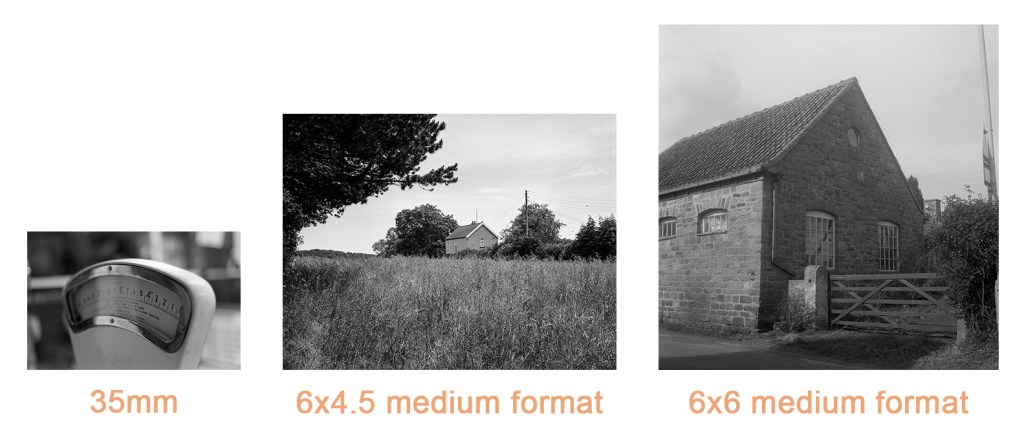
While I’ve been mostly happy with my lab scans, one point of frustration is the way they size the images. The labs I’ve looked at tend to offer scans in small / medium / large options which, on the face of it seems fine. However, what I came to realise was that a scan was based on a particular number of pixels on the short side of the image. This results in a bewildering situation where, for any given scan “size”, it seems medium format scans will be smaller than 35mm scans (or the same size, if shooting 6×9). This is clearly disappointing if you want to benefit from the added detail that medium format allows. The image below shows comparisons of three different image ratios and how the larger medium format images lose out when scan size is determined by the number of pixels on the short edge.
By comparison, when I scan at home I get larger scans for the larger formats, as can be seen in the example below with each image being scanned at a uniform DPI setting and not limited to a specific number of pixels per side:
This discrepancy in image sizes made me want to home scan my negatives. While I don’t think my Epson V550 or Plustec 8100 really compare with the abilities of something like a Noritsu of Fuji Frontier, the ability to control the settings means I can get much more detailed results than what the labs I’ve tried will supply. While I’m sure that there are labs out there who will provide higher resolution scans, many of them also charge a considerable amount for the service, putting them out of my price range unfortunately.
I’d seen very good word of mouth over the past year about Negative Lab Pro, but that costs in the region of £60, which isn’t something I want to pay right now (although I’ve been tempted), so it was with interest when someone alerted me to a new Photoshop plugin called Grain2Pixel recently. Grain2Pixel is used to convert negative scans to positives and is currently free of charge (although I believe a more feature packed version is in the works which will require payment).
In order to use the plugin, you have to make linear scans of your negative, e.g. it still looks like a negative after scanning. The plugin accepts TIFF and DNG files, so you can scan with a digital camera if you like. Once launched in Photoshop, you select your scans via the plugin’s interface, choose any settings you want to apply such as automatic colour correction, and then run the process. The process is straightforward and you can convert individual images or a batch.
I’ve tried a number of different film stocks with it and have been getting good results on the whole. Some that I’ve tried, such as Kodak Ektar and Kodak Portra 160 have looked great directly out of the plugin. Some others have been a little more tricky – Kodak Gold 200 and Kodak Portra 400 seem to have a blue / cyan cast no matter what settings I use. Despite this though, the results are still good and I am able to tweak the results further in Photoshop or Lightroom to get results I’m usually very happy with, with the extra benefit of having much higher resolution images.
The plugin can be found, along with instructional videos, here: https://grain2pixel.com/ There is also a Facebook group for the plugin which gets regular traffic and is useful if you need help.
All three of todays photos have used Grain2Pixel for initial conversion. I’ve then tweaked the results in Lightroom to add additional contrast etc. They were scanned on my Plustek Opticfilm 8100 using Vuescan to create the linear TIFF files.
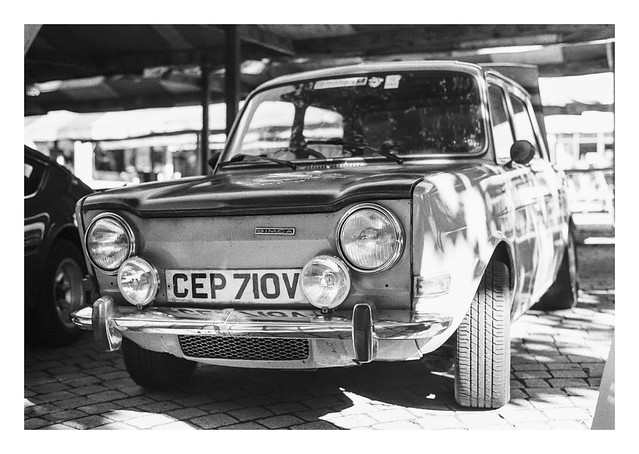
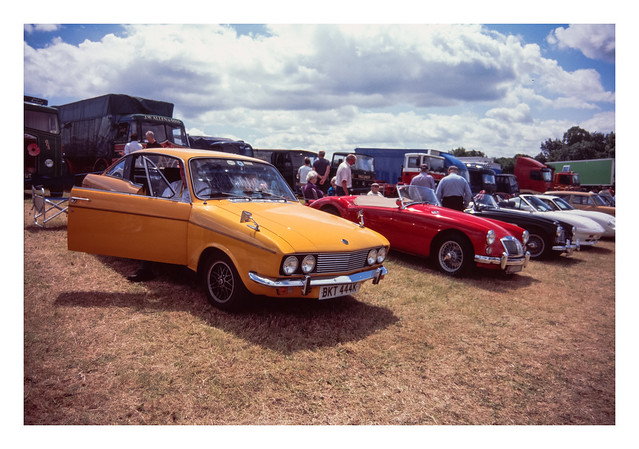
Parked a short distance from the Starsky & Hutch Gran Torino that I posted a picture of yesterday, was this Simca 1000 Rallye.
I don’t know a lot about cars and don’t have a great deal of interest in them beyond their ability to get me from A to B (and their suitability for photographing), so Simca isn’t a marque that I’d really heard of before (although the later Talbot brand was familiar). They were a French company founded in 1934, manufacturing cars for the next several decades. From the late 1950s Chrysler started to acquire a stake in the business to form part of their Chrysler Europe organisation until it collapsed in 1977. Peugot picked up what remained but the Simca brand faded from use.
A chap on a forum commented on this photo, saying he had learned to drive in a Simca 1000 – although not the souped up Rallye model seen here. He was surprised to see this one in such condition as they were apparently not vey well constructed in terms of bodywork. As the Honest John car review website states: “These cars suffer from widespread rust but are bulletproof in the engine and gearbox department.“.
Whatever the lifespan of the bodywork, it makes for a nice photographic subject
Last year I treated myself to a roll of Kodak’s re-issued Ektachrome film. I shot the whole roll at a steam rally (none of those this year, sadly 😦 ) and was looking forward to the results. Unfortunately, they weren’t what I expected – or, at least, my scans weren’t.
The slides themselves looked pretty nice. One or two of them were a little off on the exposure and looked a a bit dark, but nothing extreme, and the colours looked great. When I scanned them though, the colours were off and the levels were out considerably. Lots of deep contrast and strange, oily tones to the more vivid colours. Shadow areas lacked detail and I had to adjust the Tint and Temperature controls to make them look halfway decent. Some of them were beyond even this rectification though (or at least my skills to correct it).
The scans were made on my Plustek 8100 and Silverfast, a scanner and software that serves me perfectly well for most of the other things I scan – although this is primarily black and white. I did the best I could with them and posted some to Flickr, and a few on this blog (here, here, here & here), but otherwise wrote them off as a bit of a disappointment.
Recently however, I’ve had a hankering to shoot some more slide film, and shot a roll of 17-years expired Ektachrome the other week which gave surprisingly nice results. Not perfect, but more than I could have hoped for given the age of the film and my scanning it using Epsonscan – a package that I’ve always struggled to get satisfactory colours with (again, probably due to my skills with it as much as anything else).
So, I decided to revisit my 35mm Ektachrome slides for a fresh attempt. This time I tried something different.
Back before I bought my Plustek, I’d tried some alternative scanning applications to see if I could improve my colour scans on my Epson V550. One of those was Silverfast, the other was Vuescan. Silverfast software is linked to your scanner, so the copy I have for my Plustek won’t work on my Epson (something I dislike – If I buy a piece of software, I’d like it to work with different pieces of hardware thank you. It came with the Plustek though, so I’ll not complain too much). Vuescan however, will work with anything you own and has free lifetime updates if you buy the Pro version. As I still had the demo version, I decided to try it with my Plustek and the Ektachrome transparencies.
Lo and behold, the results looked much more promising than the scans I’d managed with Silverfast. I was pretty happy about this and, as Vuescan is discounted at present, decided to fork out for the full, non-watermarked version and give my Ektachromes a fresh attempt.
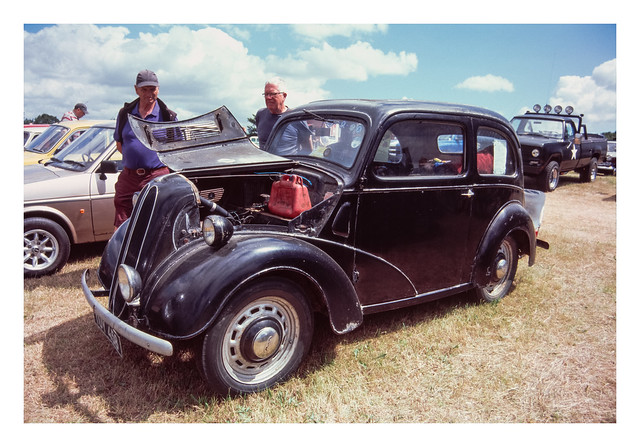
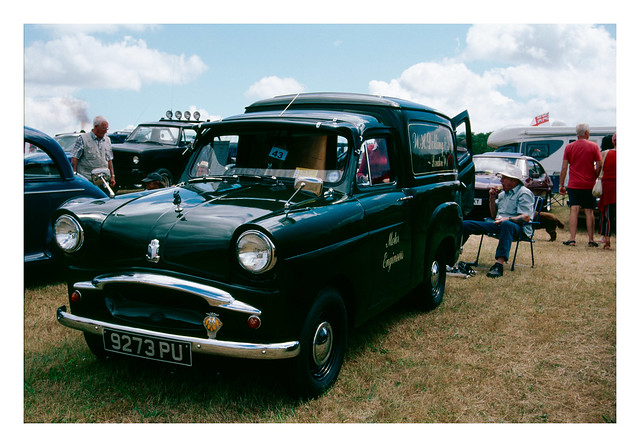
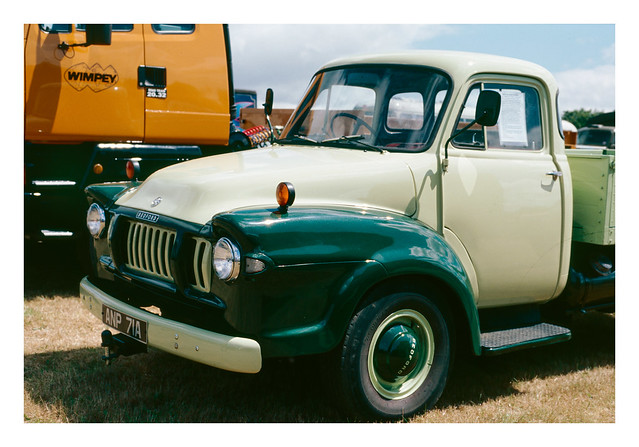
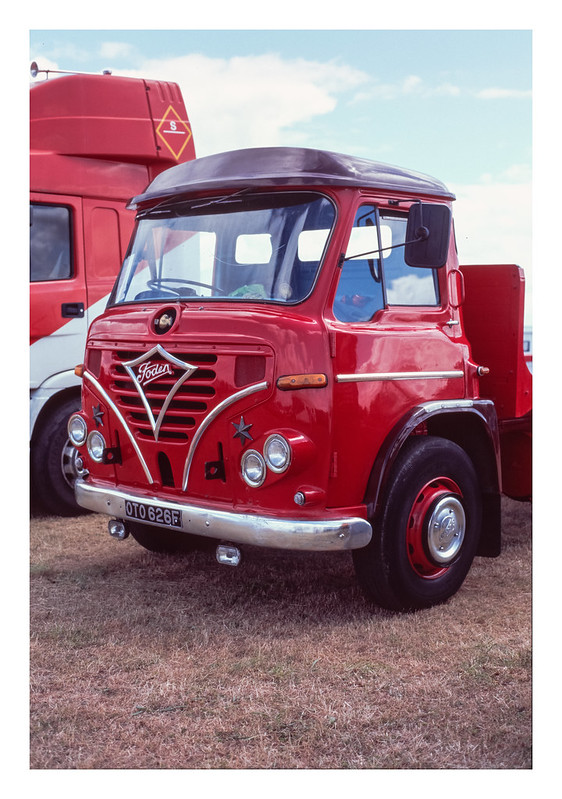
It took a bit of trial and error, but I think I’ve found a setup that does a good job on them. Certainly an improvement over the original scans to my eyes, so I thought I’d publish a few examples here today. I think the new scans are a noticeable improvement – a lot of the horrible green tinge has gone (how I didn’t spot that originally I don’t know) and there’s a lot more shadow detail. They’re in before and after pairs, the before shots first.
Nikon F80, Nikkor 28-80mm f/3.5-5.6 D & Kodak Ektachrome.


















 Steel City Snapper photography