It seems that every time I visit Cleethorpes, I photograph Papa’s fish and chip restaurant. Or, rather, I photograph the pier. Papa’s just happens to be the current tenant. It’s a photogenic scene though, so I’m not surprised that it draws my lens.
I think this is the third time I’ve featured the pier and chippy on the blog (here and here, although it might be in some other posts too , just not where I’ve mentioned it by name).
These groynes are both at Cleethorpes, but the ones I remember most vividly are the ones at Mablethorpe, a little further down the coast (although those didn’t have marker posts as far as I remember).
On days at the beach they would provide lots of opportunities to play at receding, or low tide. Most of the groynes would trap pools of water beside them or around their ends, and these were often good places to catch small crabs (I never saw any more than a few inches across their shells). The water in these pools could sometimes be deceptively deep (maybe three or four feet sometimes) and it was quite easy for the waterlogged sand to collapse beneath your feet and lurch you into the depths. I have memories of my sister doing this when she was a toddler – suddenly flipping headfirst into the water fully dressed before she was swiftly grabbed and rescued by my mum.
The outflowing water provided a multitude of engineering projects for my young self, usually in the form of creating dams, or sometimes intricate and meandering canal systems to take the water to holes I’d dig in the sand. Sometimes I would float small pieces of driftwood, upturned shells, or lollipop sticks and watch them make their way out to sea (or, usually, to a place where the sand could no longer hold its structure and the waterway had collapsed).
Unlike Cleethorpes, the groynes at Mablethorpe are no longer present. Or if they are, then they are buried beneath the sand. Mablethorpe undertook a project of offshore dredging to place a thicker layer of sand on the beach. This has not only removed the groynes, but also made some of the sea defences less vertiginous than I remember them being when I was little.
Just behind the Cleethorpes sea defences, not far from the section of beach where the wooden post that featured in yesterday’s post stands, the railway line to Grimsby passes by. On the other side of the tracks stand streets of houses and, a little beyond, the stadium of Grimsby Town Football Club.
The railway line can be crossed by a pedestrian footbridge, as seen in the first photo of today’s blog post.
Climbing the steps to the top of the bridge presents a much better view of the football ground, with the terraces of houses in the foreground. The winter sunshine was playing ball too on this day, so the scene is lit with nice low light which casts great, contrasty shadows over the scene.
This wooden post protrudes from the sand at the northern end of Cleethorpes beach, just beyond a stone breakwater. The water comes right up to the sea defences at this part of the beach, as evidenced by the treacherously slippery concrete I had to navigate, but at low tide a large expanse of sand is exposed. I say ‘sand’, but because Cleethorpes sits at the mouth of the Humber estuary, it’s a brown, silty, almost muddy sand, quite different to the golden grains you normally imagine a beach to be made of.
Further south towards the other end of the resort, the sand becomes “beachier” (if that’s a word), with the high tide not reaching as far, and more conducive to typical seaside beach activities. However, this wooden post doesn’t stand on that part of the beach.
After spotting it from the shore, I decided to walk across the beach to take the picture you see here. This was mostly uneventful – the sand was wet, with waterlogged ripples present, and mostly firm underfoot. However, in a couple of places, it felt somewhat less secure and I felt my foot instantly sink a few inches when I placed it in certain spots. As I’d reached the post I took the picture, but I was regretting having done so. While there were no signs in evidence indicating quicksand, that didn’t mean that there might not be treacherous sections present and, even if I wouldn’t sink completely, the thought of getting stuck in a foot or so of cold muddy sand didn’t appeal, so I quickly (and carefully – following my footsteps) retreated to the safety of the more solid sand closer to the sea defences.
I’m not sure of the purpose of the wooden post – there are no signs affixed, and it doesn’t have the marker atop it in the same way that the posts at the end of wooden groynes do. Maybe it’s to warn idiot photographers away?
Back at the closing days of December, just before New Year, I decided to take a trip to the seaside. Cleethorpes is the resort that’s easiest to get to as it can mostly be reached by motorway, with the journey taking about eighty / ninety minutes or so.
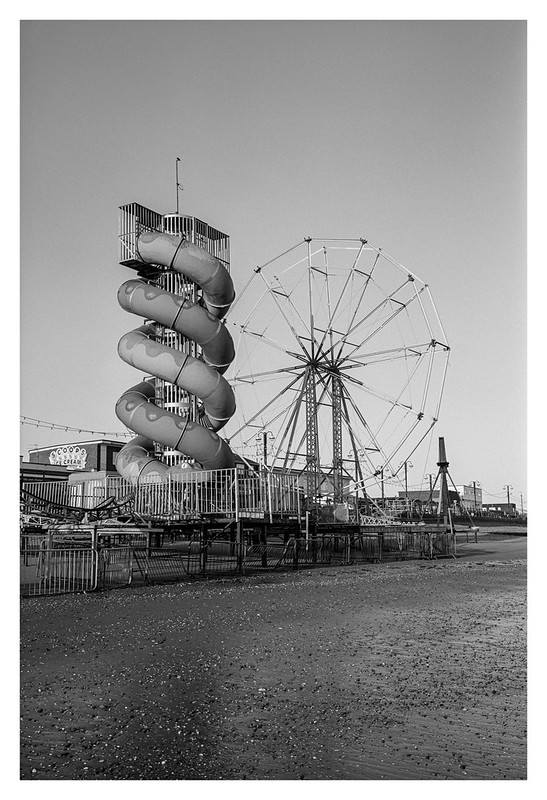
Attractions at British seaside resorts are largely closed at this time of the year, as can be seen from the picture of the helter-skelter and big wheel (sans seats) that stand on the beach just past the pier. Largely closed doesn’t mean totally closed though, and there were still arcades and cafes open (I even had myself an ice-cream before I left for home!).
I managed to get good weather for most of the time I was there, the cloud cover only arriving (along with rain) as I was heading back to the car at the end of my visit, and I shot four rolls of film through the GW690. Most of them have turned out well and I’ll be publishing them over the coming week, although I did make a complete noob mistake of shooting a couple of frames with the lens cap on – a painful error when you only get eight shots per roll!
I visited Rufford Abbey back at the end of May. It’s the ruin of a cistercian abbey dating back to the 11th century and then later incorporated into a mansion house in the 17th century.
The monastery was closed by Henry VIII when England broke away from the catholic church in 1530. Henry appointed commissioners to find evidence that would allow him to close the abbey. Apparently, one of the “disgraceful offences” that permitted this to happen was an allegation that the abbot, Thomas of Doncaster, had broken his vows of chastity with several single and married women. Following this, the abbey and lands were granted to George Talbot, one of the wealthiest people in the land at that time, and construction of the new house began.
In the 15th century, the estate passed to Sir George Savile. Savile supported the Royalists during the English Civil War, and his support for the royal family allowed for prosperity in the years following the restoration of the monarchy.
During World War II, the estate was requisitioned and used by the Leicestershire Yeomanry, 6th Cavalry Brigade. By the end of the war the estate was in poor state and Nottinghamshire County Council bought the estate to preserve it. This included demolition of some parts of the structure.
In 1969, the estate was officially designated a Country Park.
It’s not possible to enter the ruin itself, but the whole thing is surrounded by Rufford Abbey Country Park, incorporating gardens, woodland, a reservoir and various cafes and other entertainments. The park itself is free to enter, but there is a parking charge if you arrive by car.
It was a pretty hot day when I visited and there were a lot of visitors (although I’ve almost completely managed to keep them out of these pictures!). There is a large adventure playground making it ideal for familes, plus acres of open grassland, formal gardens, and woodland trails that are nice to experence and explore.
A couple of images taken within a stone’s throw of one another, both in the village of Whitwell in Derbyshire. Whitwell appears to be quite a nice place, but it’s somewhere I rarely pass through – mostly because you have to leave the main road deliberately to get there, and it’s otherwise easily bypassed. One day I think I’ll park the car and go for a proper wander around the place as I’m sure there are plenty of interesting things to photograph.
The photo published here today is the only decent photo from the roll of Kodak Gold I shot recently that still looks good in colour. All the others had colour casts and I had to convert them to black and white. This one managed to avoid the weird colours. The colour here is quite subtle but I think it still adds something to the image.
Fujica GW690& Kodak Gold . Lab developed. Home scanned and and converted using Negative Lab Pro.
One of the common nicknames for cow parsley is Mother-die. I learnt this from my grandma when I was pretty young and I remember spending quite a few years as a child being especially careful around the stuff, just in case. The name mother-die is thought to originate from rural villages and said that if a child picked the plant and brought it home then their mother would die. The rationale behind this is likely that, while cow parsley is edible, there are a number of very similar looking plants that are harmful, including hemlock.
Fujica GW690& Kodak Gold (converted to B&W in Lightroom).