Film photography · Medium Format · Photography

Holy Trinity Church, Ashford-in-the-Water

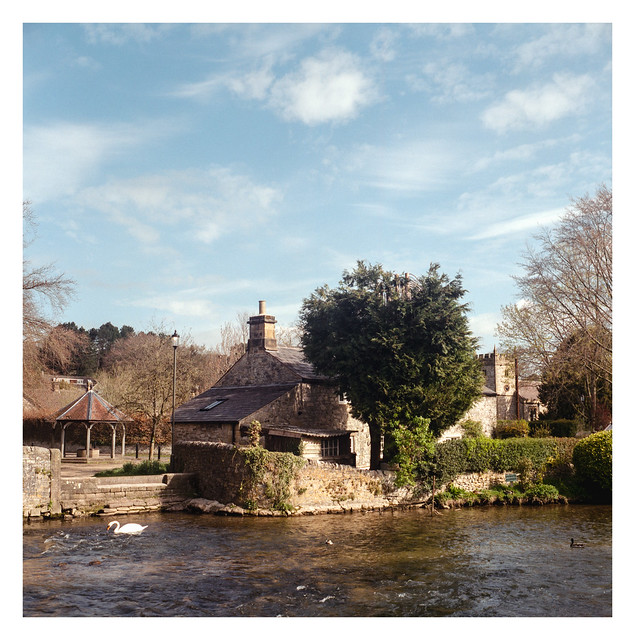
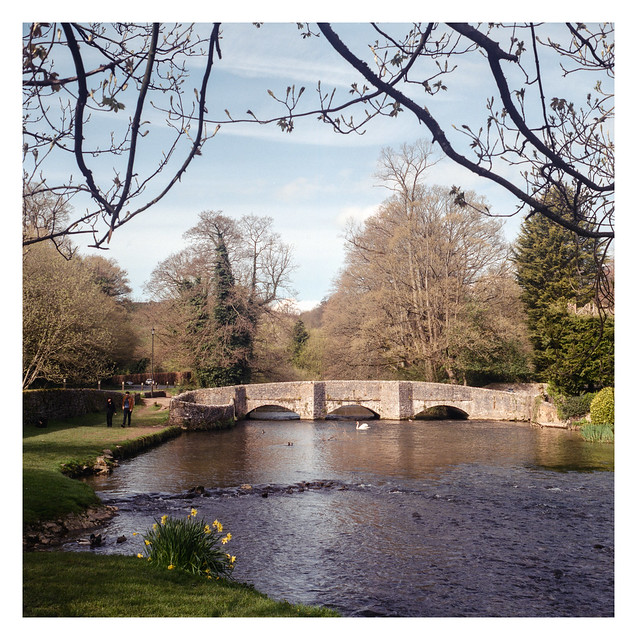
Just a quick post today with a couple of photos showing Holy Trinity Church in Ashford-in-the-Water, and a view across its graveyard. The church dates back to the 12th century but was apparently re-modelled extensively in the 19th century.

Ashford church
Resting beneath blue skies

Yashicamat 124G & Fujifilm Pro 400H. Lab developed. Home scanned and converted with Negative Lab Pro.

Taken on 19 April 2022

Film photography · Medium Format · Photography

A-maze-ing

I visited the village of Ashford-on-the-Water last month. It’s a quaint little place full of picturesque cottages, and old church, and attractive scenes where the River Wye flows through. This was the first time I’ve visited the place since a school trip back when I was probably about ten years old (on a residential week at the nearby Thornbridge Hall).

This house caught my attention with it’s maze-like pattern of miniature hedges in the front garden.

A-maze-ing garden

Yashicamat 124G & Fujifilm Pro 400H. Lab developed. Home scanned and converted with Negative Lab Pro.

Taken on 19 April 2022

Film photography · Medium Format · Photography

Sheffield University Arts Tower

One of the more noticable structures in Sheffield is the university Arts Tower. While it is not very tall when compared with towers in other cities (it’s not even the tallest building in Sheffield) at a mere twenty stories, the fact that it sits partway up the hillside beside Western Bank means that it is visible from far afield. It should be noted that far afield in this case is probably still not that far – Sheffield is a hilly city (said to be built on seven hills, like Rome) so the best views of the Arts Tower are from the north east where it can be seen from further down the flatter area around the Don valley. It can be seen peeking over the top of hills from various locations as well though.

Corner into blue

The building opened in 1965 and housed the Departments of Landscape, Modern Languages, Philosophy, Biblical Studies, and Architecture. There were eighteen arts departments located in the tower originally although, as the university and student body has grown, some of these have moved to new locations.

The Arts Tower

One of the most well known features of the building is the paternoster lift system, with many a tale being told of people going right over the top of the looping elevator system. Most of these are from people unaware of how a paternoster works and under the assumption that the unfortunate passengers would be somehow flipped upside-down as the lift reached its apex. They do make for better stories though. 🙂

It being such a focal point in Sheffield’s skyline, I’ve taken a good number of pictures of the tower which can be found here.

Entrance to the arts

Yashicamat 124G & Lomography Color Negative 100. Lab developed. Home scanned and converted with Negative Lab Pro.

Taken on 16 April 2022

Film photography · Medium Format · Photography

Expiryment #1: Ilford HP5 (expired 1982)

This is the first in what I hope to be a series of posts in which I document the results from shooting some of the expired film I have in my stash – and I have quite a bit! However, in order to keep some sort of a leash on this exercise, I will only include film that is at least ten years past its use-by date.

For this first instalment, I’ve decided to send the Delorean back to 1982, back before Ilford added the “Plus” to it’s stocks, back before I’d even entered my teens, and show the results from a roll of HP5 that expired in December 1982.

I chose the HP5 for a couple of reasons. Firstly, I shoot the modern version of the film quite a lot, so was interested to see how they compare (even if it may be an unfair test given the age of this roll) and, secondly, because I have four rolls of this film all from the same year so this first one will serve as a useful test on how it performs before I shoot any more of it. While the person who I got the film from had kept the film frozen, I have no idea of it’s provenance before that.

The sensible thing would have been to shoot the film in, around, or at least fairly close to home. That way, should the experiment be a disaster, at least I wouldn’t have wasted too much time on it. But the weather was nice so I decided to head out into the countryside, to High Bradfield over on the other side of the city. It was a risk but, hey, you only live once, right? I also took a second camera loaded with a fresh roll of Ilford FP4+ as well but only took a single shot with it, so the weight of the expedition would rest on the forty year old HP5.

I loaded the film before leaving the house and almost immediately felt some mild panic when the Yashicamat’s film advance crank partially jammed after a few turns. But, after some gentle pressure, it continued to wind the film on to frame #1. Arriving at my destination, I shot five shots at High Bradfield before driving around the surrounding area and photographing anything that caught my eye. Most of the other pictures were taken around Broomhead reservoir further to the north, although none of the reservoir itself. I rated the film at 100asa using my usual half-a-stop of over-exposure per decade of expiry that I use for expired black and white films. All metering was via incident readings from my Sekonic L-308.

This is what old Ilford backing paper looks like. I’m not sure if the mottling is just a factor of its age.

As I went out early, I was home in time to get the film developed and decided to use some Adox Adonal for the job. Ordinarily I use Ilfotec DD-X when developing modern HP5+ as it controls the tones and grain really nicely but, as this was a roll of film decades past its best, I thought the Adonal might be a good choice as I’d read that it can help to reduce fogging where it exists on old films. I used a 1+25 dilution and developed the roll for six minutes, inverting for the first minute, and then for 10 seconds at the top of each remaining minute. After that I used a one-minute stop bath and then fixed for five minutes. I washed the film using the Ilford method and then a final soak in rinse-aid before hanging it to dry for three hours. I was very happy to see easily visible images on the negatives, albeit perhaps slightly thin ones. One thing that I noticed was that the strip of negatives had an unusual, waxy sheen (see the picture below). I’m not sure if this is a factor of the film (perhaps on a different base back then?), it’s age, or even my development (although the chems should all have been in good condition).

It’s perhaps difficult to tell from this picture, but the whole roll of developed negatives had an odd, waxy sheen to them.

So, on to the photographs.

Given the age of the film I’m very happy with the results. While the negatives were a little bit thin, this wasn’t a huge problem and I was able to rectify this for the most part during the scanning phase and in Lightroom (where I also applied my other usual processing and sharpening). The grain is much more apparent than I am used to with modern HP5+ but it’s possible that this is a result of my developing them in Adonal rather than the expired nature of the film – I’ve heard other’s speak about how Rodinal developers can emphasise the grain in HP5+.

I think that I’ll rate the next roll of this HP5 I shoot at 80asa, or maybe even 50asa, and I think I’ll develop the next one in DD-X to see what difference that makes, if any, to the grain.

Here are my favourite eight shots from the roll. The other four were all ok technically but I didn’t think they worked as well artistically.

Expiriment #1 - Ilford HP5 (expired 1982)
Expiriment #1 - Ilford HP5 (expired 1982)-2
Expiriment #1 - Ilford HP5 (expired 1982)-3
Expiriment #1 - Ilford HP5 (expired 1982)-4
Expiriment #1 - Ilford HP5 (expired 1982)-5
Expiriment #1 - Ilford HP5 (expired 1982)-6
Expiriment #1 - Ilford HP5 (expired 1982)-7
Expiriment #1 - Ilford HP5 (expired 1982)-8

Overall outcome: Success!

Expiriment #2 coming soon…

Yashicamat 124G & Ilford HP5 (expired 1982). Adox Adonal 1+25 6mins @ 20°.

Taken on 14 May 2022

Film photography · Medium Format · Photography

Weston Park

Weston Park was the first municipal park in the city of Sheffield and formed from the grounds of Weston Hall. The hall itself would become Weston Park Museum incorporating the Mappin Art Gallery. The museum opened in 1875 and was extended thirteen years later.

The museum contains permanent exhibits on the local archeology, natural history, art, and social history, as well as regular temporary exhibitions.

The building was severely damaged by a bomb during the Second World War and the art gallery remained closed to the pubic in a damaged state until 1965.

As I type this, it’s a lovely evening outside. Just the other day, on the journey home from our coach trip, I commented to my wife on how nice the early evening light was and that I should really make a better effort to take advantage of it through the longer days of the summer. However, no matter how nice it looks, the effort required to get myself up and out after a day at work means I rarely do so. I must try harder! I am planning on heading out tomorrow to shoot one of the rolls of expired film I posted about last week though, so the photography itch will be scratched, albeit with no guarantee of successful images.

Weston Park museum
Edifice
Mappin art gallery

Yashicamat 124G & Lomography Color Negative 100. Lab developed. Home scanned and converted with Negative Lab Pro.

Taken on 16 April 2022

Film photography · Medium Format · Photography

Bandstand low-down

I suffered a wet knee for the sake of getting today’s blog picture, but think it was worth the discomfort and the soft focus on the forground grass along with the faint glimmer of dew give a nice sense of depth to the image. I had some expectation that the photo might be marred by camera shake as I had to hold it slightly off the ground to get the composition I wanted and felt like I wasn’t holding it completely steady, but it turned out nice and sharp. TLR’s – the flippy screens of their day!

In the park in springtime

Yashicamat 124G & Lomography Color Negative 100. Lab developed. Home scanned and converted with Negative Lab Pro.

Taken on 16 April 2022

Film photography · Medium Format · Photography

Scooter

I liked the look of this scooter parked outside this shop, especially with the helmet and standard lamp visible in the window. I’m less happy at the fact that I caught my reflection in the glass though. I’ll occasionally go for a self-portrait but, on the whole, I usually do whatever I can to avoid being caught in reflections when taking a photograph.

Number six scooter

Yashicamat 124G & Kodak Gold 200. Lab developed. Home scanned and converted with Negative Lab Pro.

Taken on 10 April 2022

Film photography · Medium Format · Photography

Out with the Holga part 1

On the day I tried out my first roll of the new Kodak Gold 120 variant, shot with my Yashicamat, I also took the Holga with me. I still had a couple of rolls of the “bad batch” Fomapan 100 (the one that liberally sprinkles little white specks on the resulting pictures), and it seems a good fit to shoot it with the Holga as, while I don’t want to use faulty film with the camera, it is great at covering up such defects due to its uniquely rendered images. I also have quite a stash of film at present and aim to try and get through some of it this year.

This was the first time I’d used the Holga in over a year – the last time was for some snowy shots back in January 2021 – and it’s easy to forget how much I like the pictures it produces. While this roll didn’t produce twelve bangers, I still got several I was happy with, and so I’ll post them here today and tomorrow.

I developed the roll in some of my remaining trial bottle of Adox Adonal (Rodinal in all but name) and used a 1+24 dilution which gave a pleasingly short 4 minute developing time. I’m pretty happy with the way they’ve turned out.

Corner plot
Communicate
Behind the pollarded trees

Holga 120N & Fomapan 100. Adox Adonal 1+25 4mins @ 20°.

Taken on 10 April 2022

Film photography · Medium Format · Photography

Silver birch re-scan

The photo in today’s post is a few years old – it was taken on a cold, but bright, February day back in 2018 on the edge of the moorland near Surprise View in the Peak District national park. I don’t think I’ve published this picture online anywhere before now.

I re-scanned it, and the rest of the photos on the roll, yesterday, using Vuescan to make a linear RAW DNG file and then Negative Lab Pro for the conversion in Lightroom.

Now I understand how to use NLP properly (or at least much better – there are still a bunch of controls and sliders that I stay away from!), I’m very pleased with the ease of getting colours that I’m happy with almost straight out of the box. I still tweak things a little, first using NLPs controls, and then maybe some minor tweaks in Lightroom itself (usually adding a little clarity and sharpness), but there has been none of the annoying mental gymnastics where I can’t decide if the colours are “off” in some hard to define way.

Obviously, colours are subjective, whether it be someone sat at home trying to get what they think Portra or whatever film stock they’ve used to look “right”, or a technician in a photo-lab making adjustments in the Noritsu software (or whatever it is they use) on the behalf of the photographer. So far, Negative Lab Pro has given me colours that feel correct with very little faff on my part, and for this I am thankful. I love black and white photography, but this new found ability to get results I’m happy with from C41 film is making me want to shoot more of the stuff (and re-scan some of the photos where I had less than satisfactory results in the past). It’s just a shame I need to sell a kidney to afford colour film these days!

Silver birch and quarry scree

Zeiss Mess-Ikonta 524/16 & Kodak Portra 400. Lab developed. Home scanned and converted with Negative Lab Pro.

Taken on 7 February 2018